
New Delhi
Madhav Sadashiv Golwalkar, also known as Guruji, was the most influential figure in shaping the ideology of the Rashtriya Swayamsevak Sangh (RSS) and the broader Hindutva movement. Revered by his followers and seen as a visionary leader, Golwalkar’s role in post-independence India has been both influential and contentious. The biography “Golwalkar: The Myth Behind the Man, The Man Behind the Machine” by Dhirendra K. Jha offers a startling look into the life of a figure whose ideas continue to reverberate in Indian politics today.
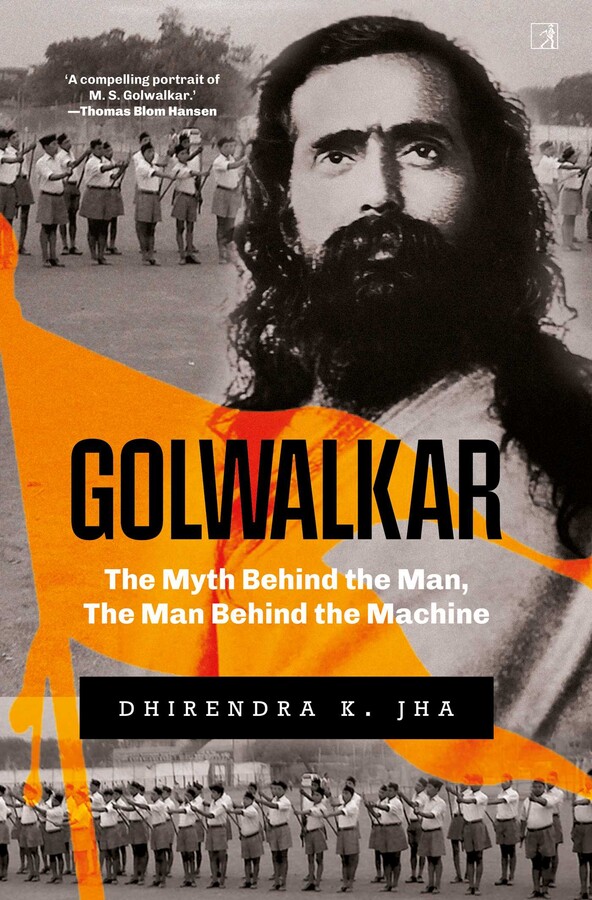
From an Insecure Youth to RSS Supremo
Golwalkar’s rise to prominence in the RSS was unexpected. In 1940, following the death of K. B. Hedgewar, the founder of RSS, a 34-year-old Golwalkar took charge of the organization. At the time, the RSS was still a relatively small organization, confined to Maharashtra. But under his leadership, Golwalkar expanded the RSS into a national organization with a vast network and significant influence on Indian society, politics, and culture. The RSS’s reach grew steadily, with an increasing number of Hindus rallying behind Golwalkar’s vision.
Jha highlights Golwalkar’s ambitious and tactful personality. Despite early insecurities, he crafted a strategy that would ensure the RSS’s growth and its dominance in Indian politics. What set Golwalkar apart was his ideological vision — a vision that was rooted in Hindu nationalism and a deep desire to counter the secular policies promoted by India’s first generation of nationalist leaders, including Jawaharlal Nehru and Mahatma Gandhi.
A Vision That Inspired the Hindutva Movement
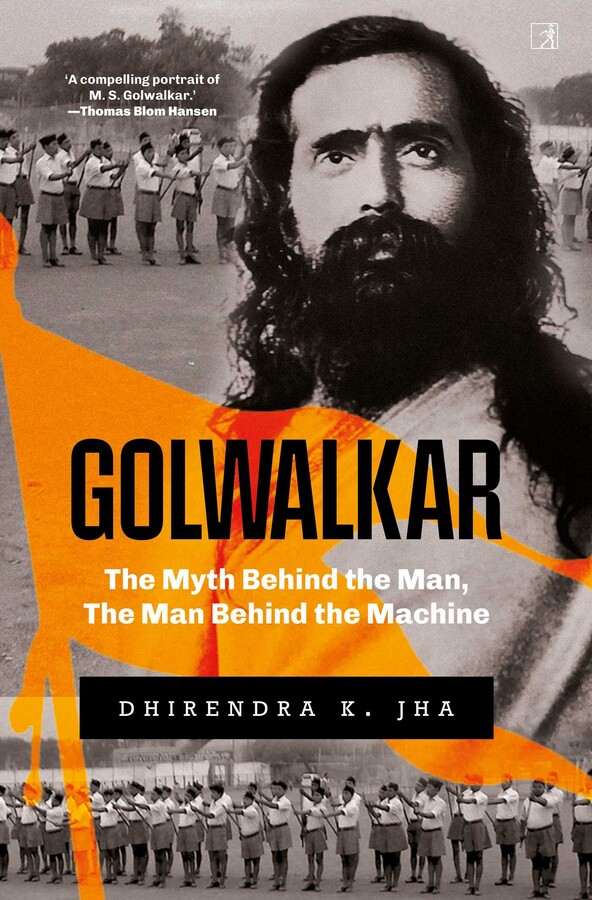
Golwalkar’s ideological influence was cemented in his 1939 book, We or Our Nationhood Defined, in which he outlined his controversial views on India’s identity and its future. One of the most troubling aspects of his ideology was his prescription for handling India’s “minority problem,” which he borrowed from the treatment of Jews in Nazi Germany. This chilling comparison laid the foundation for the RSS’s future political agenda and its treatment of religious minorities.
The book was not just a theoretical manifesto; it became central to the training and radicalization of the RSS’s youth wing. The influence of We or Our Nationhood Defined continues to this day, with its ideas still guiding the RSS and its affiliates in their quest to build a Hindu Rashtra (Hindu Nation).
Jha’s biography unpacks the ideological and strategic underpinnings of Golwalkar’s leadership. Drawing from original archival materials and interviews, he sheds light on how Golwalkar’s ideas were more than just words—they became the blueprint for a movement that would forever alter the political landscape of India.
Golwalkar’s Influence and Legacy
The impact of Golwalkar’s leadership is still felt in India today. As the chief architect of the RSS’s ideological framework, Golwalkar’s vision influenced not only the RSS but also the political trajectory of India’s right-wing politics. His leadership marked the beginning of the RSS’s rise as a political force, which eventually led to the emergence of the Bharatiya Janata Party (BJP) and its influence on Indian governance.
However, Jha’s biography also paints a portrait of a deeply secretive and ambitious individual, whose vision of a Hindu Rashtra came at a cost. His tactics often remained hidden, and his methods were far from transparent. Through careful research and analysis, Jha presents a complex and sometimes disturbing picture of the man who would become the face of Hindutva.
Uncovering the Truth
Jha’s research is a thorough dissection of the myths surrounding Golwalkar’s life. Previous biographies, written by his loyalists, painted a picture of an infallible, god-like leader. However, Jha’s work seeks to unveil the man behind the myth, offering an unflinching look at his political maneuvering, ideological convictions, and strategic moves.
The biography challenges the narrative that has been perpetuated by Golwalkar’s followers, offering instead a more grounded and critical perspective. Through meticulous research, Jha uncovers the inner workings of the RSS, exposing how Golwalkar’s ideas shaped not only the RSS but also modern Indian politics.
Questions to Ponder
- To what extent has Golwalkar’s ideology influenced the current political landscape of India?
- Can the legacy of Golwalkar and the RSS be reconciled with the ideals of a secular, democratic India?
- How should we approach the challenges posed by the ideology of Hindutva in the context of a pluralistic society?
These questions continue to linger in the wake of Golwalkar’s ideas, leaving readers with much to reflect on regarding the future of Indian politics and society.
About the Author
Dhirendra K. Jha is a Delhi-based journalist. He is the author of Gandhi’s Assassin: The Making of Nathuram Godse and His Idea of India; Shadow Armies: Fringe Organizations and Foot Soldiers of Hindutva; and Ascetic Games: Sadhus, Akharas and the Making of the Hindu Vote. He is the co-author of Ayodhya: The Dark Night—The Secret History of Rama’s Appearance in Babri Masjid.
Product Details
Publisher: S&S India (October 10, 2024)
Length: 416 pages

 Bookshotsapp
Leave a comment