
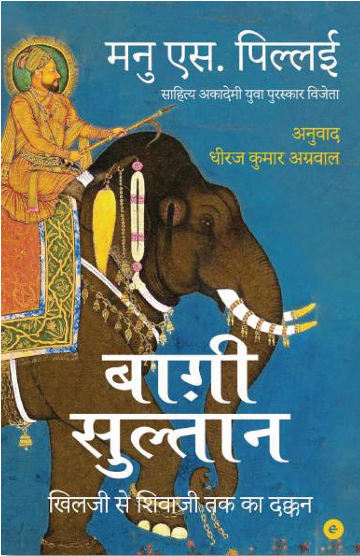
Manu S. Pillai, the acclaimed historian and author, invites readers to embark on a captivating journey through one of the most fascinating and lesser-explored chapters of Indian history in his book, The Rebel Sultans(Baaghi Sultan): Khilji Se Shivaji Tak Ka Deccan, translated by Dheeraj Kumar Aggrawal. This thought-provoking narrative takes us through a period of incredible upheaval, intrigue, and ambition, stretching from the late 13th century to the early 18th century. Through riveting tales, compelling characters, and a vivid portrayal of the Deccan region, Pillai breathes life into a forgotten era that has shaped much of India’s historical landscape.
The Rise and Fall of Empires
At the heart of The Rebel Sultans lies the story of the Deccan Plateau, a land known for its immense wealth, strategic significance, and colorful political history. The book paints a dramatic picture of the rise and fall of great empires, particularly the Vijayanagar Empire, which stood as a beacon of prosperity and cultural richness before succumbing to internal conflicts and external invasions. Pillai masterfully captures the allure of this rich land, teeming with treasures, skilled artisans, and bustling markets full of diamonds, pearls, and exotic goods.
The Deccan also emerges as a land of fierce competition and intrigue, where regional rulers vied for supremacy. The courts of the Bahmani kings and the Rebel Sultans who overthrew them were rife with political scheming and betrayals, creating a volatile atmosphere that was both dangerous and exciting. From daring military conquests to intense cultural exchanges, the Deccan became a focal point of power struggles and ambitious rulers.
Riveting Characters and Historical Intrigue
Pillai’s narrative shines with the inclusion of larger-than-life historical figures who shaped the destiny of the Deccan. The pages come alive with stories of valiant and enigmatic personalities such as Chand Bibi, the courageous queen who was tragically assassinated, and Ibrahim II of Bijapur, a Muslim prince who revered Hindu gods—a fascinating fusion of cultural identities in a region known for its diversity.
We also meet Malik Ambar, an Ethiopian-born military commander who rose to prominence through his remarkable military acumen. His rise to power serves as a testament to the Deccan’s openness to foreign influence and talent. Then, there is the legendary Krishnadevaraya, whose reign on the Diamond Throne of Vijayanagar is remembered as one of the most prosperous in South Indian history. His leadership was not just defined by military triumphs but also by his patronage of the arts and literature, leaving an indelible mark on the cultural fabric of the region.
The Mughal Envy and the Decline of an Empire
One of the most significant moments in Deccan history, as described by Pillai, is the death of Emperor Aurangzeb in 1707. His passing marked the beginning of a period of decline for the Mughal Empire, largely due to the costly and draining wars fought in the Deccan. Aurangzeb’s obsession with conquering this wealthy region proved to be his undoing. His relentless military campaigns in the Deccan exhausted the Mughal treasury, leaving the empire vulnerable to internal decay and external threats.
The Deccan itself, with its wealth and allure, became a region of envy for the Mughal emperors. It was a place that dazzled visitors with its treasures and rich cultural heritage. Fortresses once ruled by African nobles, marketplaces brimming with luxury goods, and courts where Persian, Maratha, Portuguese, and Georgian elites mingled, painted a picture of a land that was both opulent and complex.
A Forgotten Chapter of Indian History
The Rebel Sultans uncovers this lost world, shedding light on the power dynamics and intrigue that were instrumental in shaping the future of India. The book is more than just a chronicle of political events; it is an exploration of the cultural, social, and economic forces that defined the Deccan during its most tumultuous period. Through the rise and fall of empires and the personalities that defined them, Pillai opens a window into a world that had a profound influence on the course of Indian history.
By narrating the stories of the rebel sultans, Pillai challenges the conventional narratives that often center around the Mughals and the north of India. In doing so, he repositions the Deccan at the heart of India’s historical consciousness, urging readers to reconsider the significance of this region in shaping the nation’s fate.
The Rebel Sultans is a must-read for anyone interested in the history of India’s Deccan Plateau. With its blend of history, drama, and colorful characters, Manu S. Pillai’s work opens up new avenues for understanding the complex interplay of politics, culture, and power that shaped this fascinating region. It’s a timely reminder of how regional histories, often overshadowed by more dominant narratives, continue to influence the present and future of India.
For history enthusiasts and casual readers alike, this book offers a deep dive into a world filled with ambition, power, and intrigue—a world that is still waiting to be fully explored.
About the Author
Manu S. Pillai is a renowned historian and author whose work has earned him both critical acclaim and popular recognition. His debut book, The Ivory Throne, won the Sahitya Akademi Yuva Puraskar in 2017 and was followed by The Rebel Sultans, which further solidified his position as a leading voice in Indian history. With a PhD in history from King’s College London, Pillai’s scholarship extends beyond his books to his work with prominent institutions such as the BBC, where he contributed to the Incarnations radio series. His recent work, Gods, Guns & Missionaries, is set to further illuminate India’s rich historical landscape.
About the Translator
Dheeraj Kumar Agarwal is a media professional with over fifteen years of experience in journalism and communication. He has translated more than a dozen English books into Hindi. Dheeraj has a deep understanding of personal finance issues and regularly writes articles for websites like The Quint and Nivesh Manthan.
 Bookshotsapp
Leave a comment