
In Gandhi: The End of Non-Violence, political thinker and writer Manash Firaq Bhattacharjee presents a radically different portrayal of the Mahatma, challenging the glorified image of Mohandas Karamchand Gandhi that dominates history books. With a focus on Gandhi’s final years, Bhattacharjee rips apart the sanitized mythology surrounding the leader’s life and confronts the brutal complexities of his last stand amidst the violence of Partition. This groundbreaking work does not merely recount history; it offers a searing meditation on the limits of moral resistance, the brutality of political ambition, and the tragic costs of a divided nation.

A Nation in Flames, A Leader in Exile
The year 1947 marked both the birth of an independent India and the beginning of an unprecedented wave of violence. While the nation celebrated freedom, the streets of Calcutta and Noakhali were engulfed in bloodshed. Amidst this chaos, Gandhi walked alone—unarmed and unprotected—into the heart of the conflict, attempting to quell the violence that threatened to tear the nation apart.
Bhattacharjee’s narrative takes readers into the intimate, harrowing moments of Gandhi’s final journey, where his philosophy of non-violence faced its most brutal test. He walked through the wreckage of Noakhali, Bihar, and Calcutta, offering courage to the broken, often barefoot, in an effort to heal the wounds inflicted by communal hatred. Yet, despite his efforts, the violence continued unabated, and Gandhi’s moral authority seemed to fade in the face of the political machinations and ideological divisions that marked this turbulent period in history.
The ‘Sensible’ vs. ‘Senseless’ Violence Dilemma
At the heart of Bhattacharjee’s examination is a piercing question: Could Gandhi’s principle of non-violence ever have been enough to hold together a crumbling nation? As the country descended into sectarian violence, Gandhi’s idealistic vision of peace clashed with the brutal reality of the political forces at play.
Through his unflinching analysis, Bhattacharjee challenges the notion that Gandhi’s moral authority could have unified India in the wake of Partition. With assassins at his door and his closest allies betraying him, the book forces readers to confront the terrifying reality: Was Gandhi’s non-violence an unshakable principle, or a utopian illusion that failed to account for the savage undercurrents of communal politics?
The Hindu-Muslim Conflict and the Rise of Communal Violence
One of the key themes explored in Gandhi: The End of Non-Violence is the intersection of Gandhi’s ideals with the escalating Hindu-Muslim conflict in the years leading up to Partition. Bhattacharjee critically engages with the ideas of influential figures like Muhammad Ali Jinnah, Iqbal, Ambedkar, Savarkar, and others, who shaped the political landscape of the time.
The book delves deeply into the tragic repercussions of Jinnah’s call for “Direct Action Day” in 1946, which precipitated widespread violence and deepened the rift between Hindus and Muslims. Bhattacharjee’s analysis sheds light on how communal politics can descend into genocide, exploring the psychological underpinnings of communal violence and the catastrophic consequences for a nation already on the brink.
An Unfiltered Perspective on Gandhi’s Legacy
This is not the Gandhi of textbooks. Bhattacharjee presents a leader torn between his idealism and the harsh political realities of his time. Through rare witness accounts from those close to Gandhi, such as Pyarelal, Nirmal Kumar Bose, and Manu Gandhi, the book offers a personal, unfiltered look at the man who became a symbol of peace.
For Bhattacharjee, Gandhi’s journey is one of devotion, betrayal, love, and loneliness—a man struggling to make peace in a world that seemed increasingly hostile to his message. This book does not shy away from Gandhi’s flaws but instead presents him as a figure caught between the grand ideals of non-violence and the realpolitik that dominated the end of British rule in India.
Critical Acclaim
This book has garnered widespread praise from scholars and critics alike. Howard Caygill, Professor of Modern European Philosophy at Kingston University, describes it as “a profound meditation on non-violence and its limits,” while Talal Asad, Distinguished Professor of Anthropology at CUNY, commends it as “an illuminating contribution to our understanding of Gandhi’s political and ethical thought.”
A Call to Rethink History
In a world still grappling with the consequences of political violence and communal divides, Bhattacharjee’s book offers an urgent call to question the accepted narratives of history. Gandhi: The End of Non-Violence invites readers to engage critically with the past and reflect on the moral complexities of resistance, the perils of political ambition, and the price of a divided nation.
This book is not just for historians or political theorists, but for anyone willing to challenge the comfortable narratives of the past and confront the uncomfortable truths that shape our present.
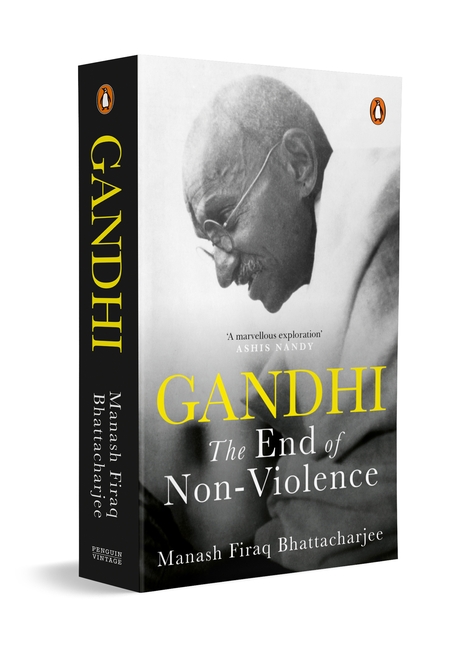
About the Author
Manash Firaq Bhattacharjee is a writer, political theorist and poet. He is the author of The Town Slowly Empties: On Life and Culture During Lockdown (2021), Looking for the Nation: Towards Another Idea of India (2018), and Ghalib’s Tomb and Other Poems (2013). His writings, apart from regular contributions to The Wire, have appeared in the New York Times, Los Angeles Review of Books, Guernica, World Literature Today, the Economic and Political Weekly, The Hindu, the Indian Express and Outlook, among others.
 Bookshotsapp
Leave a comment