
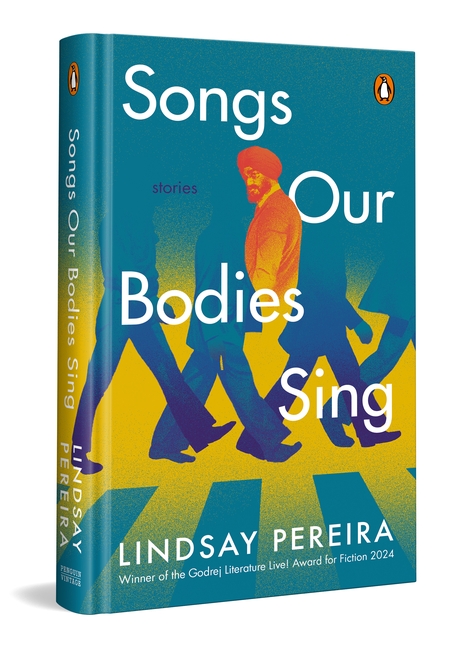
There are books that shout, and there are books that sing. Lindsay Pereira’s Songs Our Bodies Sing belongs to the latter—an understated, poetic collection of short stories that hums with quiet heartbreak and the offbeat rhythms of belonging.
A Symphony of Stillness
Set against backdrops as varied as the snow-muted outskirts of Toronto, the incense-hazed alleys of Bombay, the greying skies of London, and the romantic grit of Paris, this book explores what happens when East meets West—not with the crash of cymbals, but with the tentative notes of human connection. These are stories of people caught between continents and cultures, of lives that teeter on the threshold of past and present, tradition and reinvention, silence and song.
Between East and West, Silence and Song
A grieving father turns to the Beatles to make sense of his loss. An antique shop owner sells the past to foreigners but denies it to his own people. Two immigrants find solace not in language, but in the pulse of a rock band. And somewhere, in the stillness of a snow-covered truck, a man closes his eyes for the last time—his body quiet, his story already fading into the hush of falling snow.
What binds these narratives isn’t plot, but pulse. Each story beats with the question of what it means to exist in translation—to be one thing in one country and another elsewhere, to carry old gods in new cities, to wonder if holiness can touch dust or if belonging can be borrowed like a melody.
Tender Gaze, Unflinching Eye
Pereira’s prose is spare, yet richly textured—never showy, but full of echoes. He doesn’t offer resolutions; instead, he invites us to linger in the spaces between. Like the Oxford comma in one of his chapter titles, his characters exist in the pause before connection, the liminal space of in-betweenness. It’s a clever, often aching commentary on how migration, memory, and modernity reshape the self.
What’s particularly compelling is Pereira’s gaze—tender, but unflinching. He examines not just cultural prejudice, but the more insidious, internalised kind: the shopkeeper who prefers white buyers, the tourist who learns too late what trust costs, the immigrant who chooses silence over confrontation. His world is globalised, digitised, but the wounds are deeply personal—and timeless.
The Music Beneath the Words
Songs Our Bodies Sing is not loud. It doesn’t aim to dazzle. Instead, it holds a mirror to the soul and asks us to listen—to the ache behind the anthem, to the spaces between countries, to the music only our bodies know how to hum when words are no longer enough.
In a time of increasing borders—visible and invisible—this book is a reminder that grief, longing, love, and identity do not need translation. They are fluent in us all.
Chapters
The Antique Shop
Have a Nice Day
Oxford Comma
Love of an Orchestra
If You Don’t Weaken
In Your Eyes
Butterfly
Rivers to Cross
Songs Our Bodies Sing



 Bookshotsapp
Leave a comment