
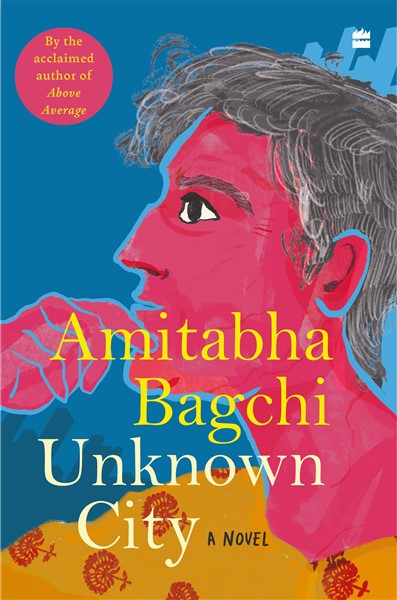
In his new novel, Amitabha Bagchi returns to Arindam Chatterjee, the IIT nerd-turned-novelist we first met in Above Average. But this is no nostalgic sequel — it’s a bold act of literary introspection, a meditation on masculinity, memory, and the subtle, slow churn of emotional growth.
We don’t often get to revisit our fictional pasts. And when we do, it’s usually through sequels that indulge our craving for familiarity — a return to a beloved world, a comforting echo of known voices. But what if a sequel didn’t offer closure or comfort? What if, instead, it pulled the carpet out from under the emotional certainties of its predecessor?
Amitabha Bagchi’s Unknown City, the long-awaited follow-up to his 2007 debut Above Average, does exactly that — and with startling elegance. The novel reintroduces us to Arindam Chatterjee, once the wide-eyed, introspective IIT Delhi student navigating campus life and existential confusion. Now nearly fifty, Arindam is a novelist and professor, and he has the air of a man who has lived long enough to regret the way he once lived.
This is not a coming-of-age story. It is, rather, a coming-to-terms story — and that, in its quiet, deliberate way, might be even more radical.
The Sequel That Doesn’t Look Back — It Looks Inward
Where Above Average was youthful and searching, Unknown City is haunted and searching in a different way. The wide-eyed boy has become a man staring down the barrel of middle age, and instead of simply reflecting on his past, he interrogates it.
Structured in a nonlinear collage of memories, reflections, and interior monologues, the novel unfolds like an intimate self-audit. Arindam revisits three central relationships from his life — Supriya, Lisa, and Razia — each woman representing not just a chapter of his romantic history, but a lens through which he comes to examine his own masculinity, his privilege, and his emotional evasions.
Supriya, a sharp, articulate history student from JNU, was the first relationship to deeply shape him — or rather, the first to show him what he wasn’t yet capable of understanding. Lisa, an activist with whom Arindam failed to register the silent weight of depression, becomes emblematic of how people can inhabit the same space yet live in completely different emotional worlds. And Razia, a fellow writer, emerges not just as a romantic partner but as a mirror to his self-deceptions — someone he sees more as a balm for his emotional wounds than as a person with her own narrative.
Through these recollections, Bagchi does something remarkable. He doesn’t romanticize regret, but he elevates it. Regret becomes a tool — painful, yes, but necessary — for excavating the self.
Masculinity and the Echo Chamber of the Self
At the heart of Unknown City lies a confrontation with masculinity — not its caricatured versions, but its quieter forms: intellectual arrogance, emotional myopia, and the tendency to see relationships as extensions of one’s own journey.
Arindam, though reflective and well-read, realises just how often he failed to see the women in his life. Not because they were elusive, but because his lens was fogged by years of conditioning. He remembers his time at Johns Hopkins, surrounded by brilliant female classmates, and recognises how easily he dismissed their intellect while overestimating that of his male peers. The metaphor he uses — of water settling perfectly into the pothole it finds — is as damning as it is poetic.
“It is only now that I realise how an underlying tendency to downplay the intellectual capabilities of women so naturally fit the particular shape of the situation I found myself in — like water forming a puddle in the exact shape of a pothole that was already present in the road.”
In lesser hands, such introspection might feel performative — the literary equivalent of a “male ally” panel at a tech conference. But Bagchi’s writing steers clear of posturing. His prose is subtle, textured, and achingly human. There’s no grand redemption arc, no sermonising. Just a man learning, slowly, how to see past himself.
Memory as Geography, Geography as Feeling
The title Unknown City is no accident. Cities — both literal and metaphorical — play a crucial role in this novel. Arindam’s life is mapped across places: the intellectual thrum of JNU, the elite corridors of Johns Hopkins, the sprawling anonymity of New York, the emotional density of Delhi.
These aren’t just backdrops. They’re emotional landscapes. Bagchi, a writer deeply attuned to how geography shapes human experience, uses each location as a kind of psychic mirror. Baltimore reflects Arindam’s outsider status. Delhi absorbs his intellectual contradictions. Mumbai, fleeting in its appearance, stands as a symbol of unrooted ambition.
Places, like people, carry emotional residue. And Bagchi treats them with the reverence of an architect sketching not structures, but the invisible tensions that live within them.
A Novel in the Key of 2 A.M.
One of the most distinctive aspects of Unknown City is its tone — quiet, ruminative, intimate. Reading it feels like sitting across from an old friend at a dimly lit bar at 2 a.m., the music low, the conversation unspooling in layers. You’re not solving anything. You’re just trying to say it all out loud.
Bagchi admits this was intentional. Arindam is not narrating his life to someone in particular. But he speaks with a sense of address, as if someone — maybe the reader, maybe an imagined other, maybe himself — is listening. The result is a voice that is personal without being confessional, vulnerable without being indulgent.
This tonal control is what makes the novel sing. It’s the literary equivalent of jazz — loose in structure, tight in rhythm, full of unexpected notes.
What Literature Should Do With Its Men
In a literary world filled with male protagonists who fail to evolve — or worse, evolve through the suffering of women — Unknown City is a quiet revolution. Arindam doesn’t seek to be absolved. He seeks to understand. And in doing so, he offers us a rare gift: a portrait of a man who looks at himself not through the mirror of success or accomplishment, but through the eyes of those he once failed to see clearly.
Bagchi isn’t interested in giving Arindam a clean resolution. Because life doesn’t offer those. What it does offer, occasionally, is a chance to look again — more honestly this time — and to begin, however imperfectly, to do better.
Beyond the Page: The Real Takeaway
So what, in the end, does Unknown City give us that Above Average did not?
Perspective. Not the Instagrammable kind, but the kind that creeps in late in life when you realise the real work of being human isn’t in achieving things but in understanding others — and, by extension, yourself. It teaches us that the real arc of growth isn’t plotted from youthful promise to middle-aged achievement, but from blindness to clarity, from centering the self to listening for the silences of others.
As Arindam says in Above Average, and as Bagchi echoes here:
“It is a blessing to be understood, and an even greater blessing to be granted understanding.”
With Unknown City, Bagchi grants us both.



 Bookshotsapp
Leave a comment