
Hot Water by Bhavika Govil is a quiet, emotionally rich debut novel that follows a single mother, Leela, and her two children, Mira and Ashu, during one sweltering summer in a small Indian town. Told through tender, perceptive narration—especially from nine-year-old Mira—the story explores the unspoken tensions, buried secrets, and emotional distances within a fragile family. With water as a recurring metaphor, the novel moves through themes of silence, identity, and love that doesn’t always find words. Subtle, lyrical, and haunting, Hot Water is a story of reckoning more than resolution, revealing the quiet ways people hurt, heal, and hold on.
A Summer of Secrets and Stillness
In Hot Water, Bhavika Govil brings to life one long, sultry Indian summer in a quiet, unnamed town—a season where heat hangs heavy in the air, and secrets simmer just beneath the surface. At its heart, this debut novel is a deeply intimate exploration of a family on the edge: a single mother and her two children—nine-year-old Mira and fourteen-year-old Ashu—each carrying secrets too big for their small, shared lives.
Govil writes with the sensitivity of someone attuned to the emotional frequencies between people, especially those bound by blood. Her narrative doesn’t explode; it unfolds quietly, like ripples across a still pool—one small disturbance after another until the surface is forever changed.
Mira: A Child’s Voice, A World of Emotion
The story’s emotional anchor is young Mira, who sees the world with a mixture of wonder and worry. Her voice is tender, whimsical, and heartbreakingly perceptive. Mira is alert to every flicker of mood in her home, every shift in her mother’s voice, every glance between her brother and his best friend.
Govil captures childhood in all its intensity—how feelings get stored in your body, how fear feels like cake sitting too long in your stomach, how silence can be more frightening than yelling. Mira’s attempts to understand the grown-up world around her are endearing and, at times, devastating. Her mischief, curiosity, and emotional depth make her one of the most compelling child narrators in recent memory.
Ashu: Teenage Longings and Quiet Rebellion
Ashu, Mira’s teenage brother, is caught between adolescence and adulthood, grappling with emotions he can barely name. He’s surly, secretive, and at odds with the world—but also deeply loyal, especially to Mira. His friendship with Rahul, his best friend and confidant, is fraught with tension, closeness, and unspoken questions.
Govil sketches Ashu’s emotional journey with great nuance—his quiet floundering, his acts of defiance, and his tender, guarded love for his family. As he begins to make sense of who he is and what he wants, Ashu becomes a mirror to the novel’s larger themes: identity, yearning, and the blurry lines between closeness and distance.
Leela: The Mother Who Doesn’t Say Everything
Leela, the single mother at the center of this family triangle, is perhaps the most enigmatic of all. She is emotionally complex—often loving, sometimes distant, and frequently silent. Her history is revealed in scattered flashbacks: a past in Delhi, a husband who vanished from the children’s lives, choices made and not spoken of again.
Her silence is both a shield and a wound. When she stops speaking to her children after a dramatic poolside incident, it’s not out of cruelty but something deeper—fear, exhaustion, or maybe grief. Govil refuses to simplify her. Instead, Leela is rendered in all her contradictions: brittle and brave, flawed and deeply human.

The Water Metaphor: More Than Just a Setting
Water isn’t just a backdrop in this novel—it’s a character in itself. The book is structured into sections titled Plunge, Float, Surface, and Swim, each mirroring the emotional tides of the story. The swimming pool becomes both a literal and symbolic space: a site of escape, confrontation, and revelation.
Whether it’s Mira holding her breath underwater, Ashu drifting away from the safety of home, or Leela trying to stay afloat in a life she didn’t expect, water carries the weight of their experiences. It cleanses, drowns, hides, and connects. Govil’s use of this motif is subtle and elegant, adding depth to an already emotionally rich story.
A Quiet Setting That Amplifies Tension
The unnamed small town where the family relocates after leaving Delhi is rendered with a vivid sense of place. It’s not just the scorching sun or the trees turning from orange to angry red—it’s the stillness of life in a place where everyone notices everything.
This setting functions like a pressure cooker, forcing characters into emotional proximity. There’s nowhere to run from your feelings, no distractions from what’s wrong. The heat becomes a physical manifestation of their inner turmoil.
A Story That Resists Easy Answers
Hot Water doesn’t tidy up its threads. Mira never fully understands the truth about her father. Ashu’s emotional landscape remains complex and unresolved. Leela continues to guard parts of herself. But that ambiguity is precisely what makes the novel so powerful.
This isn’t a story about resolution—it’s a story about reckoning. About the quiet ways people hurt each other and the even quieter ways they try to heal. Govil trusts her readers to sit with discomfort, to feel the sting of silence and the bittersweet pull of love that can’t always say its name.
Final Thoughts: A Debut of Subtle Power
Hot Water is not a loud book. It doesn’t chase drama or indulge in melodrama. Instead, it whispers truths you carry long after the story ends. It asks you to listen closely—to the things left unsaid, to the gaps between words, to the undercurrents of emotion running through every glance and gesture.
Bhavika Govil’s writing is luminous, precise, and full of empathy. Her debut is a tender, haunting portrait of a family treading water, trying desperately not to go under.
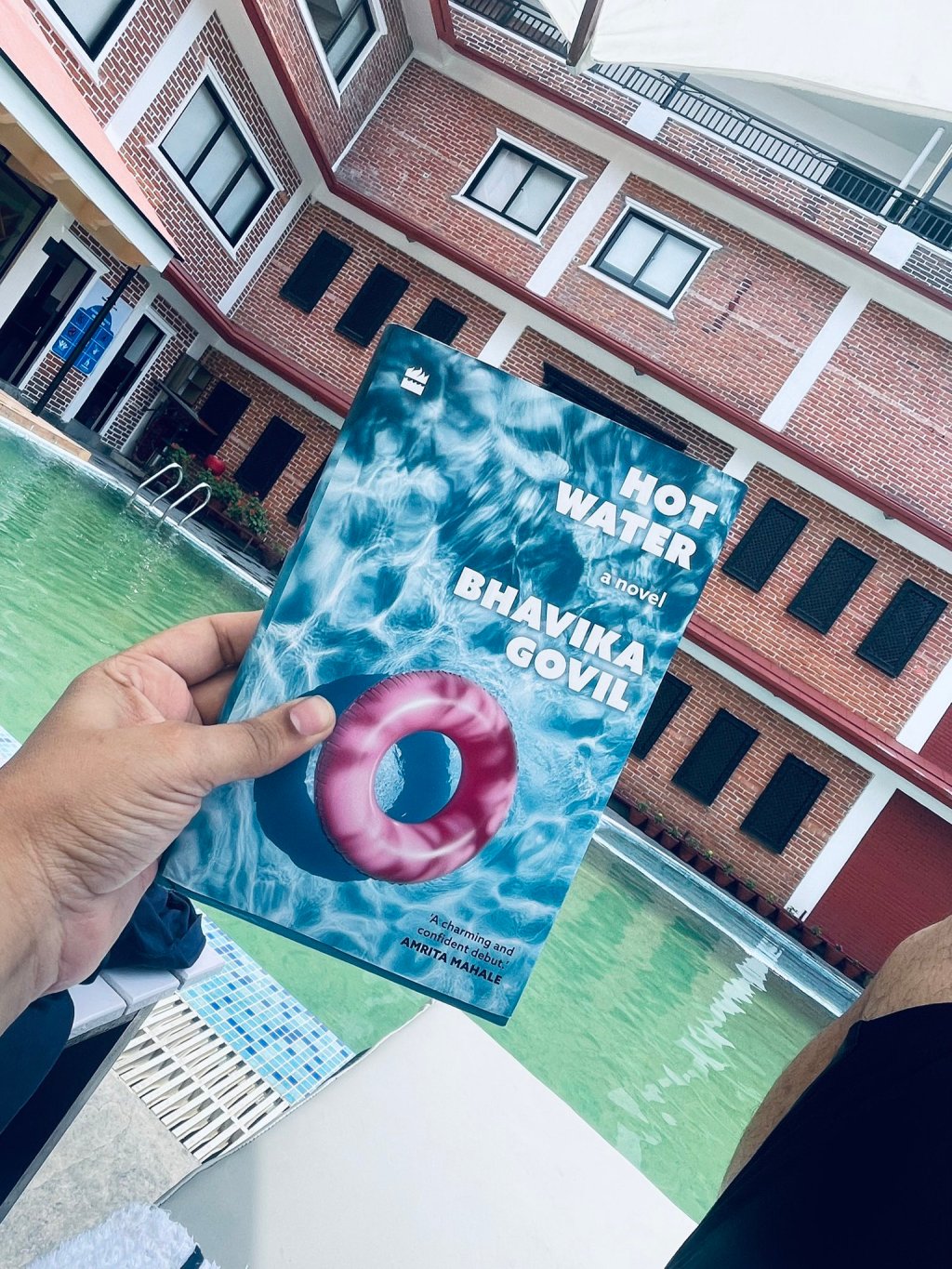
A stunning, emotionally resonant debut
Hot Water captures the beauty and burden of loving people you don’t always understand. Quiet, powerful, and unforgettable. The very first page of the book begins like this….
He and I were doomed from the start. It was as if he had no confidence in my ability to take care of him, to feed him, to keep bim alive. One time, a few months after he was born, I woke up after he had been wailing all night. I was parched, desperate for a sip of water, but his cries kept rising in intensity. I got out of bed and hurried to him. Those days, I used to put a black dot on his forehead to ward off evil spirits, a nazar battu, a superstition I had inherited from my mother. It stared at me, this black dot, looking abnormally large and out of place. I grabbed his forehead and rubbed it off until all that remained was a smudge.
When I bent over his cot to get him, I found that he was suddenly impossible to lift. He was heavy, heavier than the books had said. Though I pulled and tugged, I couldn’t pick him up. He kept resisting, I kept trying. I couldn’t understand what was happening and I began crying too-my tears louder and more urgent than the baby’s-which now sounded like nothing more than a muffle underwater. Only, I was swimming in the middle of the ocean and he was the pile of rocks my foot had got stuck under. He kept weighing me down to the floor, and no matter how much I kicked and screamed and wailed, I couldn’t pull out my foot from under him, I couldn’t let it loose, I couldn’t kick off the ground and buoy myself up, I couldn’t breathe.…….




 Bookshotsapp
Leave a comment