
Saurabh
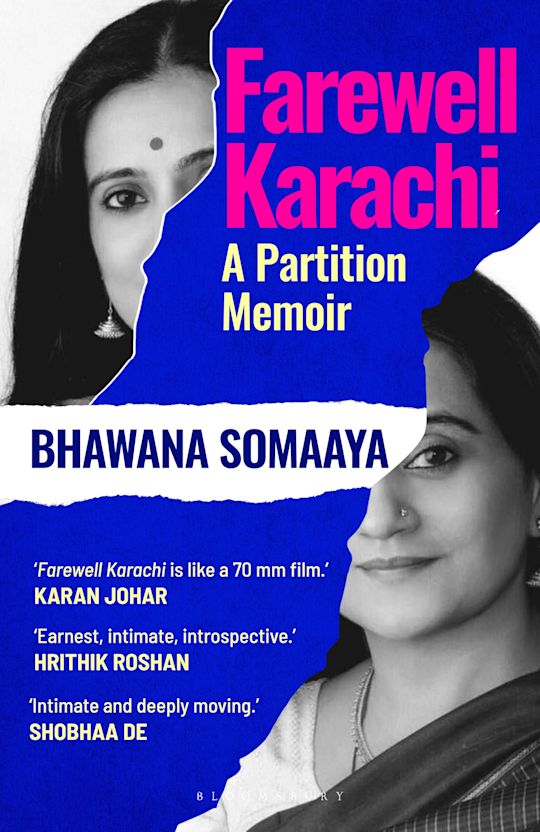
The story of Partition is often told through maps, dates, and official narratives. But for those who lived it—or inherited its memory—it is etched in the grain of everyday life: in recipes passed down without written measure, in half-remembered street names, in the silence that follows a long sigh. Bhawana Somaaya’s Farewell Karachi: A Partition Memoir steps into that space, where the political collides with the personal and memory becomes both wound and salve.
Best known for her decades-long career as a film critic and cultural commentator, Somaaya turns the spotlight inward in this intimate chronicle of her family’s flight from Karachi during the bloody aftermath of Partition. More than a memoir, Farewell Karachi is a reflection on exile, resilience, and the quiet determination of a family that refused to be defined by displacement.
A City That Lingered Long After It Was Lost
To Somaaya, Karachi wasn’t a distant name on a birth certificate or an abstract place in family folklore—it was present, almost tactile, in the home she grew up in. Her mother spoke of it while examining sarees. Relatives remembered its air, its streets, its rhythm. Though left behind, the city followed them into every corner of their new life.
Her grandfather, Mulji Dayalji, had established himself as a builder in the heart of pre-Partition Karachi. The family owned Bhatia Bhawan A and B, prominent buildings in Empress Market. Her father, Madhavji, was a promising young man working at Burmah Shell, a British oil company, when the streets turned violent and familiar alleys became threats.
The turning point came in June 1948. A routine day disintegrated into chaos. Calls from relatives warned of imminent riots. Phones went silent. A truck carrying armed men stormed their home, tearing apart furniture and any illusion of safety. A city once filled with comfort and dignity became unrecognizable. Three months later, the family boarded a ship and looked back at Karachi for the last time.
From Escape to Arrival: Finding Shelter in Bombay
Their exile began with uncertainty and a reluctant farewell. From Karachi, the family moved first to Bhuj in Kutch, seeking refuge before eventually finding their way to Bombay. The journey was long, made harder by emotional weight and logistical hurdles. But in Kalyan, a suburb of the sprawling metropolis, they found space to breathe and rebuild.
Madhavji, now employed in the Indian oil sector, secured a house. Valiben, his wife, followed with her children, navigating railway stations, unfamiliar cities, and anxious transitions. For the younger ones, Bombay was both disorienting and dazzling—teeming with people, sounds, and new possibilities. Compared to the narrow lanes of Bhuj, it felt like freedom.
This was the beginning of a new chapter—not just for Somaaya’s family, but for thousands like them who crossed borders with nothing but memory and willpower. Refugee colonies across India were full of such stories, of people trying to recreate what they had lost while learning to call new places home.
Telling the Story That Lived in Silence
For decades, Somaaya avoided films and books about Partition. She didn’t need them. The grief was already living in her home, embedded in her parents’ cautious tone and fragmented recollections. Writing Farewell Karachi meant facing that inherited trauma—unpacking what had long been buried under the surface.
But this wasn’t a historical project. “I didn’t write this to add to Partition literature,” she says. “I wrote it to honor my family.” Through their experiences, Somaaya gives readers access to a more layered understanding of what Partition meant—not just the act of leaving, but the long, painful process of starting again.
Her memoir spans over a century, tracing five generations of a Gujarati family whose destiny was intertwined with the great rupture of the subcontinent. It weaves through childhood memories, ancestral legacies, and the evolution of identity in a land still finding its post-colonial self.
A Tapestry of Memory and Survival
What sets Farewell Karachi apart is its texture. It’s not just about history—it’s about heritage. The book is alive with detail: meals lovingly remembered, family rituals carefully preserved, the language of loss carried across decades. There are heartbreaks, but also humor. There is grief, but it never overshadows gratitude.
In telling her family’s story, Somaaya shows how history lives in homes, in kitchens, in photo albums, in the pauses of conversation. Karachi may have been lost to geography, but it remained stitched into their lives—visible in gestures, flavors, and values.
The Past That Walks Beside Us
Farewell Karachi is not a tale of victimhood, but of quiet strength. It reminds us that Partition was not a moment—it was a continuum. Its consequences ripple through generations, shaping not just where people live, but how they remember, how they dream, and how they define “home.”
For readers today—many of whom are far removed from the original trauma—this memoir offers a bridge. It connects the past to the present, the political to the personal, and the pain of loss to the power of continuity.
Ultimately, Farewell Karachi is not about saying goodbye. It is about refusing to forget. It is about the dignity of those who lost everything and still found ways to build again. In remembering her family’s journey, Bhawana Somaaya makes space for countless untold stories—each one carrying a trace of a homeland left behind, and a hope for what lies ahead.
 Bookshotsapp
Leave a comment