
Saurabh Shankar
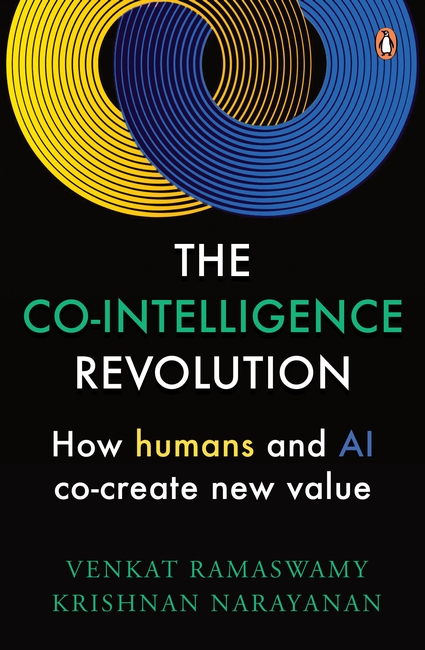
As conversations around artificial intelligence (AI) continue to stir anxiety about job loss and human obsolescence, The Co-Intelligence Revolution boldly reframes the narrative. Instead of treating AI as a replacement, authors Venkat Ramaswamy and Krishnan Narayanan advocate for a more hopeful and collaborative vision: a future shaped by co-intelligence—the creative and synergistic interplay between human insight and machine intelligence.
This isn’t just a philosophical perspective. It’s a call to action grounded in a deep understanding of systems thinking, real-world applications, and the urgent need for sustainable, inclusive progress.
What Is Co-Intelligence?
Co-intelligence, as defined in the book, is more than just collaboration between man and machine—it is a radical redesign of how we create value. It’s a framework where human experience and AI capabilities combine across ecosystems to generate scalable, sustainable impact. In this emerging paradigm, AI is not an automator, but a co-creator.
Three Game-Changing Frameworks
The authors introduce three foundational concepts that reshape how we understand intelligence and innovation:
- Life-Xverse: A multidimensional, immersive environment where human–AI collaboration unfolds across physical, digital, and virtual worlds, reshaping innovation through lived experience.
- Tokenized Digital Intelligence (TDI): A transformative idea where intelligence is produced, stored, and distributed—like electricity—empowering next-gen digital enterprises and social infrastructure.
The PIEX Lens: A design model for Platforms of Interactive Engagements across life-experience ecosystems, helping industries and governments unlock participatory value at scale.
These aren’t theoretical constructs—they’re strategic tools that redefine how we build the future.
From Industrial Metaverses to Digital Public Infrastructures
The book draws on over 100 real-world case studies from more than 25 global ecosystems. Whether it’s L’Oréal’s inclusive beauty platforms, Siemens’ industrial metaverse, Monarch Tractor’s AI-led agriculture, or India’s Aadhaar and ONDC digital infrastructure, the examples showcase how co-intelligence is already reshaping business, public services, and daily life.
This diversity of examples grounds the book’s vision in practical reality, demonstrating that co-intelligence is not a distant ideal, but a present opportunity.
EcoAI Literacy: A New Imperative for Sustainable Innovation
One of the book’s most compelling ideas is ecoAI literacy—a conceptual expansion of ecoliteracy, adapted for a world driven by co-intelligence. EcoAI literacy equips individuals and institutions to use AI responsibly to solve environmental challenges and advance the UN Sustainable Development Goals (SDGs).
As the book argues, this literacy is not just for technologists. It’s essential across universities, industries, and governments to ensure ethical and inclusive progress.
A Cosmic Perspective on Human Progress
The authors offer a poetic yet sobering metaphor: a cosmic clock where each hour represents 10,000 years. Humanity’s transformative shift—from hunter-gatherers to the digital era—has occurred in the last few seconds before midnight. We now stand on the brink of a new epoch—the Co-Intelligence Anthropocene—where our innovations have the power to alter not just civilization, but the planet itself.
This narrative underscores the urgency and responsibility of shaping this next chapter wisely.
Why This Book Matters Right Now
At a time of existential risk and digital transformation, The Co-Intelligence Revolution offers a refreshing alternative to fear-based discourse. Rather than asking “Will AI replace us?”, the book urges us to ask, “How can we co-create value with AI?”
This timely and visionary work is a blueprint for embracing AI as a tool for shared prosperity, participatory innovation, and planetary wellbeing.
What Thought Leaders Are Saying
“This book captures a fundamental leap, where AI becomes not just an automator but a co-creator alongside human ingenuity.”
— Narayana Murthy, Co-founder, Infosys“A treasure trove of powerful ideas, vividly demonstrating how co-intelligence is revolutionizing industries.”
— Gopal Srinivasan, Chairman & MD, TVS Capital Funds“A crucial read as AI reshapes research, learning and the very meaning of intelligence.”
— V. Kamakoti, Director, IIT Madras
A Transformative Read
The Co-Intelligence Revolution is not just another book about AI. It’s a paradigm-shifting manifesto for a future where humanity and technology evolve together—intentionally, ethically, and sustainably. Whether you’re a policymaker, entrepreneur, educator, or curious citizen, this book will change how you see intelligence, value, and possibility.
Highly recommended for anyone ready to co-design the future, not just survive it.
About the Authors
Venkat Ramaswamy is Professor of Business at the Ross School, University of Michigan. One of the world’s most cited experts in strategy, innovation, and experience design, he co-authored The Future of Competition with the late C.K. Prahalad. His groundbreaking work has influenced how Fortune 500 companies and governments reimagine customer experience and strategic value creation.
Krishnan Narayanan is co-founder and president of itihaasa Research and Digital, and a leading scholar of India’s technological transformation. Formerly a senior leader at Infosys Labs, he is co-author of Against All Odds: The IT Story of India and Empowering India. He advises national AI and digital governance programs and serves on multiple public impact bodies.



 Bookshotsapp
Leave a comment