
Gardiner Harris Unveils the Hidden History of America’s Most Beloved Healthcare Giant
Saurabh Shankar
In March 2004, pharmaceutical journalist Gardiner Harris sat down at an airport bar, expecting nothing more than a burger and a basketball game. What he got instead was the story that would redefine his career—and, eventually, challenge the legacy of one of America’s most trusted corporations.
The woman beside him, wearing a maroon Mississippi State cap and mourning a basketball loss, turned out to be a pharmaceutical sales representative for Janssen, a Johnson & Johnson subsidiary. What began as light banter turned into a candid, beer-fueled confession. She spoke about her nephew, a healthy 10-year-old who was prescribed Risperdal, a powerful antipsychotic she helped promote. Within months, the boy had gained excessive weight and withdrawn from his former life. Her guilt was palpable. She’d helped fuel the very marketing machine that led to this—and likely many similar—cases.
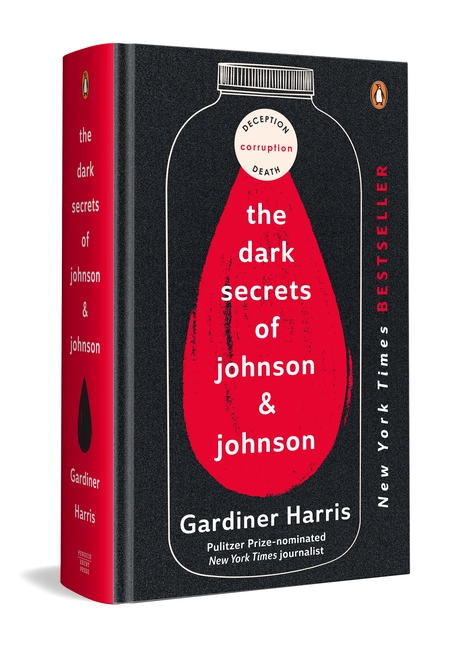
That conversation haunted Harris. And it ultimately became the genesis of The Dark Secrets of Johnson & Johnson, a powerful and disturbing exposé of the world’s largest healthcare conglomerate. Harris, a longtime reporter for The New York Times and The Wall Street Journal, spent five years digging through hundreds of thousands of pages of internal documents, court records, and grand jury transcripts. The result is a meticulously constructed indictment of a company that has for decades placed profits above patients.
From Baby Powder to Big Pharma
For most Americans, Johnson & Johnson evokes images of soft baby shampoo, first-aid kits, and family medicine cabinets. It’s a brand synonymous with safety, care, and trust—a reputation built over more than a century. But as Harris reveals, this carefully crafted image masks a darker reality.

Among the most explosive revelations in the book is the company’s decades-long cover-up regarding the contamination of Johnson’s Baby Powder with asbestos. Despite mounting internal evidence linking the talc-based product to ovarian cancer, the company continued to market it as safe—primarily to women and children.
Then there’s Tylenol, a household staple whose risks, Harris argues, have been persistently underplayed. The narrative only deepens with Risperdal, the drug at the heart of Harris’s airport encounter. Though never approved for pediatric use, it was aggressively marketed to child psychiatrists, with dire consequences for young patients.
Perhaps most damning is Johnson & Johnson’s role in the opioid epidemic. While Purdue Pharma and the Sackler family have drawn the lion’s share of public outrage, Harris paints a compelling case that J\&J’s involvement may be even more insidious. The company not only supplied the raw materials for other opioid manufacturers but also pushed its own opioid products through questionable marketing tactics. “The Sacklers are pikers compared to Johnson & Johnson,” one former executive tells Harris.
An Ethical Facade
Johnson & Johnson has long positioned itself as a paragon of corporate virtue. Its 1943 Credo, etched in stone at its New Jersey headquarters, famously declares that its first responsibility is to patients—not shareholders. The company’s celebrated response to the 1982 Tylenol tampering crisis, where it pulled millions of bottles from shelves at great expense, is still taught in business schools as a gold standard in crisis management.
But Harris exposes the growing chasm between that public persona and internal practices. He argues that the Credo became less a guiding principle and more a public relations tool, selectively referenced to protect the company’s image while internally disregarded when inconvenient to business objectives.
Over the years, Johnson & Johnson has paid billions in settlements and admitted to multiple criminal violations. Yet, astonishingly, its reputation remains largely intact. In 2023, Fortune named it one of the world’s most admired companies for the 21st consecutive year.
How is this possible?
The System That Enabled It
Harris places some of the blame on the Food and Drug Administration, which he argues failed to act decisively when it mattered most. He also scrutinizes the medical establishment—doctors, academics, and researchers who were often complicit, benefiting from consulting fees, speaking gigs, and referral networks created by the company’s deep pockets.
Equally culpable, Harris suggests, is the media—including The Wall Street Journal and The New York Times, where he worked. He acknowledges that even he, in his early years, underestimated the scope of Johnson & Johnson’s corporate maneuvering. The media’s failure to adequately investigate and hold the company accountable played a role in sustaining its saintly reputation.
A Corporate Colossus and an American Allegory
Johnson & Johnson is not just a pharmaceutical giant. It is the central player in American healthcare—one that touches almost every aspect of the \$4 trillion industry. From surgical sutures and cancer treatments to baby lotion and mouthwash, its products reach billions around the world.
But Harris’s book is not merely about a company. It is about a system. A uniquely American system where corporate mythology often outpaces reality, where regulatory failures are systemic, and where public trust is quietly eroded behind closed doors.
“This is the quintessential American story,” Harris writes. And he’s right.
Johnson & Johnson, with its iconic red logo and benevolent branding, represents both the promise and peril of American capitalism: capable of extraordinary innovation, but also unchecked overreach.
Verdict
The Dark Secrets of Johnson & Johnson is a masterclass in investigative journalism. Harris’s storytelling is sharp, his research exhaustive, and his conclusions unflinching. This is not a smear job. It is a sobering, evidence-based examination of a company that has long held the public’s trust—and, arguably, abused it.
For consumers, it’s an eye-opener. For regulators and policymakers, it’s a call to action. And for those working within healthcare, it’s a mirror held up to the industry’s most uncomfortable truths.
This book will enrage, inform, and ultimately empower its readers. It is not just a takedown of a corporation—it is a reckoning with the stories we tell ourselves about trust, health, and responsibility.
Title: The Dark Secrets of Johnson & Johnson
Author: Gardiner Harris
Publisher: [Penguin]
Pages: [464]
Genre: Investigative Nonfiction / Corporate Ethics / Healthcare
Rating: ★★★★★
Recommended for: Journalists, policymakers, healthcare professionals, consumers, and anyone who believes that corporations should be accountable to the people they serve.
About the Author
Gardiner Harris previously served as the public health and pharmaceutical reporter for the New York Times and is now a freelance investigative journalist. He also served as a White House, south Asia and international diplomacy reporter for the Times. Before that, he was a reporter for the Wall Street Journal, covering the pharmaceutical industry. His investigations there led to what was then the largest fine in the history of the Securities and Exchange Commission. Previously, he was the Appalachian reporter for the Courier-Journal of Louisville, Kentucky. He won the Worth Bingham Prize for investigative journalism and the George Polk Award for environmental reporting after revealing that coal companies deliberately and illegally exposed miners to toxic levels of coal dust. Harris’s novel, Hazard, draws on his experience investigating these conditions. He has also been a Pulitzer Prize finalist with a team of others at the Times. He lives in San Diego, California.



 Bookshotsapp
Leave a comment