
Saurabh Shankar
Few figures in modern Indian history evoke as much debate, admiration, and criticism as Indira Gandhi. Her name is etched into the very foundations of postcolonial India—not only as the country’s first and only female Prime Minister but as a political force who wielded immense power, often with audacity, and shaped India during some of its most turbulent decades.
In Indira Gandhi and the Years That Transformed India, noted historian and public intellectual Srinath Raghavan offers an incisive, richly detailed account of her political journey, exploring the pivotal years of her leadership and the profound impact they had on the Indian republic. Drawing on a wealth of archival material and extensive research, Raghavan brings a fresh analytical lens to the life and legacy of a leader whose decisions continue to shape India’s political landscape.
An Unlikely Rise to Power
Indira Gandhi’s emergence as Prime Minister in 1966 was far from preordained. Following the sudden death of Prime Minister Lal Bahadur Shastri, Congress party elders saw her as a pliable compromise candidate—the daughter of Jawaharlal Nehru, yes, but a seemingly inexperienced figure whom they believed could be controlled.
They were wrong.
As Raghavan meticulously documents, Indira Gandhi quickly defied expectations. Once in office, she maneuvered with increasing political finesse and boldness, asserting her authority within the Congress party and across the nation. Within a few years, she had reshaped the political calculus, centralizing power and marginalizing rivals. Her early tenure culminated in the dramatic 1971 electoral victory and the decisive Bangladesh Liberation War, establishing her as a formidable leader on the global stage.
The Decade that Defined a Nation
The 1970s, as Raghavan compellingly argues, were the crucible in which modern India was forged. This decade saw major transformations—economic, political, and institutional—many of which were either initiated or accelerated under Indira Gandhi’s leadership.
It was also a time of extreme volatility. Faced with economic stagnation, social unrest, and challenges to her authority, Gandhi responded with increasing authoritarianism. The declaration of the Emergency in 1975 remains one of the most controversial chapters in Indian democracy. Civil liberties were suspended, political opponents jailed, the press censored, and constitutional norms altered.
Yet, Raghavan does not present a one-dimensional account. He delves into the complexities of the period, highlighting Gandhi’s motivations, the broader political pressures she faced, and the competing visions of India’s future that animated both her supporters and detractors. He explores the limits of state power and the role of institutions during this time of crisis, making the book not just a political biography, but a deep study of democratic endurance and fragility.
A Shifting Political Terrain
After lifting the Emergency and facing defeat in the 1977 elections, Indira Gandhi staged an extraordinary political comeback in 1980. This second phase of her leadership was marked by a different set of challenges: growing regionalism, increasing religious tensions, and deepening economic difficulties.
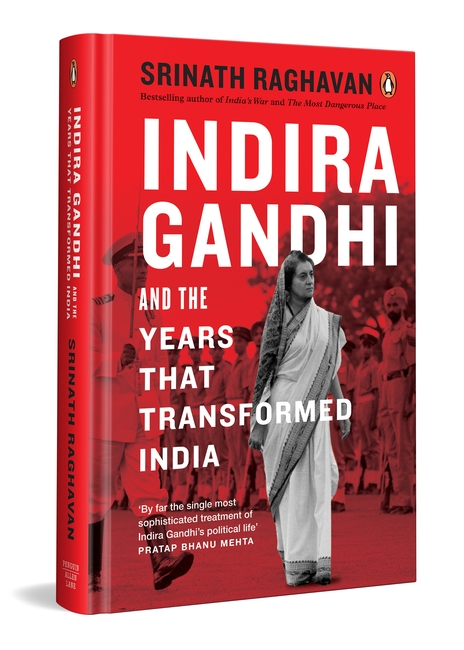
Raghavan explores how Gandhi attempted to navigate this changing terrain—sometimes adapting, often resisting. Her handling of the Punjab crisis, the rise of insurgency, and her strained relationship with democratic institutions are all examined with nuance and critical insight. Her assassination in 1984 by her own bodyguards, in the aftermath of Operation Blue Star, brought to a violent end the life of a leader who had come to symbolize both the aspirations and anxieties of a young nation.
Legacy and Reckoning
One of the strengths of Indira Gandhi and the Years That Transformed India is its refusal to offer easy judgments. Raghavan neither romanticizes nor demonizes his subject. Instead, he situates Indira Gandhi within the wider currents of Indian and global history, revealing how she operated within—and at times transformed—the constraints of her era.
Her legacy remains deeply ambivalent. To some, she is the Iron Lady who gave India strength and direction in moments of uncertainty. To others, she is the architect of centralization and authoritarianism. Raghavan embraces this complexity, encouraging readers to grapple with the contradictions of power, leadership, and democracy.
A Historian’s Perspective
Srinath Raghavan, a professor of history and international relations at Ashoka University and a noted authority on modern South Asian politics, is well-equipped to undertake such a sweeping study. His previous books—India’s War and Fierce Enigmas—have established him as a leading interpreter of the region’s strategic and political history. In this book, he combines academic rigor with accessible prose, making it suitable for both scholars and general readers.
Conclusion: Understanding the Past to Shape the Future
Indira Gandhi and the Years That Transformed India is more than a political biography; it is a profound exploration of how individuals and institutions shape national destinies. Raghavan’s treatment of Indira Gandhi’s life is neither hagiographic nor hostile. It is a powerful reminder that democratic societies are shaped not only by ideals but by the people who wield power, with all their flaws, ambitions, and contradictions.
For anyone seeking to understand the roots of contemporary India—its centralization of power, its democratic challenges, and its complex political inheritance—this book is essential reading.
Book by Srinath Raghavan
Published by Penguin Books
Read an interesting article on book at …

 Bookshotsapp
Leave a comment