
Saurabh Shankar
In the still, early hours before sunrise, the women of a Bangalore neighbourhood gather at the community water taps. As they fill their vessels, they also trade stories — quiet, intimate fragments of truth that ripple through the narrow lanes. It’s here, in these hushed exchanges, that Sundar Sarukkai’s Water Days finds its voice.

Following his acclaimed debut Following a Prayer — selected by The Telegraph and Mint as one of the best novels of 2023 — Sarukkai returns with a powerful, meditative work that is part mystery, part social portrait, and entirely original. Set at the turn of the millennium in a fast-changing locality, Water Days begins with the unexplained death of a young woman — a tragedy that stirs unease, rumours, and a search for answers.
At the heart of the story is Raghavendra, a former security guard with modest dreams of owning a grocery shop. When his wife Poornima urges him to investigate the girl’s death — a task charged with both urgency and moral weight — Raghavendra finds himself reluctantly pulled into a maze of silences, suspicions, and buried grief.
But this isn’t a typical whodunit. Instead of rushing toward resolution, Water Days dwells in ambiguity. The novel unfolds over thirteen days — echoing the traditional Hindu mourning period — as the community processes the girl’s death and their own lives in tandem. Each day brings a new layer, a new voice, a new question.
Sarukkai’s gift lies in his attentiveness to language — not just as words, but as feeling. In this multi-lingual world of Kannada, Tamil, Malayalam, Telugu, and Hindi, he paints a mosaic of India’s urban margins. His characters speak in dialects and silences, dreams and fragments — each sentence steeped in philosophy, yet rooted in the tangible rhythms of daily life.
One of the novel’s most vivid scenes captures Poornima’s unspoken fury at her husband, interrupted by the sudden appearance of Rajesh, a migrant worker whose body posture mimics Bollywood action heroes and whose Hindi-English patter is laced with longing and absurdity. These moments — sharp, tender, absurd — bring the story’s social layers into focus: migration, masculinity, hunger, hope.
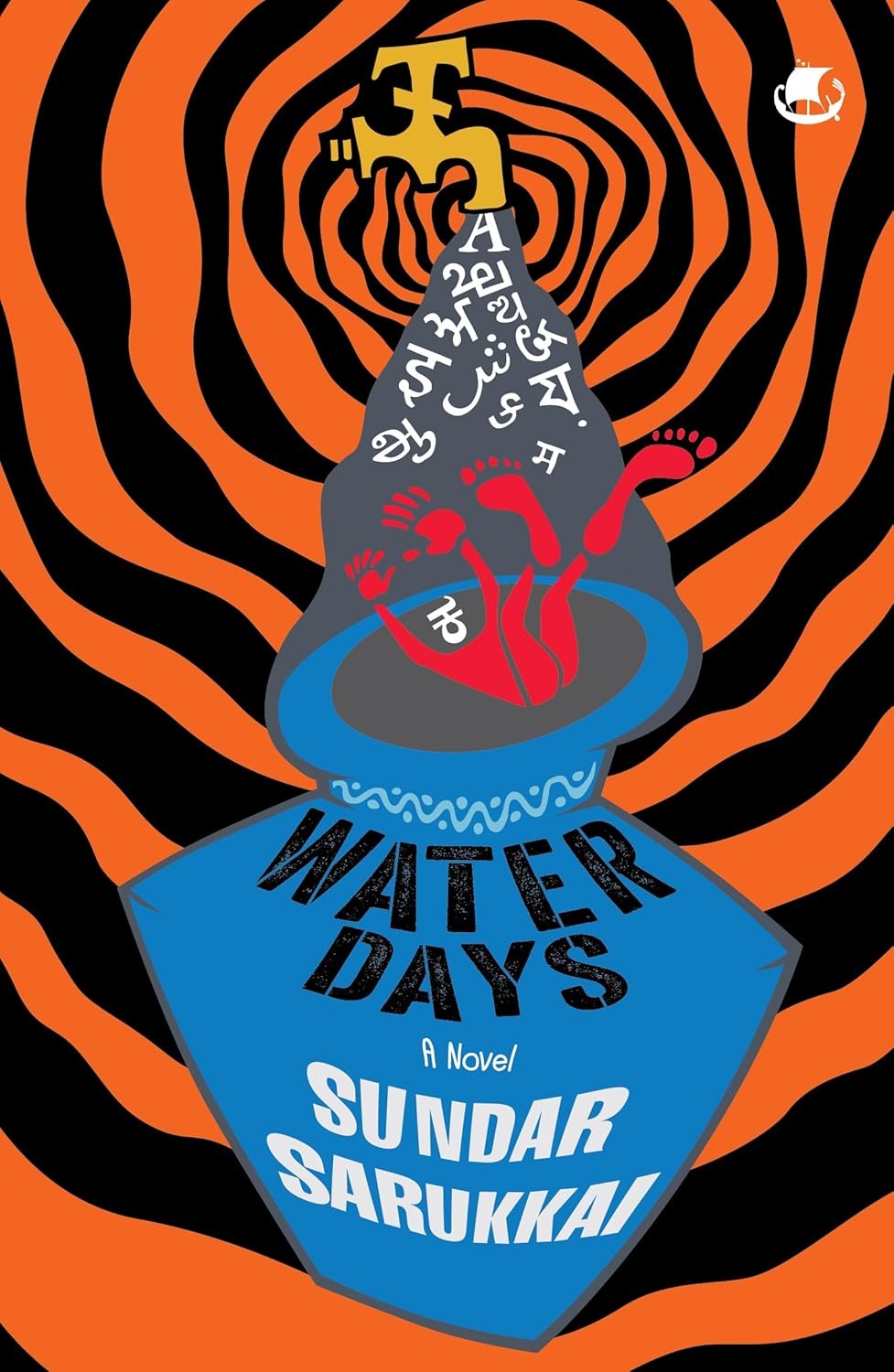
As Rajesh dreams of food that tastes like home and Raghavendra stumbles toward reluctant truth-seeking, the reader is drawn into a quiet investigation — not just into a death, but into the life that preceded it, and the lives that remain.
With Water Days, Sarukkai once again proves himself a writer of rare insight. This is a novel that listens deeply — to voices at the edge, to stories carried in buckets, and to the water that flows through grief, memory, and time.



 Bookshotsapp
Leave a comment