
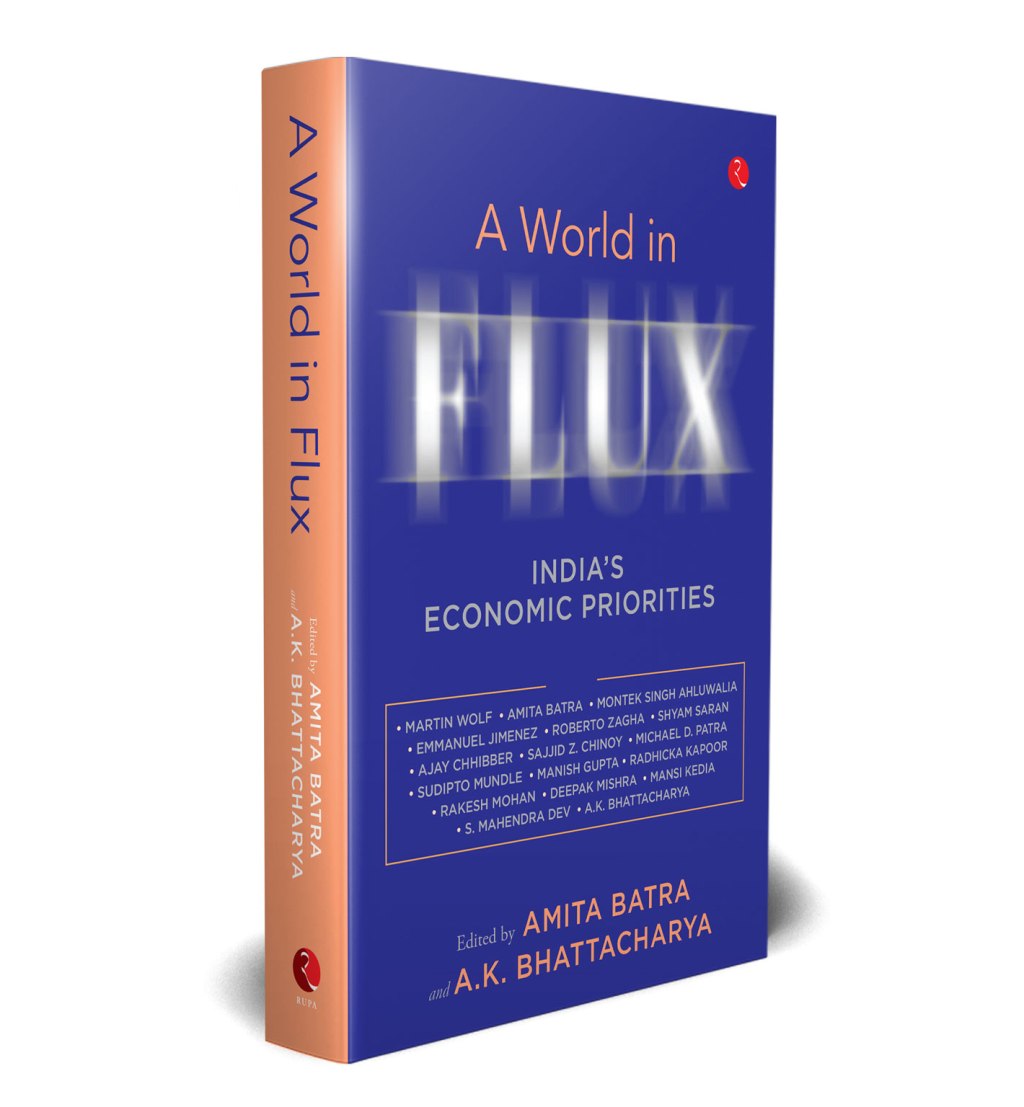
Edited by: Amita Batra and A.K. Bhattacharya
Publisher: Rupa Publications
Reviewed by: Saurabh Shankar
A World in Transition, a Mind Anchored in Clarity
In a time of global turbulence, when the boundaries between economic theory, political will, and institutional stability are constantly shifting, few voices have managed to provide the kind of balanced clarity that Dr Shankar Acharya has offered India over the past four decades. In A World in Flux: India’s Economic Priorities, a collection of essays edited by Professor Amita Batra and A.K. Bhattacharya, some of the world’s leading economic thinkers come together to reflect on the evolving global order and India’s policy responses—while honouring one of the nation’s most principled and influential economists.
What makes this volume both timely and timeless is the convergence of deep expertise, lived experience, and a personal intellectual tribute. At its heart, this is a book about India’s place in a world undergoing rapid realignment—but also about how one man’s quiet, rigorous, and unfailingly honest approach to economic policy has left an enduring imprint on India’s institutional and macroeconomic landscape.
The Foreword: A Personal Window into Public Legacy
Uday Kotak’s foreword sets a deeply human and thoughtful tone. His narrative weaves together a professional chronicle and a personal homage—describing how his association with Dr Acharya, beginning in the policy corridors of Delhi in the 1990s, evolved into a two-decade-long partnership at Kotak Mahindra Bank. Acharya, he writes, was more than an economist; he was a guide, a sounding board, and a quiet force of institutional wisdom.
In a financial sector beset by volatility and regulatory flux, Acharya’s stewardship as Chairman of the bank from 2006 to 2018 helped Kotak evolve from a promising new entrant into a leading private-sector institution. Kotak recalls how Acharya, with his trademark blend of realism and foresight, often raised red flags that proved prescient. Yet he also brought an entrepreneurial spirit and openness to innovation that resonated deeply with the bank’s DNA.
Crucially, Kotak situates Acharya’s legacy not only within finance or government policy, but in his role as an advocate for economic integrity—someone who consistently pushed for fiscal prudence, trade openness, employment generation, and institution-building. It is a legacy that, Kotak argues persuasively, deserves far more recognition than it has received.
The Architecture of the Volume
A World in Flux is divided into two broad thematic parts: ‘Global Dynamics’ and ‘India: The Domestic Economy’—a structure that mirrors Acharya’s own dual expertise in international economics and domestic policymaking.

The first section addresses global economic shifts: the retreat from multilateralism, the recalibration of global value chains, and the broader transitions shaping trade, growth, and climate policy. The second section zooms in on India’s internal challenges—from macroeconomic management and public finance to employment, urbanisation, digitisation, agriculture, and political economy.
The essays are wide-ranging yet cohesive, offering not just diagnostics but often strategic direction. This is not a volume of abstract theorising. Instead, it offers grounded, context-sensitive, and solution-oriented writing—reflective of Acharya’s own methodological approach.
Global Headwinds, National Imperatives
The opening essay by Martin Wolf, Chief Economics Commentator at the Financial Times, provides a compelling overview of the fraying global order. He traces the arc from “hyperglobalisation” to “slowbalisation”—a world increasingly fragmented by protectionism, geopolitical tensions, and diminishing multilateral cooperation. Using long-term data, Wolf shows a sustained deceleration in global growth and a weakening in the convergence between developed and developing economies.
Yet within this sobering picture, he identifies a unique opportunity for India. In the emerging “China-Plus-One” world, Wolf argues, India could reposition itself as a global production and services hub—if it adopts a more outward-oriented growth model. He challenges India’s persistent overreliance on its domestic market as a growth driver, cautioning that insularity could limit long-term potential. With its strategic geopolitical placement, youthful human capital, and influential diaspora, India has the ingredients to thrive—provided it remains open, competitive, and globally engaged.
Amita Batra’s essay builds on this by mapping the evolution of global trade and value chains. She traces the shifts triggered by the global financial crisis, natural disasters in East Asia, and rising nationalist economic agendas—factors that have led to the fragmentation and restructuring of global production networks. For India, she notes, this requires a recalibrated trade strategy—one that moves beyond rhetoric to active participation in reconfigured global supply chains.
Domestic Priorities: From Diagnosis to Reform
The second half of the volume turns inward—to the nuts and bolts of India’s macroeconomic framework. Essays examine fiscal consolidation, monetary policy challenges, structural employment issues, and the changing nature of urbanisation and agricultural productivity. What distinguishes this section is its pragmatic tone—authors acknowledge institutional limitations, political economy constraints, and governance deficits, while still offering policy pathways that are credible and implementable.
The discussion on digitalisation and India’s political economy is particularly timely. In an era marked by rapid technological disruption and heightened democratic expectations, the authors ask hard questions: Can India generate jobs at the pace technology displaces them? Can governance institutions keep pace with the scale and complexity of transformation?
These questions echo Dr Acharya’s own persistent focus on employment and human capital—issues he has long viewed as central to India’s ability to grow not just rapidly, but sustainably and equitably.
A Quiet Mind, A Lasting Legacy
Throughout the book, a subtle yet powerful portrait of Shankar Acharya emerges—not through explicit praise, but through the intellectual influence he has left on those who write here. As Uday Kotak puts it, some may have seen Acharya as too cautious. But in truth, he has been one of India’s most reliable economic risk managers—someone who has consistently asked difficult, necessary questions, and insisted on balancing ambition with responsibility.
That balance—between vision and caution, optimism and realism—is what defines both this book and Acharya’s legacy. In a landscape where policy is too often driven by immediacy, noise, or ideological certainty, his example reminds us of the virtues of intellectual honesty, institutional discipline, and macroeconomic sobriety.
Conclusion: A Volume of Ideas, a Tribute of Integrity
Published by Rupa Publications, A World in Flux: India’s Economic Priorities is more than an academic volume. It is a thoughtful intervention into one of the most critical questions of our time: how should India respond to the tectonic shifts in the global and domestic economic landscape?
But it is also something more intimate: a tribute to a man whose influence has been quiet, steadfast, and far-reaching. For students, scholars, policymakers, and practitioners, this book is an invitation to engage with the ideas that have shaped—and will continue to shape—India’s economic future.
Shankar Acharya may never have sought the spotlight, but this book ensures that the light finds him. And deservedly so.


 Bookshotsapp
Leave a comment