
The Indian Northeast has long existed as both a geographical and psychological frontier in the national imagination—remote, richly diverse, and often shrouded in misconceptions. Home to more than 200 distinct ethnic communities, crisscrossed by histories of conflict, colonial disruption, and postcolonial volatility, the region has consistently defied easy categorization or assimilation. Yet, behind the curtain of mainstream narratives, a quiet, persistent political project has been taking shape over the past century.
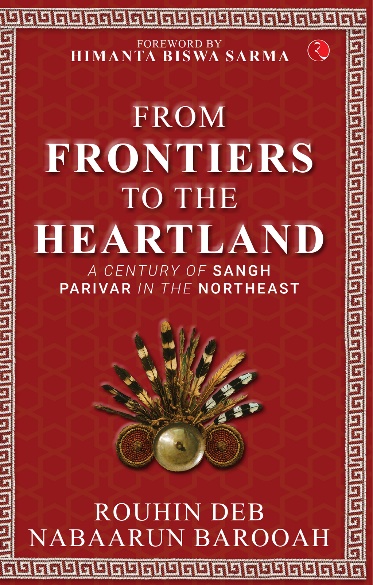
In their groundbreaking book, From Frontier to the Heartland: A Century of Sangh Parivar in the Northeast, scholars Rouhin Deb and Nabaarun Barooah cast a fresh and rigorous light on an overlooked yet transformative presence in the region’s socio-political landscape—that of the Sangh Parivar.
At once deeply researched and deeply resonant, the book presents the first comprehensive chronicle of the Rashtriya Swayamsevak Sangh (RSS) and its affiliated organizations’ journey in the seven (now eight) northeastern states of India. Far from the dominant perception of the Sangh as a homogenizing force in Indian politics, the authors argue, its century-long engagement with the Northeast tells a more nuanced story—of adaptability, cultural negotiation, and complex regional embedding.
Decoding a Quiet Political Expansion
Through oral histories, archival research, and a rich tapestry of firsthand accounts, Deb and Barooah trace how the Sangh Parivar has, over time, moved from being a marginal outsider to a central actor in the political and cultural life of the Northeast. What began as a cautious entry into a linguistically and religiously diverse frontier has evolved into a far-reaching ecosystem of schools, service organizations, ideological affiliates, and political platforms.
The book outlines how the Sangh first encountered the region during the final decades of British rule—a period that also saw a widespread Christian missionary presence, particularly in tribal areas. While Christianity grew rapidly among communities in states like Nagaland, Mizoram and Meghalaya, the Sangh’s efforts focused on what it saw as preserving and revitalizing “indigenous cultural identities” that could align with a pan-Indian civilizational ethos.
Post-Independence, the Northeast became a crucible of challenges: separatist insurgencies, border insecurities, ethno-nationalist uprisings, illegal migration, and underdevelopment. The authors show how the Sangh’s presence gradually adapted to these realities—focusing not only on ideological propagation but also on relief work, cultural education through organizations like the Vanvasi Kalyan Ashram, and strategic political alignments that would eventually yield electoral dividends.
By the 1990s and 2000s, with the rise of the BJP and the expansion of its political network, the Northeast began to shift from periphery to platform. Today, the BJP governs several northeastern states, and the Sangh’s ideological and organizational footprint has become undeniable.
An Unvarnished, Region-Specific Account
Crucially, From Frontier to the Heartland does not seek to glorify or vilify. Its strength lies in its refusal to take a simplistic or ideologically blinkered approach. Deb and Barooah interrogate how an organization widely associated with cultural majoritarianism has had to accommodate—at times resist, at times embrace—the intricate mosaic of tribal identities, languages, religions, and local histories that make the Northeast what it is.
From their close analysis of the Sangh’s role during the Emergency, to its response to the Assam agitation, to its recent navigations of the Citizenship Amendment Act (CAA) controversy, the authors provide a grounded, region-specific account that is as much about Northeast India as it is about the Sangh Parivar.
They also spotlight the internal frictions and ideological negotiations within the Sangh ecosystem, often hidden from the public eye, that have shaped its Northeast strategy. This lends the book a rare honesty and complexity.
Meet the Authors
Rouhin Deb, an economist by training, currently serves as Chief Economist in the Chief Minister’s Secretariat, Government of Assam. A product of the Vivekananda Kendra Vidyalaya system in Arunachal Pradesh, Deb brings to the book not only analytical rigour but lived familiarity with the socio-cultural landscape of the Northeast. He holds a PhD from IIM Shillong and regularly contributes to leading national publications.
Nabaarun Barooah is a Sir Jadunath Sarkar Fellow at the Foundation for Indian Historical and Cultural Research (FIHCR), and a prolific writer on politics, culture, and Northeast Indian affairs. A graduate of Ashoka University, Barooah brings youthful clarity and scholarly precision to the narrative, enriching the book with critical insight and narrative fluency.
Together, the authors bridge the insider-outsider duality, crafting a narrative that is at once academically sound, politically provocative, and regionally rooted.
Why This Book Matters Now
At a time when the Northeast is becoming increasingly central to India’s strategic, political, and cultural imagination—from Act East policies to majoritarian debates to border security—From Frontier to the Heartland arrives as an essential intervention. It invites readers to look beyond clichés and assumptions, and instead engage with a layered, evolving reality.
It is a book that will resonate with political scientists, historians, students of cultural studies, policymakers, journalists, and anyone invested in understanding the future of Indian democracy in one of its most complex regions.
More than a history, it is a mirror—reflecting not just the Sangh’s century in the Northeast, but also the Northeast’s century of negotiation with modern India.

 Bookshotsapp
Leave a comment