
(Genre: Geopolitics / Public Policy / Global Transitions )
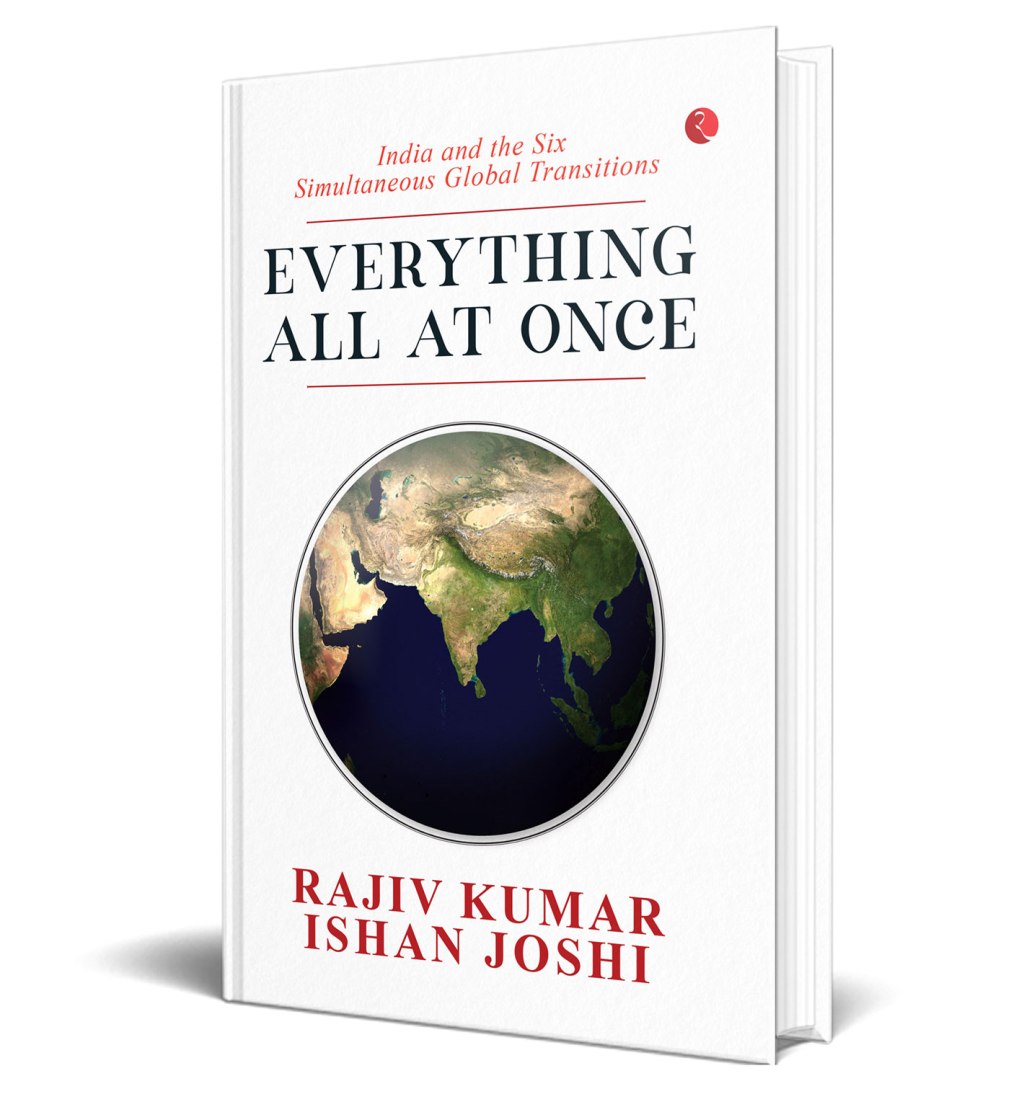
In Everything All At Once, Rajiv Kumar—economist, policymaker, and former Vice Chairman of NITI Aayog—and journalist-author Ishan Joshi confront one of the most complex intellectual challenges of our time: making sense of a world undergoing simultaneous, rapid, and deeply consequential transitions. Their response is as timely as it is ambitious, offering readers a wide-angle, yet rigorously argued perspective on the tectonic shifts redefining global politics, economics, technology, and climate—and their implications for India.
A World in Flux
The title itself—Everything All At Once—evokes the dizzying simultaneity of today’s crises and transformations. Kumar and Joshi argue that we are not witnessing isolated disruptions, but six overlapping and interdependent global transitions that are reshaping the 21st-century world order. These are:
- The Geopolitical Transition — the erosion of Pax Americana and the rise of multipolar competition.
- The Geoeconomic Shift — marked by deglobalization, trade fragmentation, and rising protectionism.
- The Reorientation of the Global Centre of Gravity — from the transatlantic to the Indo-Pacific.
- The Rise of the Global South — a growing redistribution of power and influence away from the OECD bloc.
- The Technological Transition — propelled by AI and digital disruption, with promises and perils alike.
- The Ecological Transition — where mitigation alone no longer suffices, and carbon removal becomes critical.
Each of these is examined with clarity, drawing on data, historical perspective, and realpolitik insight. The authors are particularly astute in analyzing how these transitions—while global in nature—manifest differently for different nations, depending on their strategic posture, economic resilience, and policy agility.
Crumbling Certitudes and Trump’s Return
One of the book’s strongest sections is its exploration of the erosion of post-Cold War consensus. What the authors term “crumbling certitudes” encapsulates the deep unease in global capitals—where optimism about globalization, technology as a universal good, and the inevitability of liberal democracy has given way to fragmentation, volatility, and even despair.
The chapter on Donald Trump’s return to the White House in 2025 is particularly powerful. It details how Trump 2.0 has accelerated many of these global transitions, transforming what were gradual shifts into ruptures. The analysis goes beyond mere political commentary—it frames the Trump era as a historical inflection point, potentially marking the formal unraveling of Pax Americana and the long-term decline of U.S.-led multilateralism.
A Framework for India
At the heart of Everything All At Once lies a question: how should India respond? The authors argue convincingly that piecemeal or reactive policymaking is no longer tenable. India must embrace a systems-level approach—rooted in strategic foresight, social equity, environmental responsibility, and technological innovation.
Rather than prescribing a one-size-fits-all model, Kumar and Joshi lay out a blueprint for Viksit Bharat (a developed India) by 2047. This includes:
- Reducing inequality, not just accelerating GDP growth.
- Building adaptive state capacity.
- Investing in climate-positive growth pathways.
- Leveraging India’s unique democratic and demographic advantages to shape, not merely respond to, global narratives.
Why This Book Matters
In a global environment marked by accelerating change, polarizing politics, and shrinking decision windows, Everything All At Once is both diagnostic and prescriptive. It explains what is happening, why it matters, and what India must do. But perhaps most crucially, it restores a sense of strategic agency to India’s policy discourse—moving beyond fatalism or imitation, and toward a confident, context-sensitive global posture.
Verdict
Everything All At Once is an important book—one that demands to be read slowly, discussed widely, and taken seriously by anyone concerned with India’s place in a changing world. It combines policy realism with moral clarity, historical depth with futuristic thinking. Whether you are a student of international affairs, a policymaker, a business leader, or simply a citizen trying to understand the churn, this is the roadmap you didn’t know you needed.
Rating: ⭐️⭐️⭐️⭐️⭐️ (5/5)
Essential reading for: Policy professionals | Diplomats | Strategic thinkers | Economists | Students of geopolitics | Climate and tech analysts
Praise for Everything All At Once
“A tour de force critically examining the six simultaneous global transitions shaping our world… A must-read to understand how the contemporary geostrategic, climate, and technological flux can be leveraged to India’s advantage.”
— Erik Solheim, former Executive Director, UNEP, and former Minister, Government of Norway“A thought-provoking, strategic roadmap for India in a rapidly changing world. Kumar and Joshi blend clarity with conviction in this seminal work—essential reading for policymakers, entrepreneurs, and engaged citizens alike.”
— N.R. Narayana Murthy, Founder, Infosys“With intellectual rigour and deep insight, the authors identify six transformative global shifts and articulate a compelling vision for India’s journey to Viksit Bharat by 2047. A timely and important contribution to our national discourse.”
— Shivshankar Menon, former National Security Advisor and Foreign Secretary“An indispensable guide to understanding the unprecedented global transitions unfolding today—and India’s potential role in shaping the emerging world order. Sharp, analytical, and forward-looking.”
— Shyam Saran, former Foreign Secretary“This compelling book advances a nuanced paradigm of development—one that balances growth with sustainability and equity. A rigorous blueprint for India’s future, rooted in strategic foresight.”
— Amit Chandra, Founder, ATE Chandra Foundation, and Governing Board Member, Ashoka University“A vital work that urges every thinking Indian to engage with the defining transitions of our time—from climate and technology to global power shifts. A call to shape, not just survive, the future.”
— Sundeep Waslekar, President, Strategic Foresight Group“A crystal-ball roadmap for India’s bright future. Accessible and insightful—a compelling read for both lay readers and experts.”
— Kevin Stanton, former Chief Services Officer, Mastercard
ABOUT THE AUTHOR
Rajiv Kumar, a highly regarded economist, Rajiv Kumar served as Vice Chairman of NITI Aayog— the Government of India’s premier policy think tank—from 2017 to 2022. He has held senior positions at FICCI, ICRIER, CII, and the Asian Development Bank. Dr Kumar holds a PhD in economics from Lucknow University and a DPhil from Oxford University. He has authored several books and papers on macroeconomics, trade, industry and strategic foreign policy. In 2023, Dr Kumar was awarded the Order of the Rising Sun, Gold and Silver Star by the Government of Japan for strengthening India Japan economic ties.
Ishan Joshi’s research interests include geostrategy, communication and media policy, and foreign affairs. His work has been published in academic journals and conferences, and he contributes regular op-eds to prominent media platforms. He has been a faculty member of the School of Communication, Ateneo de Manila University, Philippines. As a journalist, Ishan has held leadership positions in quality broadsheets. Educated in India and the UK, he is a recipient of the Chevening Fellowship for Young Journalists as well as the British Foreign and Commonwealth Office Scholarship for Postgraduate Studies.




 Bookshotsapp
Leave a comment