
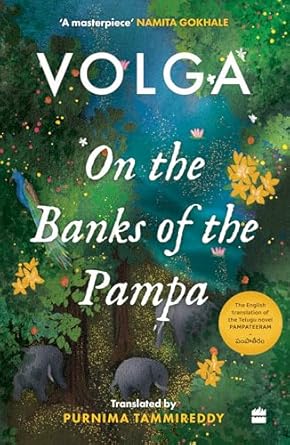
Some books grab you by the heart and don’t let go. Volga’s On the Banks of the Pampa, translated from Telugu by Purnima Tammireddy, is one of those. It takes Sabari, a fleeting figure from the Ramayana known for her devotion to Rama, and gives her a story so rich and human that you’ll never see her as just a devotee again. There’s this one line that stopped me cold: “What does the universe lose if we don’t exist?” It’s the kind of question that makes you pause, breathe, and rethink everything. That’s Volga’s magic—she turns a simple moment into something profound.
After falling in love with The Liberation of Sita, I couldn’t wait to dive into this book, and it didn’t disappoint. It’s soulful, poetic, and deeply moving, reimagining Sabari not as a side note in Rama’s epic, but as the heart of her own story. Volga asks the questions we’ve all wondered: Who was Sabari before Rama? What drove her to wait for him? What shaped her spirit? This novella answers with a quiet wisdom that feels like a conversation with an old friend.
Sabari’s Story, Reclaimed
Sabari’s journey starts with loss. Born to the Aranyavasi, she’s uprooted as a child and thrown into a harsh city where rules are cruel and life feels like a trap. When she gets the chance to escape, she takes it, unsure of her parents’ fate but determined to find freedom. She ends up on the banks of the Pampa River, where the forest becomes her home. There, she meets her guru, Matanga Muni, and everything changes. The forest isn’t just a place to hide—it’s where she heals, grows, and finds herself.
Volga paints the Pampa so vividly—through Tammireddy’s beautiful translation—that you can almost hear the birds chirping and feel the breeze. Sabari learns from Matanga’s stories of pain and resistance, soaking up his wisdom about a world that treats people like them as outsiders. She becomes more than a student; she carries his legacy while carving out her own path. The forest becomes her teacher, too—she talks to the trees, listens to the river, and learns to live in sync with nature, not separate from it.
After Matanga passes, Sabari runs the ashram with Kabanda, a character I absolutely adored. He’s loyal, warm, and grounded, like the steady hum of the forest itself. His moment with Rama and Lakshman is unforgettable, not just for its place in the story, but for how he describes the Pampa’s beauty. Through his words, you don’t just read about the forest—you feel like you’re standing in it, surrounded by its life and magic.
When a visitor named Sutapa mentions Rama wandering the forest, something sparks in Sabari. She starts to wait, but it’s not a passive kind of waiting. It’s active, full of purpose, like she’s preparing for a moment that’s bigger than herself. Yet Volga makes it clear: Sabari’s life doesn’t revolve around Rama. Her story—her strength, her healing, her connection to the forest—stands on its own.
A Story That Sings
Volga’s writing is like a song—lyrical, emotional, and quietly powerful. Tammireddy’s translation keeps that melody alive, letting every word feel clear and true. The prose flows like the Pampa River, pulling you into Sabari’s world. You feel her grief, her quiet strength, the way she grows into someone unshakable yet gentle. Volga doesn’t just tell you about Sabari—she invites you to walk with her, to feel the weight of her pain and the lightness of her healing.
The book opens with a forest so dense the sun can barely break through, yet bursting with life—elephants playing with trees, cuckoos singing, flowers falling like a fragrant carpet. It’s a scene that mirrors Sabari herself: vibrant, resilient, part of something bigger. Lines like, “Stop this relentless pursuit of the universe’s buried secrets. Instead, listen to its whispers,” stay with you. They’re a reminder to slow down, to notice the small things—the breeze, the trees, the stories that shape who we are.
A Book That Stays With You
On the Banks of the Pampa is more than a retelling of a myth. It’s a story about womanhood, spirituality, and finding your place in the world. Volga’s feminist lens is subtle but fierce, calling out society’s injustices through Sabari’s eyes while celebrating her resilience. The forest, Kabanda’s warmth, Matanga’s teachings—they all weave together into a tale that feels alive and urgent.
If you loved The Liberation of Sita or crave stories that blend mythology, feminism, and poetic prose, this book is a gem. It’s gentle but bold, quiet but transformative. It’s the kind of story that settles into your heart and lingers, urging you to listen to the world a little more closely. I know I’ll be coming back to Sabari’s journey again and again.
About the Author
VOLGA is a writer, critic, translator and poet, who has been a forerunner in introducing a feminist perspective into the literary-political discourse of the Telugu-speaking states. One of the most significant figures in Telugu literature today, her works opened the floodgates for a host of women writers to articulate the doubts and confusions they experienced as women. Her novel Sveccha (Freedom) marks a watershed in women’s writing in Telugu and is now being published in all Indian languages by the National Book Trust of India. Her other works include the short-story collection Rajakiya Kathalu (Political Stories), that looks at the oppression of and control on a woman’s body; Maaku Godalu Levu (We Have No Walls), the first volume in feminist philosophy in Telugu, which she edited; and an anthology of feminist poems, Neeli Meghalu (Dark Clouds), also one she edited. She co-authored Saramsam, which documents the anti-arrack struggle, and Mahilavaranam (Womanscape), a detailed collective biography of important Telugu women of the twentieth century. With works like Atadu Ame Manam (He–She–Us) and Sahita (Inclusion), she has contributed richly to feminist literary criticism. Volga has translated several important texts into Telugu, such as Agnes Smedley’s autobiographical novel, Daughter of Earth, as Bhumi Putrika. She has also written screenplays for Telugu films, composed lyrics for dance ballets like War and Peace, and represented India in women’s conferences in China and the United States.
She has received numerous awards and honours, including the Sahitya Akademi Award for her short-story volume, Vimukta (published in translation as The Liberation of Sita), the South Asia Ladli Media and Advertising Award for Gender Sensitivity 2015–2016, and an honorary doctorate from Sri Padmavati Women’s University.
Volga lives in Hyderabad.
 Bookshotsapp
Leave a comment