
Saurabh Shankar
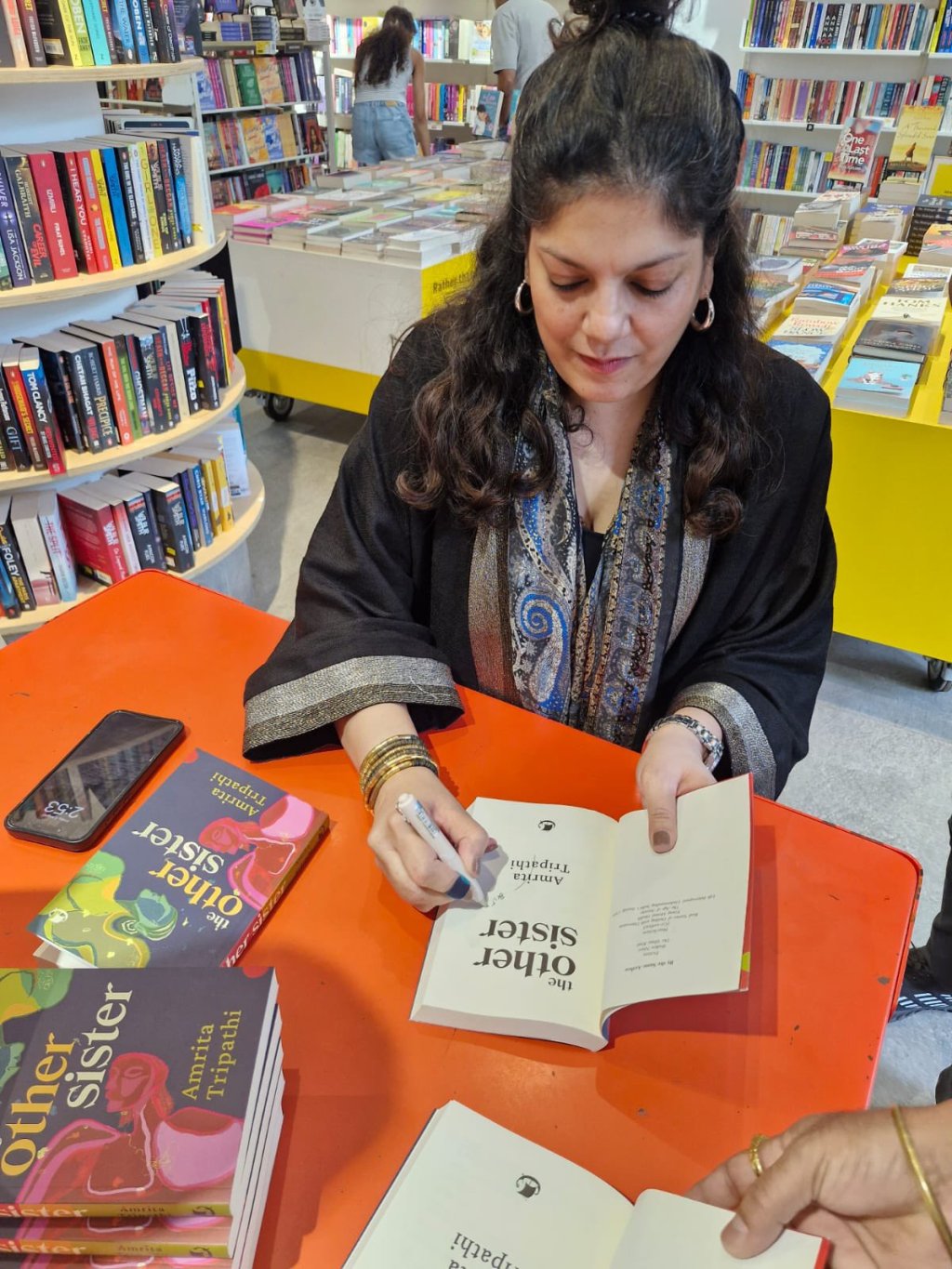
In a world overflowing with notifications, updates, and curated lives, The Other Sister by Amrita Tripathi offers a rare moment of pause—a quietly powerful novel that explores what it means to disconnect in order to truly reconnect with oneself. Set in the post-pandemic landscape of digital fatigue and emotional fragmentation, the story follows Maya, a young woman who retreats from the virtual world and confronts the weight of her past, her mental health, and the blurred lines between being seen and being known. Tripathi’s storytelling is subtle yet affecting, capturing the silent struggles of a generation tethered to their screens, but yearning for something real.
An Exit from the Noise
In The Other Sister, Amrita Tripathi offers an incisive portrait of a generation grappling with connection and disconnection in equal measure. The novel opens with a simple, cryptic message on social media—Maya, the protagonist, announces her virtual exit with the words: “Life is short, before you know it, time’s up.” The silence that follows becomes the novel’s most striking device. What begins as a vanishing act turns into an intimate excavation of identity, memory, and unresolved grief.
A Fractured Life, Told with Restraint
Maya retreats to her childhood home, where the silence of being offline reveals the louder truths of her life. Tripathi narrates her journey with restraint, avoiding melodrama in favor of quiet emotional resonance. The story unfolds in a non-linear fashion, echoing Maya’s fragmented mental and emotional state. Her struggles with dissociative identity disorder are portrayed with empathy and realism—never romanticized, but never pathologized either.
The Weight of Absence and the Complexity of Family
At the heart of the novel is Maya’s relationship with her step-brother, Gautam. Their bond is one of quiet endurance, shaped by shared loss and a mutual desire to protect. The family dynamic—marked by abandonment, silence, and unspoken grief—is handled with nuance. The absent mother, the deceased father, and the extended family each occupy space in Maya’s psyche, creating a portrait of family that is messy, fractured, but deeply human.
Mental Health, Performed and Lived
Tripathi tackles mental health in a way that feels both current and timeless. The novel critiques society’s performative engagement with wellness, particularly in the digital age. Therapy, spirituality, and self-care are all explored—not as tropes or aesthetic choices, but as urgent necessities that are often misunderstood. Maya’s journey through therapy is not linear; healing is portrayed as a slow, imperfect, and deeply personal process.
Digital Clutter, Spiritual Noise
The Other Sister also casts a critical eye on the commodification of spirituality. From Instagram influencers to YouTube-guided meditations, the novel explores how faith is consumed like content—quick, packaged, and algorithm-friendly. Yet, even here, Tripathi shows empathy for those drawn to such spaces. There is no moral judgment, only a recognition of the human need for meaning, especially in moments of crisis.
Grief as the Underlying Score
Loss permeates every chapter, subtle yet ever-present. Tripathi’s handling of grief is particularly affecting—its presence is not always loud, but it underlies every decision Maya makes. The loss of her father is a turning point, not just emotionally but existentially. As Maya slowly unravels and reconstructs herself, the reader is reminded that grief does not simply end; it reshapes the self.
A Narrative of Our Time
Set against the backdrop of a hyper-connected yet emotionally distant world, The Other Sister reflects a generation searching for meaning beyond likes, stories, and endless scrolls. As Maya’s therapist observes, the ubiquity of social media has made people “more exposed but less seen.” It’s this duality—visibility without intimacy—that Tripathi captures with elegance and precision.
A Novel That Listens More Than It Speaks
The Other Sister is a quietly radical novel. It refuses spectacle and embraces subtlety. It is a book that sits with discomfort, listens to silence, and acknowledges the unseen pain of everyday life. In doing so, it becomes a mirror for a generation that feels everything but often struggles to say so out loud.
With measured prose and emotional intelligence, Amrita Tripathi has written a story that doesn’t clamor for attention—but earns it. In an era of noise, The Other Sister is a necessary pause.




 Bookshotsapp
Leave a comment