
Vignesh Rajahmani’s The Dravidian Pathway offers more than a standard political history—it is a compelling exploration of how ideas, identities, and grassroots organisation came together to reshape South Indian politics. With clarity and depth, Rajahmani presents the Dravidian movement not just as a regional phenomenon, but as a significant example of how social movements and electoral politics can evolve in tandem.
While many studies focus on outcomes such as electoral victories or policy changes, Rajahmani asks a more foundational question: how does a cultural and social movement become an electorally successful political force? In answering this, he moves beyond conventional narratives and presents a layered account of transformation—one that highlights ideology, organisation, and public participation.
At the centre of his analysis is Christophe Jaffrelot’s integrated theory of ethnic nationalism, which outlines how identity-based movements progress through stages of ideological consolidation, cultural mainstreaming, and political mobilisation. Rajahmani uses this framework to examine the rise of the Dravida Munnetra Kazhagam (DMK) and its evolution between 1949 and 1967. But his contribution goes beyond theory. He supports his arguments with rich historical detail, drawing from archival sources, speeches, campaign materials, and oral histories to show how politics was made on the ground.
One of the book’s most distinctive contributions is its attention to reading rooms, or padippakams—community spaces where political engagement and education flourished. These spaces, often attached to DMK branch offices, were hubs for distributing pamphlets, screening films, hosting discussions, and building awareness. Drawing on the work of Sandria Freitag and Narendra Subramanian, Rajahmani argues that these reading rooms were central to creating a public culture that was politically active, socially inclusive, and culturally rooted.
The author also offers a nuanced view of leadership. Rather than treating figures like Periyar, Annadurai, or Karunanidhi as icons, he frames them as strategic thinkers and organisers. Periyar, in particular, is described as a “chief aggregator”—someone who brought together strands of anti-caste thought, social reform, and regional pride to build a cohesive ideological platform. Annadurai, meanwhile, is portrayed as a communicator who popularised this vision among the masses, while Karunanidhi emerges as a flexible leader who knew how to adapt ideals to the demands of electoral politics.
A recurring theme throughout the book is the careful balance between ideological commitment and political pragmatism. Rajahmani shows how the DMK evolved by constantly negotiating its original goals with the changing political landscape. This adaptability was not seen as betrayal, but as a necessary strategy for survival and relevance—especially in a democracy where engagement with diverse communities is key.
In doing so, the book offers a broader lesson: regional movements, when rooted in justice, inclusion, and cultural pride, can resist centralising pressures and offer a viable, pluralistic alternative to dominant political narratives. Tamil Nadu’s political story, as told here, is not isolated or exceptional—it is deeply connected to the Indian democratic experiment.
This work is essential reading for anyone interested in Indian politics, social movements, or South Asian history. Its attention to both grassroots activism and strategic leadership makes it valuable for scholars, students, and general readers alike.
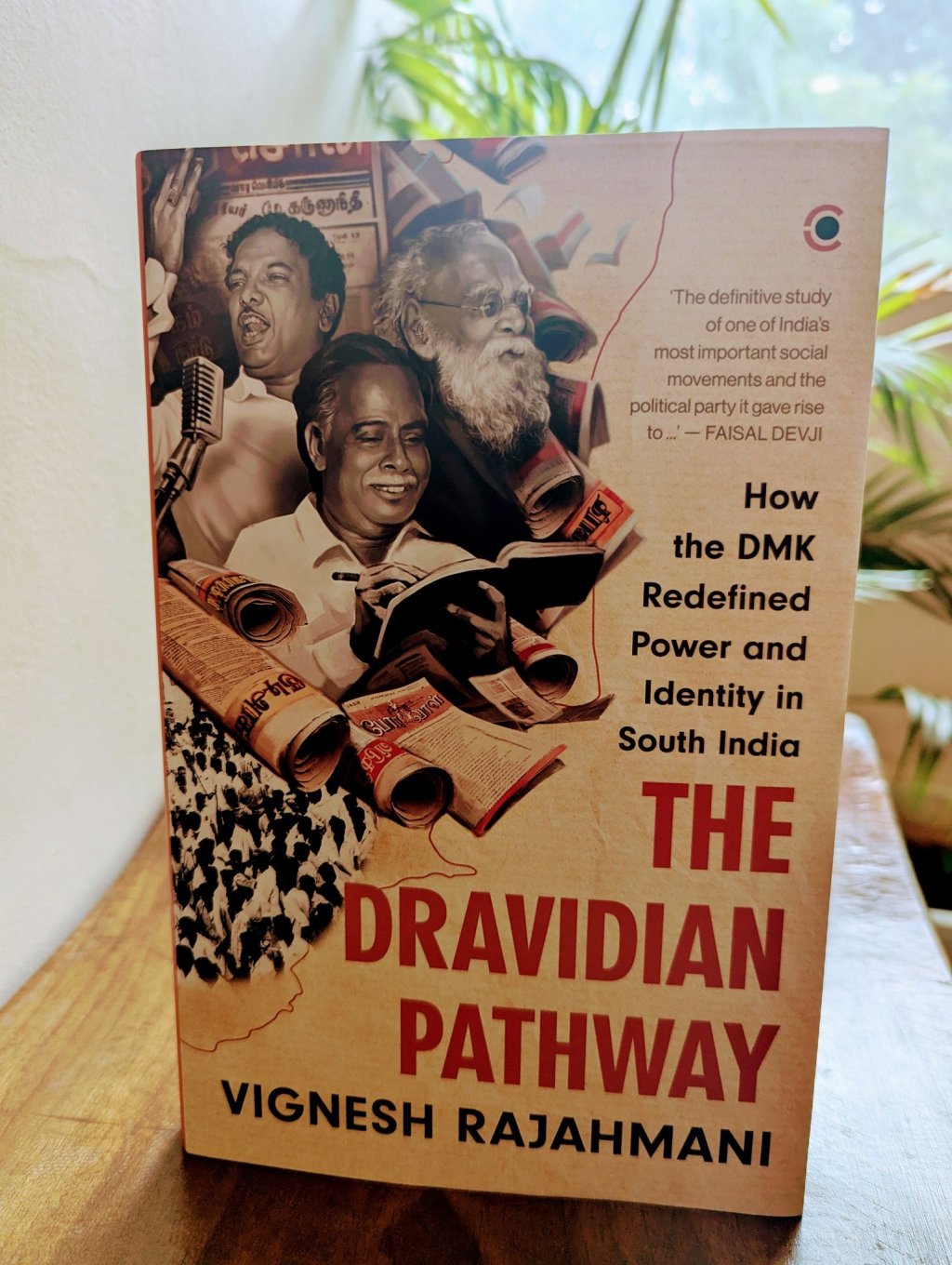
Vignesh Rajahmani’s The Dravidian Pathway is a timely, insightful, and well-researched examination of how movements can become political institutions, and how political institutions can stay true to their roots while embracing change.
Publisher: Westland Books
Length: 300 pages

 Bookshotsapp
Leave a comment