
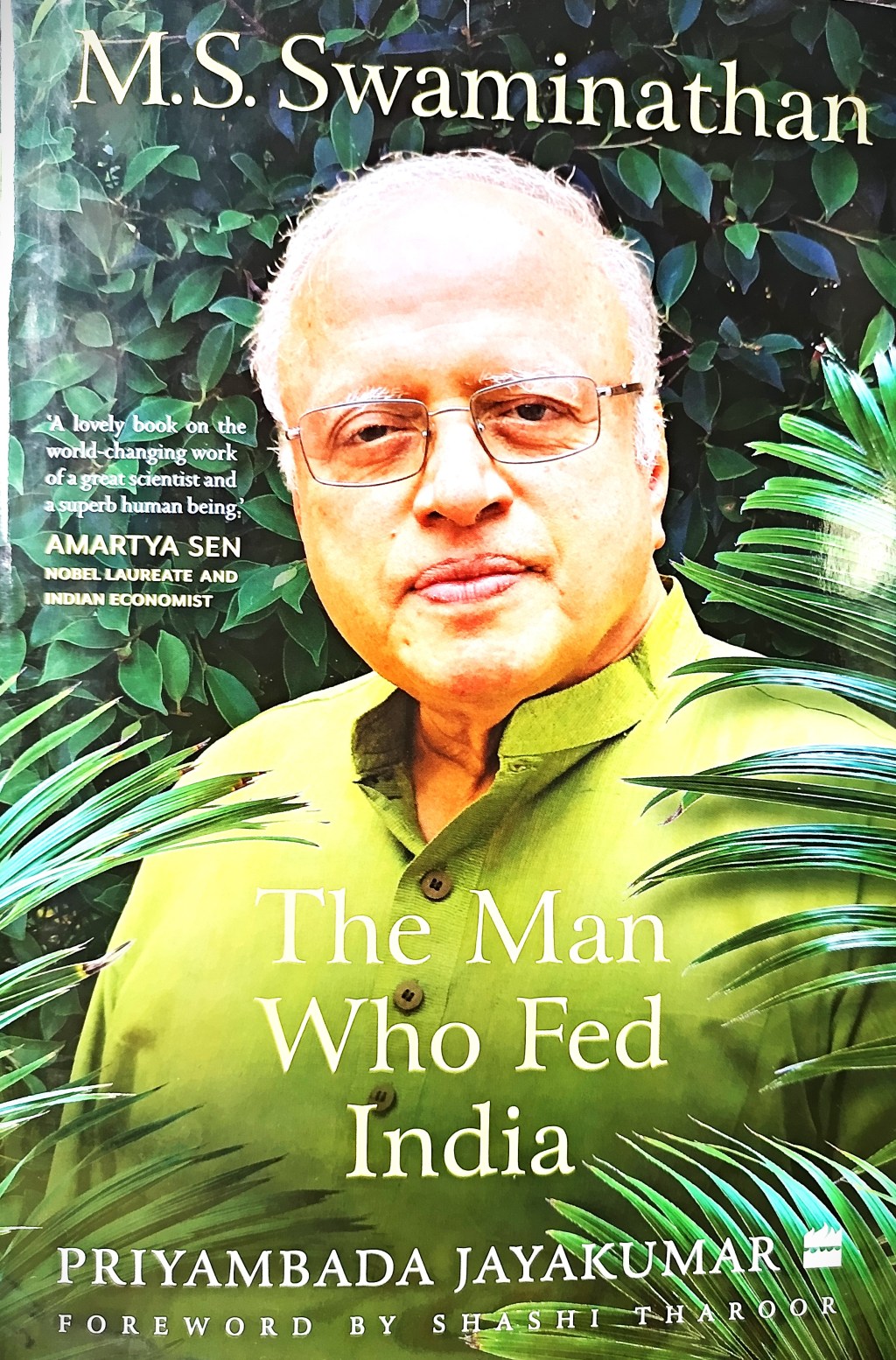
In M.S. Swaminathan: The Man Who Fed India, Priyambada Jayakumar delivers a vivid and timely portrait of the scientist who redefined India’s relationship with food, farming, and the future. Marking his centenary, this biography is not a mere chronicle of achievements, but a deeply textured account of a man whose scientific brilliance was matched by his moral clarity and policy foresight.
Jayakumar navigates Swaminathan’s life with both intimacy and insight—drawing from personal memories, public milestones, and political landscapes. Her prose is engaging, and her narrative choices bring warmth to complex themes like hunger, sustainability, and national policy. Particularly striking is her focus on Swaminathan’s role as a bridge between science and statecraft—someone who didn’t stop at lab results, but pushed for structural change.
This book avoids hagiography. Instead, it offers a grounded and human view of Swaminathan: a boy planting saplings under a burning sun, a young man abandoning medicine for agriculture, and an elder statesman advocating for ecological balance in a climate-stressed world.
The Man Who Fed India is a biography that speaks not just to the past, but to our shared future. Essential reading for those interested in science with purpose, leadership with empathy, and the enduring relevance of food security in a divided world.
Advance Praise: A Glimpse into M.S. Swaminathan’s Legacy
The praise for The Man Who Fed India has been resounding, with luminaries such as Naveen Patnaik, the former Chief Minister of Odisha, offering high praise for the book’s ability to weave together the scientific rigor and humanitarian spirit that defined Dr. Swaminathan’s life. Patnaik, in his endorsement, calls the book essential reading for anyone keen on understanding modern India’s agricultural revolution and the legacy of a towering figure who shaped the nation’s destiny.
Shashi Tharoor, the Member of Parliament for Thiruvananthapuram, underscores Jayakumar’s skillful narrative, highlighting how the author breathes life into Dr. Swaminathan’s story with sonorous prose that captivates readers. He emphasizes that the book is far from a dry academic account; rather, it is a compelling narrative that invites readers to reflect on the future of the nation. Tharoor calls it an indispensable contribution to modern Indian history.
Economist Montek Singh Ahluwalia, another esteemed voice, commends Jayakumar for capturing the idealism and commitment to social justice that defined Dr. Swaminathan’s life. He emphasizes the importance of the visionary’s work in the Green Revolution and his ability to not just contribute as a scientist, but also as a policy advocate who helped push India towards food security at a time of acute crisis.
Author’s Note: The Relevance of M.S. Swaminathan Today
In the Author’s Note, Jayakumar reflects on the relevance of Dr. Swaminathan’s life and work in today’s world. Through an anecdote about a conversation with a friend, she poignantly draws a parallel between the lack of food access faced by millions globally and the visionary’s lifelong dedication to ensuring that food is not just a commodity but a right. As long as hunger remains a global crisis, the core message of Dr. Swaminathan’s life—the fight for food security—continues to resonate profoundly.
Jayakumar also introduces her personal connection to Dr. Swaminathan, recounting how she first met him at the age of seven in Kolkata. This personal connection infuses the book with authenticity, making Dr. Swaminathan’s contributions feel deeply human and relatable, while also presenting him as a towering intellectual force who dedicated his life to the betterment of the marginalized and the nation at large.
A Journey Through the Green Revolution and Beyond
The book is not just about the science behind the Green Revolution. It is about the man behind the revolution, his childhood, his ideals, and the various forces—both political and social—that shaped his career. Jayakumar deftly explores the young Swaminathan’s decision to shift from medicine to agricultural science, spurred by Mahatma Gandhi’s call to serve the nation’s farmers. His commitment to improving agriculture in India was not merely academic; it was rooted in a deep, personal commitment to alleviating poverty and hunger, two of the greatest challenges facing the country in the 1960s.
M.S. Swaminathan is celebrated not only for his scientific accomplishments but also for his role as a statesman, philanthropist, and diplomat. The book beautifully captures his multi-dimensional personality, showing him as a scientist who believed that knowledge must be linked to action, particularly when it comes to policy advocacy. His ability to engage with politicians and policymakers helped shape crucial agricultural policies that have had a lasting impact on India’s farming communities.
A Profound Legacy
As The Man Who Fed India progresses, Jayakumar draws readers into the evolving narrative of Dr. Swaminathan’s work, from his involvement in the Green Revolution to his leadership in creating institutions dedicated to sustainable agriculture and bio-diversity. His work not only transformed Indian agriculture but also set a global example for bio-farming, environmental stewardship, and sustainable food systems. The author’s portrayal of Swaminathan’s humility, compassion, and dedication to social justice adds depth to the narrative, showcasing him as not just a scientist but as a humanitarian visionary.
In a world where food security remains a challenge, particularly for the underprivileged, Swaminathan’s legacy continues to inspire. The book serves as a reminder that leadership rooted in service to humanity is the greatest kind of leadership—one that shapes both policy and the people it serves.
A Narrative Rich in Humanity and Vision
Jayakumar’s writing is imbued with a novelist’s flair, making the biography a riveting read. She doesn’t merely present facts but weaves a narrative that captures the essence of Swaminathan’s journey, from his early days as a curious young boy to his rise as the father of India’s Green Revolution. Each chapter resonates with the intensity of his commitment to social justice and the betterment of the agricultural community, and the narrative is filled with vivid anecdotes, such as his youthful interactions with his peers, that humanize this monumental figure.
The book’s first chapter begins with an evocative scene from Dr. Swaminathan’s childhood, wherein a young boy named Ambi enthusiastically attempts to help a woman plant saplings under the scorching sun. This scene, laden with warmth and innocence, acts as a metaphor for Dr. Swaminathan’s own journey—marked by hard work, perseverance, and a deep love for the land and its people.
A Timely Tribute to the Visionary Who Nourished a Nation
The Man Who Fed India is not merely a biography of a scientist—it is the story of a visionary whose impact transcended the realm of agriculture. It is a timely exploration of the fight for food security, sustainability, and social justice in a deeply divided world. Jayakumar’s vivid storytelling, combined with her scholarly rigor, ensures that the book is both intellectually enriching and emotionally stirring.
This work is a must-read for anyone interested in understanding the profound changes that shaped modern India, the legacy of one of its most influential leaders, and the continuing fight for a future free from hunger.
“M.S. Swaminathan: The Man Who Fed India” by Priyambada Jayakumar is a tribute to the genius, the compassion, and the far-reaching impact of a man who fed millions and sowed the seeds for India’s agricultural revolution. With endorsements from distinguished individuals such as Naveen Patnaik, Shashi Tharoor, and Montek Singh Ahluwalia, this book is a testament to Dr. Swaminathan’s lasting influence and a vital resource for anyone who wishes to understand the making of modern India.
About The Author
PRIYAMBADA JAYAKUMAR was raised in India, specifically in the City of Joy—Kolkata. Born to a Bengali mother and a Tamil father, she completed her schooling from La Martiniere for Girls, Kolkata. The capital city of Delhi soon beckoned where she received her BA (Hons) degree in History from St. Stephen’s College, University of Delhi. A Tripos in Social and Political Sciences followed thereafter from the University of Cambridge. Subsequently, she attended Harvard University for a further period of study. She is married with three children and currently lives in Singapore.



 Bookshotsapp
Leave a comment