
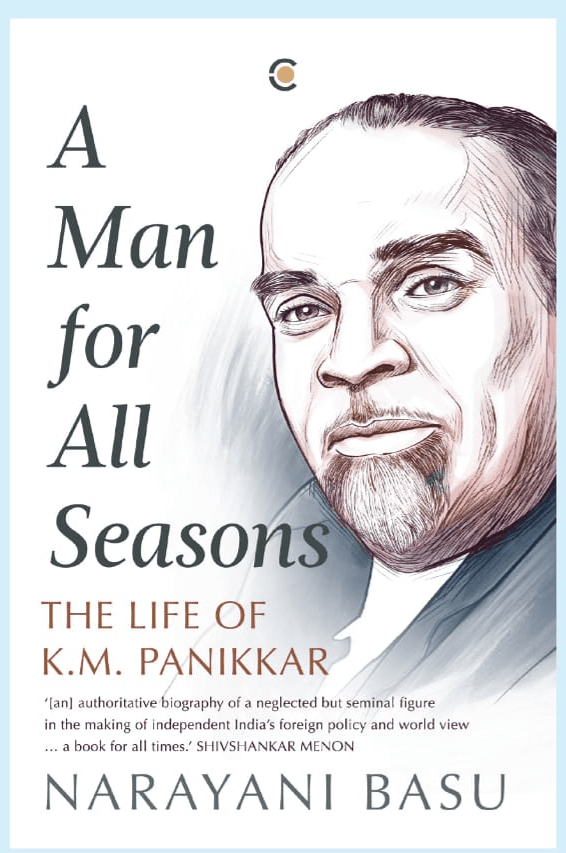
In A Man for All Seasons, Narayani Basu crafts a vibrant, meticulously researched biography that breathes life into the elusive figure of K.M. Panikkar, one of modern India’s most fascinating and multifaceted founding fathers. With a narrative as dynamic as the man himself, Basu unravels the layers of a nationalist, historian, diplomat, poet, and provocateur whose influence shaped India’s colonial and postcolonial journey. This is not just a biography; it’s a sweeping exploration of a young nation finding its footing, seen through the lens of a man who was impossible to ignore.
A Kaleidoscope of Roles
Born in the lush, waterlogged hamlet of Kavalam in Kerala’s Kuttanad, Panikkar’s life was as fluid and interconnected as the canals of his homeland. Basu paints a vivid picture of his early years, where the silver ripples of Vembanad Lake and the swaying coconut trees shaped a boy who would grow into a restless, roving spirit. From these humble roots, Panikkar emerged as a polymath: a constitutional lawyer who helped forge India’s federal structure, a maritime strategist whose ideas still anchor India’s naval policy, and a diplomat who navigated the choppy waters of the Cold War with equal parts audacity and finesse.
Panikkar’s career was a technicolor tapestry woven across the 20th century’s most pivotal moments. He rubbed shoulders with giants—Gandhi, Nehru, Sardar Patel, Zhou Enlai, Mao, and Nasser—while leaving his mark on everything from the princely states’ integration to the linguistic reorganization of India’s states. As Basu notes, he was “Nehru’s man” in Cairo and France, a controversial ambassador to China, and a quiet supporter of the Zionist cause. His fierce patriotism drew the wary gaze of British and Dutch intelligence, while his sharp intellect earned him both admirers and adversaries, from the CIA to his own Ministry of External Affairs.
A Literary Giant and Cultural Bridge
What sets Panikkar apart, and what Basu captures so brilliantly, is his relentless intellectual output. He wrote prolifically—on history, foreign policy, nationalism, and Indian identity—producing works that remain strikingly relevant seven decades later. In Malayalam literature, he was a titan, dabbling in poetry, drama, satire, and prose with a versatility that defies categorization. His tract on federal India and his foundational book on maritime policy, both penned in the 1930s and 1940s, showcase a mind that could distill complex ideas into blueprints for a nation in transition.
Yet, Panikkar was more than a scholar or diplomat. Basu humanizes him as a charming, unconventional family man who loved the finer things—be it Parisian cafes or Kuttanad’s traditions. His impish humor and provocative streak made him a delightful, if exasperating, figure. As his friend K. Iswara Dutt remarked, Panikkar was one of India’s “impossible men,” a phrase Basu uses to anchor her portrait of a man who was both fiercely patriotic and unapologetically himself.
A Story of India Itself
Drawing on Panikkar’s vast writings, archival material from India, England, France, China, Israel, and the United Nations, and first-time interviews with his family, Basu constructs a narrative that is as much about Panikkar as it is about India’s evolution. From the British Raj to the Constituent Assembly, through two world wars and the Cold War, Panikkar was a constant presence—a bridge between India’s past and its ambitious future. His role in the States Reorganisation Commission, which carved out linguistically cohesive states, underscores his lasting impact on Indian nationhood.
Basu’s storytelling is vivid and engaging, populated with a cast of historical titans and set against a backdrop of global upheaval. She doesn’t shy away from Panikkar’s contradictions: a committed secularist who believed in an essential Hindu culture, a nationalist who provoked both the Raj and New Delhi, a diplomat who annoyed as much as he impressed. These tensions make him all the more human, and Basu’s ability to weave them into a cohesive narrative is a testament to her skill as a historian and storyteller.
Why This Book Matters
A Man for All Seasons is a triumph of biography, filling a glaring gap in our understanding of one of India’s most enigmatic figures. Panikkar’s story is not just his own—it’s the story of a nation grappling with its identity, its borders, and its place in the world. Basu’s prose is as captivating as her subject, blending rigorous research with a novelist’s flair for detail. The Kavalam of Panikkar’s youth comes alive, as do the smoky diplomatic corridors of Cairo, Paris, and Beijing.
For anyone seeking to understand modern India’s intellectual and political roots, this book is essential reading. It’s a reminder that history is made not just by events but by the “impossible” men and women who dare to shape them. Panikkar, with his roving spirit and forensic mind, was one such figure—and Basu ensures he will not be forgotten.




 Bookshotsapp
Leave a comment