
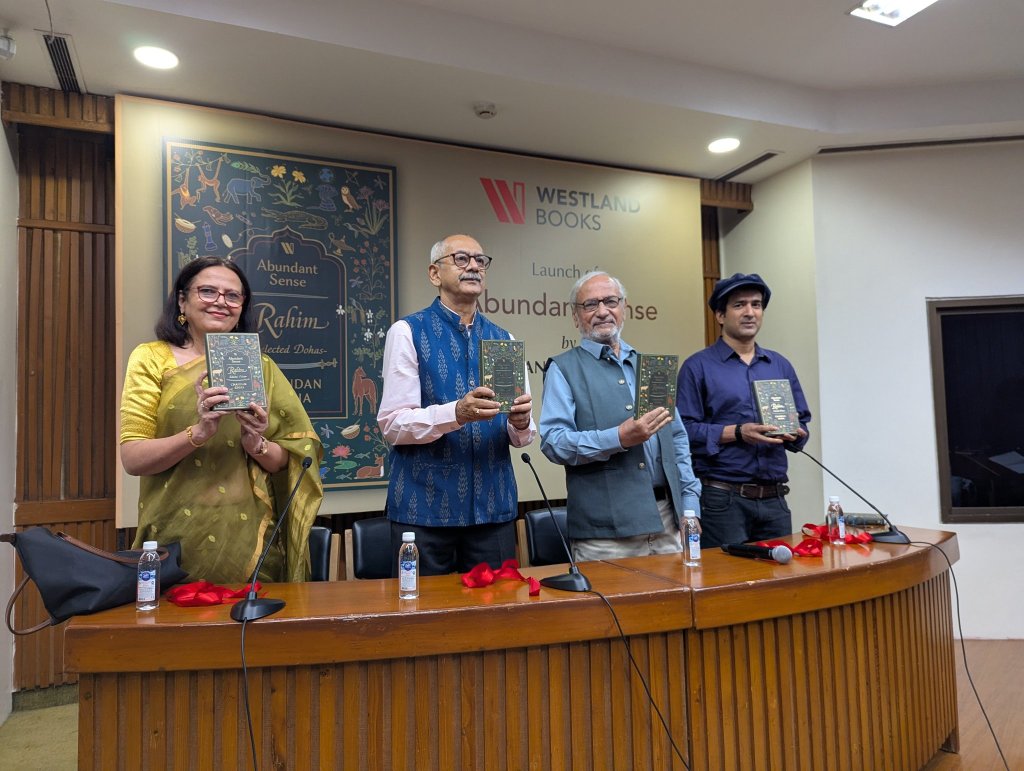
रहिमन दाहे प्रेम के, बुझि बुझि के सुलगाहिं……There is something uncanny about how the verses of a 16th-century Mughal courtier still feel relevant, intimate, and urgent in our deeply fractured times. In Abundant Sense: Rahim — Selected Dohas, Chandan Sinha offers a lucid and well-researched translation of Abdur Rahim Khan-e-Khana’s celebrated couplets — a project that does much more than bring old poetry to life. It revives a world view.
Rahim, a towering figure in Akbar’s court, is remembered today in fragments — a couplet quoted in a school textbook, a line recited by grandparents. But who was this man really? A military commander, scholar, polyglot, astronomer, mystic, and poet — Rahim’s life is as layered as his poetry. Born to Bairam Khan, a Turkic general, and a Rajput mother, he embodied the pluralism that defined the Mughal zenith.
In Abundant Sense, Sinha takes on the difficult task of translating Rahim’s pithy, metaphor-rich dohas — each just two lines, packed with layered meanings, wordplay, and cultural nuance. These are not just verses to admire; they are vehicles of a worldview — one shaped by humility, irony, compassion, and a deep understanding of human nature.
The Doha is Mightier than the Sword
Rahim wrote in a form called doha, a 24-beat rhyming couplet (13:11 syllabic meter), made famous by poets like Kabir, Tulsidas, and Nanak. The strength of the doha lies in its brevity. Rahim likened it to a coiled rope in an acrobat’s hands — when unfurled, it reveals its true length.
Sinha’s translation captures this duality — the formal conciseness and emotional expansiveness. Take this well-known verse:
“रहिमन तीर की चोट ते, चोट परे बचि जाय। नैन बान की चोट ते, चोट परे मरि जाय॥”
This isn’t simply romantic hyperbole. It reflects Rahim’s larger engagement with love — as ecstasy, as torment, and as surrender. Love, for him, is not merely emotion but an ordeal requiring moral strength:
“रहिमन मैन-तुरंग चढ़ि, चलिबो पावक माँहि। प्रेम-पन्थ ऐसो कठिन, सबसों निबहत नाँहि॥”
The same poet who can speak of the fire of longing can also, with startling clarity, describe the dangers of pride:
“रहिमन अती न कीजिए, गहि रहिये निज कानि। सैजन अति फूले तऊ, डार पात की हानि॥”
In just two lines, Rahim builds a bridge between botany and wisdom. These aren’t lofty pronouncements from a court poet; they are distilled observations drawn from life, offered with the restraint of someone who has known the violence of both war and courtly ambition.
Translation with Tact and Texture
Chandan Sinha is no stranger to literary scholarship. A former civil servant with a background in history and administration, he brings to this work both a researcher’s precision and a translator’s sensitivity. Unlike many English renditions of Hindi poetry that lean toward free verse, Sinha retains the original meter and attempts to rhyme, even within the constraints of English prosody.
Every translated doha is placed alongside the original Nagari script, making it accessible to bilingual readers. Sinha also includes insightful footnotes that explain the cultural or mythological allusions. For instance, in one verse, Rahim references Vishnu’s Vamana avatar:
“माँगे घटत रहीम पद, कितौ करो बढ़ि काम। तीन पैग वसुधा करो, तऊ बावनै नाम॥”
The subtext — that even gods lose dignity when they beg — is a sharp, almost subversive commentary wrapped in wit.
Beyond Shringar and Bhakti: Rahim as Thinker
What makes Abundant Sense more than a poetry collection is its framing. Sinha groups the verses under three classic themes: bhakti (devotion), reeti (ethical living), and preeti (love), echoing the classical triad of Bhartrihari. But Rahim resists easy categorisation. He moves from sacred myth to sensual love to court satire with seamless ease.
His couplets on friendship, loyalty, and political power resonate sharply in today’s hyper-cynical age. There is empathy in his vision, but also irony. Take this example:
“फरजी साह न है सके, गति टेढ़ी तासीर। रहिमन सीधे चालसों, प्यादो होत वजीर॥”
And yet, in another doha, the same pawn is ridiculed:
“जो रहीम ओछो बढ़े, तौ अति ही इतराय। प्यादा सों फरजी भयो, टेढ़ो टेढ़ो जाय॥”
Rahim is not being inconsistent. He’s showing us that truth, like poetry, depends on context. His metaphors are living things — dynamic, contradictory, and endlessly interpretable.
Why Rahim Now?
In our current cultural climate, where binaries dominate and nuance is often lost, Rahim’s poetry is a gentle but firm reminder of India’s composite literary and philosophical heritage. His verses reflect a lived syncretism — a man comfortable quoting the Puranas in one breath and Sufi saints in the next. As Sinha points out, Rahim’s closeness to Sanskrit scholars like Tulsidas (despite dubious hagiographies) and his literary experiments with hybrid forms like Hindvi mark him as a bridge between seemingly separate worlds.
At a time when language itself is being politicised, and when Bhakha poets are either sanitised or erased, this book does the quiet work of cultural repair. It brings back into conversation a voice that refused to shout but never stopped speaking.
The Power of Passion, the Language of Love
Some of Rahim’s most exquisite verses deal with love — romantic, unrequited, and philosophical. One of his most poignant observations on the enduring agony of love goes:
“जे सुलगे ते बुझि गए, बुझे तो सुलगे नाहिं। रहिमन दाहे प्रेम के, बुझि बुझि के सुलगाहिं॥”
Or take this gentle lament of longing:
“बिरह रूप घन तम भयो, अवधि आस उद्योत। ज्यों रहीम भादों निसा, चमकि जात खद्योत॥”
And the love that needs no heaven:
“कहा करौं बैकुंठ लै, कल्प बृच्छ की छाँह। रहिमन ढाक सुहावनो, जो गल पीतम बाँह॥”
These are not abstract declarations. They are the distilled experiences of a man who has known battlefields and betrayal, politics and poetry, and still chooses tenderness.
Abundant Sense is that rare book that illuminates without simplifying, educates without pedantry, and moves without melodrama. For readers new to Rahim, this is a perfect introduction. For those familiar with his poetry, it offers fresh context and appreciation.
But above all, this book makes a compelling case for returning to our classical voices — not just to admire their artistry, but to engage with their ethical vision.
Rahim never claimed to be a prophet. He merely observed the world — and did so with humour, humility, and hard-earned wisdom.
And so he writes:
“यह न रहीम सराहिए, लेन देन की प्रीति। प्रानन बाजी राखिए, हार होय कै जीति॥”
More than four hundred years later, that’s advice worth taking.
Rating: ★★★★☆ (4/5)
Recommended for: Readers of Indian poetry, lovers of translation, students of history, and anyone curious about the moral wisdom of a more gracious age.



 Bookshotsapp
Leave a comment