
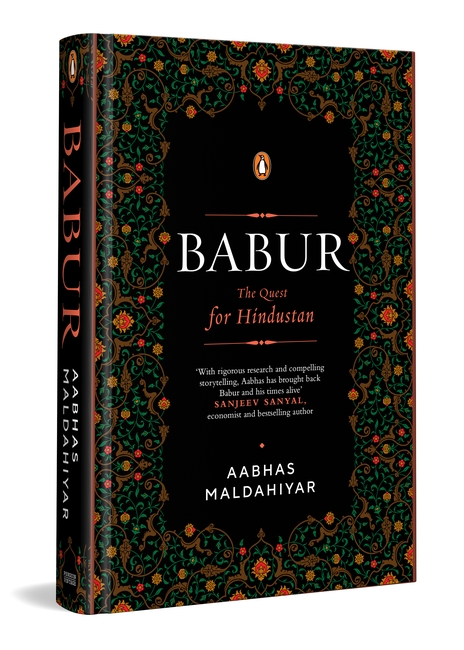
Aabhas Maldahiyar’s The Quest for Hindustan: A Biography of the First Mughal Emperor is a groundbreaking and fearless intervention in Indian historiography—an unvarnished yet multi-dimensional account of Babur, the Timurid conqueror whose arrival reshaped the political and cultural landscape of the Indian subcontinent. This meticulously researched volume stands as the second installment in Maldahiyar’s ambitious series on the Timurid Gurkaniyan dynasty, and builds upon the foundation laid by the first volume, Babur: The Chessboard King.
Drawing heavily from Baburnama and other Persian chronicles, Maldahiyar reclaims the narrative by returning to primary sources—removing layers of romanticism, ideological filters, and colonial-era mythology to present Babur as he was, not as he has been manufactured by subsequent political, academic, or cultural agendas.
A Biography Rooted in Originality and Primary Evidence
What sets The Quest for Hindustan apart from previous biographies or school textbook accounts is its unapologetic fidelity to source material. Maldahiyar not only learned Persian to engage directly with original texts such as Baburnama, but also collated obscure manuscripts and ignored chronicles shelved in libraries for decades.
This scholarly rigor allows him to challenge long-standing assumptions—such as the Babri Masjid’s origins, the Humayun-Karnavati Rakhi tale, and even the use of the term ‘Mughal’, which Babur himself never employed. Maldahiyar insists on identifying Babur by his Timurid lineage, situating him within the Central Asian context rather than the falsely unified ‘Mughal’ identity retroactively assigned by later historians.
Babur: More Than Just a Conqueror
While the book does not shy away from confronting the brutal realities of Babur’s campaigns—including the establishment of skull towers, the decimation of “kafir” populations, and his religious motivations—it also attempts to understand Babur in totality. He is revealed not just as a military strategist, but as a poet, a statesman, a family man, and a keen observer of Hindustan’s flora, climate, and culture.
The reader encounters Babur not only at Panipat or Khanwa, but also in moments of reflection—composing Persian verses, pondering architecture, or attempting to govern a newly conquered and complex land.
This is where Maldahiyar’s own professional background as an architect and urban designer enriches the narrative. His deep understanding of how physical spaces act as repositories of memory and violence allows him to trace history not just through dates and documents, but through forts, mosques, ruins, and battlefields. For him, architecture is history made tangible—and it shows in his storytelling.
A Style That Balances Objectivity with Elegance
One of the most striking features of this volume is its elevated literary style. Maldahiyar’s prose, poetic and lyrical in places, evokes not only the grandeur of medieval courts and battlefields, but also the deep emotional and civilizational trauma experienced during this era. The Jauhar of Chittor, for example, is narrated with heartbreaking clarity, drawing from Rajput and Persian sources alike to reconstruct the fiery resistance of a culture on the edge.
But the author never lapses into sentimentality. His strength lies in his ability to tell difficult truths dispassionately—even if they disturb the modern reader. That objectivity has earned him criticism from ideological fringes on both ends of the spectrum. Some ultra-Hindus accuse him of ‘humanizing’ Babur, while others view his critique of Marxist and Islamic historiography as politically inconvenient. Maldahiyar wears such criticism as a badge of authenticity—proof that he is pursuing history, not narrative warfare.
The Most Contested Ground: Ram Janmabhoomi
Arguably the most controversial and consequential segment of the book is the author’s claim—supported by meticulous research—that Babur neither ordered nor oversaw the demolition of the Ram Mandir in Ayodhya. The long-held assumption of Babur or his general Mir Baqi being responsible for the construction of the Babri Masjid is challenged.
Instead, Maldahiyar attributes the temple’s destruction to Aurangzeb, aligning it with a broader policy of religious repression seen also in Varanasi and Mathura. This assertion, if further corroborated by mainstream historians, may fundamentally reframe public discourse around Ayodhya and its deeply politicized history.
Myth-Busting with Precision: The Rakhi Episode and Humayun’s Silence
In another major historiographical correction, Maldahiyar debunks the romanticized “Rakhi” narrative between Rani Karnavati and Humayun—popularized in school textbooks and colonial-era works like James Tod’s Annals and Antiquities of Rajasthan. He presents evidence from contemporary sources, including Ferishta and Abdul Qadir Badayuni, to show that Humayun refrained from aiding Chittor not due to helplessness or miscommunication—but because he consciously chose not to oppose another Muslim ruler waging jihad against “idolaters.”
This cold realism of medieval politics is a far cry from the sugarcoated fairy tales of courtly virtue, and Maldahiyar uses it to emphasize the need for historical maturity in the Indian public consciousness.
Authorial Journey: From Marxist to Historian of Civilizational Consciousness
It’s important to contextualize Aabhas Maldahiyar not just through his book, but through his broader intellectual journey. Once a Marxist, he later emerged as a vocal critic of left-leaning historical interpretations, as evidenced in his earlier work Modi Again: An Ex-Communist’s Manifesto. His transition is marked not by a swing into ideology, but by a re-centering on evidence, civilizational memory, and cultural continuity—values that form the bedrock of The Quest for Hindustan.
His unique combination of architecture, historical method, and cultural insight makes him a distinct voice in a landscape often dominated by either academic elitism or populist myth-making. In this book, he forges a third path—rigorous, responsible, and readable.
Final Verdict: A Monumental Work That Will Stand the Test of Time
Babur: The Quest for Hindustan is more than a biography. It is a civilizational autopsy, a reconstruction of a political psyche, and a bold invitation to reassess one of the most significant figures in Indian history—not with hate, not with heroism, but with honesty.
It challenges the bland secular narratives that sanitize medieval Islamic conquests, while refusing to slip into shrill religious polemic. It restores Babur’s humanity, but never at the cost of whitewashing his brutality. This is historical writing at its most courageous—and its most necessary.
⭐ Rating: 4.5/5
Must-read for:
- Students of medieval Indian history
- Researchers of Islamic conquests and Timurid culture
- Politically aware citizens seeking historical clarity
- Anyone willing to confront the past without filters
 Bookshotsapp
Leave a comment