
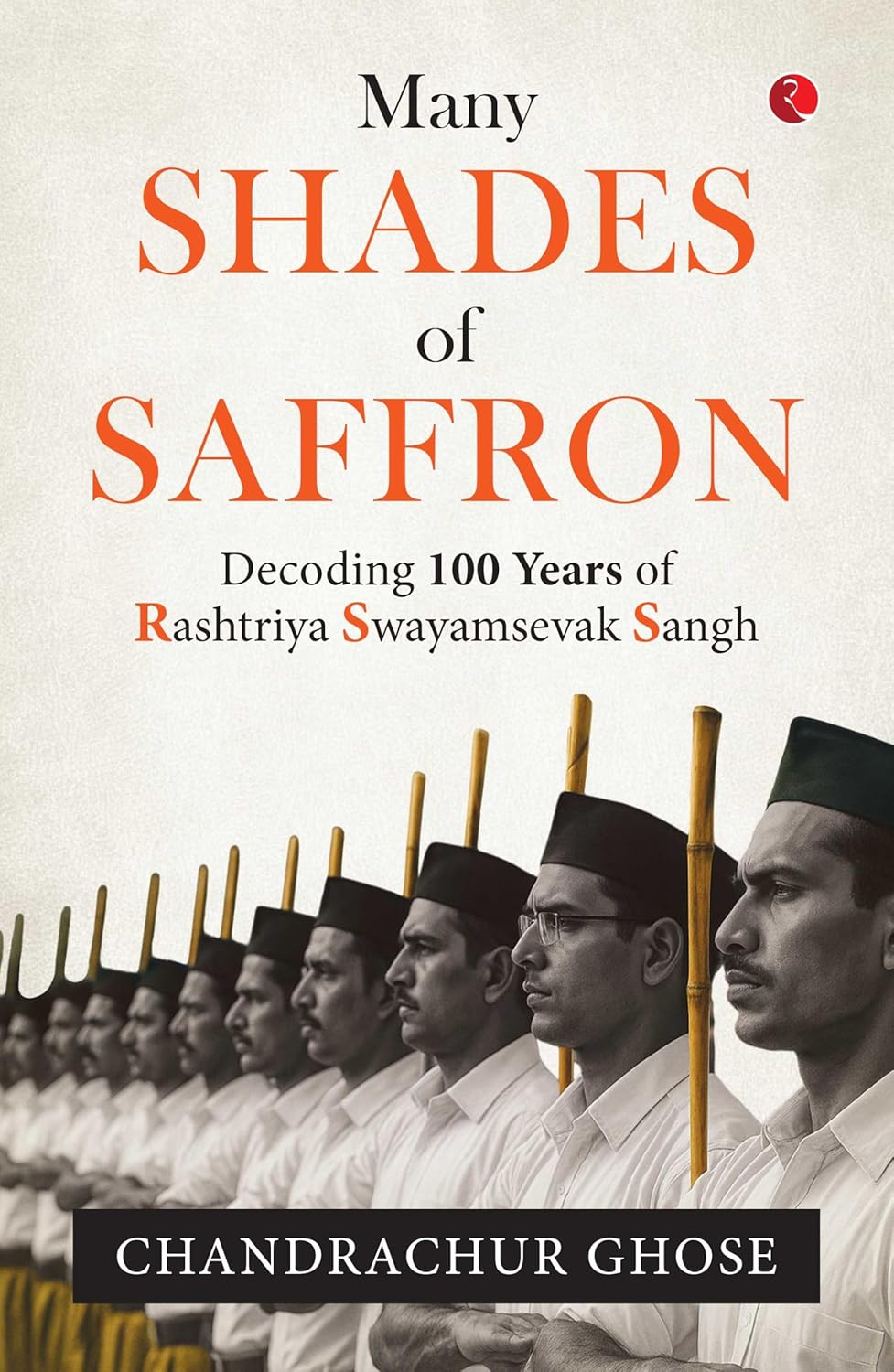
Chandrachur Ghose’s Many Shades of Saffron is a lucid, layered exploration of the Rashtriya Swayamsevak Sangh’s (RSS) hundred-year journey—from its 1925 origins in Nagpur to its present influence on Indian politics and culture. Balanced and deeply researched, the book avoids both glorification and vilification, offering readers a clear-eyed account of how the Sangh evolved, adapted, and endured. Ghose writes with rare detachment and insight, decoding the myths and realities surrounding one of India’s most powerful yet misunderstood institutions. A must-read for anyone seeking to understand modern India’s ideological heartbeat.
Few organizations in modern India evoke as much admiration and anxiety as the Rashtriya Swayamsevak Sangh (RSS). For some, it represents the essence of cultural nationalism and disciplined patriotism; for others, it symbolizes majoritarian politics and ideological rigidity. Between these extremes lies a century-long story that has shaped India’s social, political, and cultural imagination. In Many Shades of Saffron: Decoding 100 Years of Rashtriya Swayamsevak Sangh, historian and author Chandrachur Ghose undertakes the formidable task of narrating this complex journey — not to praise or condemn, but to understand.
A Century That Shaped India’s Right
Ghose’s book arrives at a moment when the RSS stands at the peak of its influence. Its ideological offspring, the Bharatiya Janata Party (BJP), rules India with a commanding majority, and its worldview increasingly informs the nation’s cultural and policy debates. Yet, despite this centrality, the Sangh remains an enigma — an organization both omnipresent and opaque.
Ghose opens his narrative with a fascinating historical parallel. The year 1925 saw the birth of two movements that would chart radically different paths — the RSS in Nagpur and the Communist Party of India (CPI) in Kanpur. “One rooted in cultural nationalism,” Ghose writes, “the other in Marxist-Leninist revolutionary ideals.” A hundred years later, the contrast between their fates is stark: while the communist movement has splintered and declined, the RSS has expanded into a vast network of educational, social, and political institutions known collectively as the Sangh Parivar.
Between Hagiography and Hostility
In his preface titled “In for the Long Haul,” Ghose observes that most existing literature on the RSS is deeply polarized. “On one side are works that celebrate the Sangh’s achievements, discipline and vision, often with little room for critique. On the other are writings that portray the RSS as a regressive, conspiratorial force fundamentally inimical to India’s pluralistic ethos.” His goal, therefore, is not neutrality — which he calls “an impossibility in historical writing” — but balance.
Ghose brings to the subject the rigor of a historian and the patience of a chronicler. Having co-authored Bose: The Untold Story of an Inconvenient Nationalist, he is no stranger to ideological minefields. In Many Shades of Saffron, he resists both the temptation of vilification and the comfort of glorification. Instead, he examines how the RSS evolved under successive sarsanghchalaks — from Dr. K.B. Hedgewar’s foundational emphasis on discipline and service, to M.S. Golwalkar’s philosophical articulation of Hindu nationalism, to the post-independence efforts of Balasaheb Deoras, K.S. Sudarshan, and others who navigated the organization through changing political landscapes.
A Silent Force and Its Paradoxes
One of the book’s most revealing insights is the Sangh’s long-standing aversion to documentation. Ghose notes that “until 1950, it did not even formalize its Constitution or systematically record the resolutions passed in its meetings.” This secrecy was not accidental — it was rooted in founder Hedgewar’s belief that “silent service, discipline and personal example were more important than public exposition or written records.”
That philosophy, Ghose argues, became both a strength and a weakness. It allowed the RSS to build a tightly knit cadre united by shared values rather than written doctrine, but it also made the organization inscrutable to outsiders — and thus, often misunderstood. Over time, that opacity invited projection: admirers saw it as a moral order; detractors, as a shadowy network.
Reading the Sangh in Context
Ghose situates the Sangh’s evolution within India’s broader historical currents — colonial resistance, Partition, post-independence nation-building, and the Emergency. He charts its complex relationship with political power, especially its ambivalence toward electoral politics. Though officially apolitical, the Sangh’s ideological kinship with the BJP has ensured that its shadow looms large over India’s governance.
At the same time, Ghose emphasizes the Sangh’s adaptive capacity. It has weathered bans, imprisonments, and public suspicion, yet emerged stronger each time — not through confrontation, but through incremental growth and local engagement. Its success, he suggests, lies in “its ability to operate simultaneously as a cultural organization, a social movement, and a political influence — without being reducible to any one of these.”
An Attempt at Dispassionate Storytelling
What distinguishes Many Shades of Saffron from other works on the RSS is its tone — measured, reflective, and richly sourced. Ghose neither indicts nor idolizes; he interprets. He acknowledges that “despite its century-long presence and growing influence, the RSS remains one of the most misunderstood and contested institutions in Indian public life.” His book, therefore, is not an exposé but an inquiry — a patient decoding of a movement that has often been defined by others rather than by itself.
The prose is accessible yet deeply informed, combining scholarly analysis with narrative flow. Ghose resists the easy binaries that dominate contemporary discourse. Instead, he invites readers to ask harder questions: How has the Sangh adapted its ideology to democratic India? How does it balance tradition with modernity, discipline with diversity, and nationalism with constitutionalism?
Why It Matters
At a time when the RSS’s influence pervades everything from textbooks to television debates, understanding its century-long evolution is not a matter of political preference but of historical necessity. Many Shades of Saffron fulfills that need with remarkable clarity. It reminds readers that history is never monochrome — it is layered, contested, and alive with contradictions.
Ghose writes for the curious reader, not the convinced one. He warns that the book “does not deal with each and every development in the RSS or in national or international affairs,” acknowledging the impossibility of compressing a hundred years into a single volume. Yet, within those limits, he offers a panoramic view of how the Sangh has endured — from a small volunteer group in Nagpur to one of the world’s most influential socio-political movements.
Verdict
Many Shades of Saffron: Decoding 100 Years of Rashtriya Swayamsevak Sangh is an ambitious, illuminating, and balanced exploration of an institution that has shaped India’s past and will continue to influence its future. Chandrachur Ghose succeeds where many before him have stumbled — in seeing the RSS not as a caricature, but as a complex historical phenomenon, alive with ideas, contradictions, and endurance.
Whether you admire the Sangh or mistrust it, this book will make you think — and that, perhaps, is its greatest achievement.



 Bookshotsapp
Leave a comment