
When Giorgia Meloni walked up to the podium as Italy’s first female prime minister in 2022, the applause was mixed with whispers. To some, she was a nationalist savior who had broken the glass ceiling. To others, she was a danger to democracy — “the far-right heir of Mussolini,” as a few Western headlines screamed. But behind the political firestorm and global media labels stood a woman who had spent her entire life defying definitions.
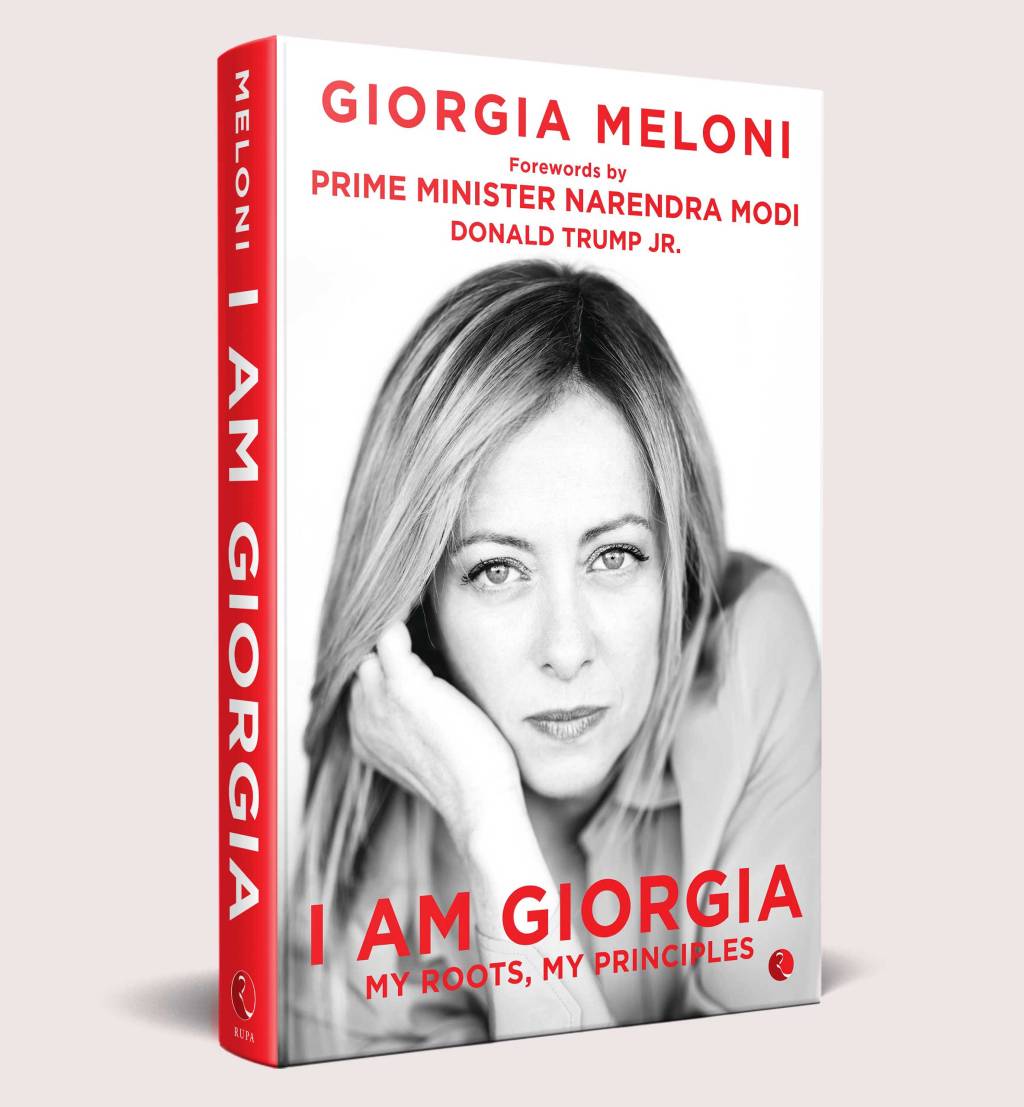
In I Am Giorgia: My Roots, My Principles, now available in India through Rupa Publications, Meloni tells her story in her own unmistakable voice — sharp, emotional, self-assured, and unapologetically personal. The book is part memoir, part political reflection, and part declaration of identity. It charts her rise from a modest Roman neighborhood to the corridors of power, chronicling how a self-described “short, fat, sullen, bullied girl” became one of Europe’s most formidable leaders.
From the Shadows to the Spotlight
Meloni’s childhood is painted with the tenderness and turbulence of survival. Her father left the family when she was young, a wound she admits never fully healed. Raised by her mother in a working-class neighborhood, Giorgia learned early what it meant to fight for space in a world that had already decided her limits. “Overcoming the expectations of those before me proved less challenging than I had expected,” she reflects. It is this defiance — this refusal to accept pity or privilege — that becomes the spine of her story.
In her teenage years, she found a sense of belonging in the youth wing of the post-fascist Movimento Sociale Italiano (MSI), a controversial choice that would shadow her for decades. Yet, Meloni reframes this chapter not as ideology but as initiation — the beginning of her belief in merit, identity, and hard work. She does not dwell much on the party’s extremist past, a silence that critics will find telling, but she articulates her guiding philosophy: “One is equal to one. No favoritism, no bias — how far you go depends solely on what you can prove.”
The Politics of Perseverance
Meloni’s writing style is brisk, vivid, and often humorous. She quotes Michael Jackson, references The Lord of the Rings, and confesses to learning English through pop culture. Between anecdotes and arguments, her voice carries the rhythm of someone who has spent her life speaking to crowds — and fighting to be heard.
She recounts how being a woman on the political Right in Italy often meant being doubly scrutinized: first for her gender, then for her ideology. “Whatever women do, they must do twice as well as men to be thought half as good. Luckily, this is not difficult,” she writes. It’s a line that sums up her fierce self-belief — and her subtle humor.
But what gives I Am Giorgia its heart is her account of becoming a mother while being in the public eye. When she announced her pregnancy in 2016, the news sparked a wave of online abuse and ridicule. Trolls mocked her, and some even wished her harm. “For the first time, I felt as though I had failed my very first mission as a mother,” she writes, revealing a rare vulnerability. Yet, amid the venom, she also remembers the kindness of strangers and the quiet solidarity of political rivals who sent her gifts and good wishes. It is in these moments that the politician fades, and the woman takes center stage — resilient, wounded, and remarkably human.
The Personal as Political
For all its emotional power, I Am Giorgia is not free from the trappings of political autobiography. It is, in parts, self-protective — even self-serving. Meloni sidesteps controversies that have followed her party, and personal details like her public breakup with journalist Andrea Giambruno are treated with polite brevity. Yet, what the book lacks in confession, it makes up for in conviction.
Meloni’s central argument — that the Right values merit over privilege — recurs like a refrain. She contrasts her own political journey with what she calls the “lip service feminism” of the Left, where women often rise as concessions rather than through competence. On the Right, she insists, “If women rise, it’s not because some man made it happen.” It’s a provocative statement, one that will certainly invite debate, but it also reflects the raw confidence that has carried her this far.
A Mirror to Modern Leadership
To read I Am Giorgia is to encounter a leader who is, above all, emotionally transparent. Meloni doesn’t pretend to be flawless. She admits to moments of doubt, anger, and exhaustion. Yet she refuses to see herself as a victim — a quality that explains her enduring appeal among supporters. “I’m used to being insulted — sometimes to such a degree that I’ve become immune to the nastiness — but not this time,” she writes, describing the vitriol she faced while pregnant.
At a time when global politics is saturated with cynicism, Meloni’s memoir feels strikingly personal. It is not an ideological manifesto; it is a testament to perseverance. Her story is, in many ways, the story of modern leadership — where conviction collides with criticism, and personal identity becomes a political battlefield.
There’s something undeniably compelling about her voice — part streetwise Roman, part stateswoman. She doesn’t try to please the reader; she argues, persuades, and occasionally provokes. And that makes her book, like her politics, impossible to ignore.
The Woman Behind the Power
By the time you close I Am Giorgia, you may still disagree with her politics — and that’s perfectly fine. But you will have glimpsed the human story behind the headlines: a woman who grew up without privilege, who faced scorn and stereotypes, who stumbled and stood tall again, and who eventually reached the highest office in her country.
Her journey, marked by contradictions and courage, reads like a case study in self-belief. “The real victory,” she seems to say between the lines, “is not in conquering others, but in mastering oneself.”
Verdict
I Am Giorgia: My Roots, My Principles is a bold and engaging memoir that blurs the line between the political and the personal. It is both an act of storytelling and self-definition — a manifesto in the language of memory. Meloni’s writing is clear, compelling, and unapologetically hers. You may not always agree with her, but you cannot help but listen.
A defiant, intimate portrait of a woman who refused to be reduced — and became the face of a new Italy.


 Bookshotsapp
Leave a comment