
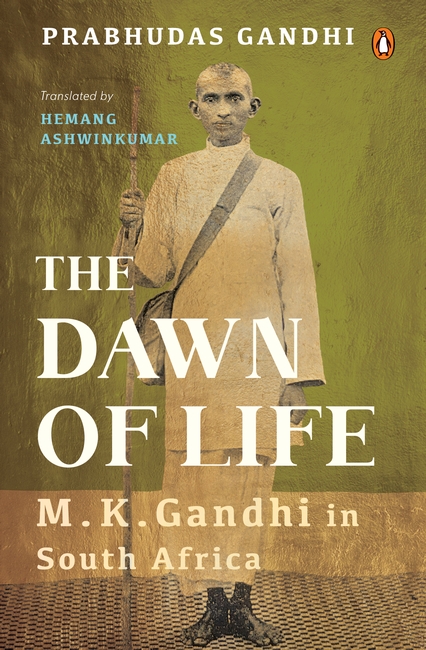
In the rich archive of Gandhian literature, The Dawn of Life arrives as a rare and revelatory gem—a memoir that illuminates the intimate, human side of Mahatma Gandhi before he became the Mahatma. Written in Gujarati by Prabhudas Gandhi, Gandhi’s nephew and one of the youngest members of his ashram circle in South Africa, and now translated into English for the first time by Hemang Ashwinkumar, this volume offers an unvarnished, child’s-eye view of a world in moral and spiritual formation.
The book transports readers to the Phoenix Settlement, the modest commune Gandhi founded near Durban in 1904. This was where the moral architecture of satyagraha—“holding on to Truth”—was first built, tested, and refined. Through Prabhudas’s recollections, we witness not the distant saint of history textbooks, but the deeply humane figure of “Bapuji,” a man of patience and laughter, whose life was a seamless blend of thought and action, principle and play.
Prabhudas began recording these memories in 1923 as a twelve-year-old editor of Madhpudo (“The Beehive”), a handwritten ashram journal run by students of Gandhi’s National School at Sabarmati. When his regular contributors were imprisoned or absorbed into the national movement, he began filling the pages himself—with stories of Phoenix: of Gandhi teaching by example, spinning, cooking, cleaning, and gently guiding children through lessons in self-restraint and service. What began as a stopgap effort soon evolved into a vivid chronicle of the early Gandhian experiment.
What makes The Dawn of Life remarkable is its unaffected simplicity and spiritual clarity. Prabhudas explicitly disavows any attempt at autobiography, claiming he was too young to write one; yet, in refusing self-importance, he achieves something greater. His narrative captures the innocence of a child who looks upon greatness without awe, seeing Gandhi not as a monumental leader but as a constant presence—disciplining, storytelling, teasing, and inspiring. There is something profoundly moving in this youthful gaze: it restores to Gandhi the ordinariness that history’s sanctification has often effaced.
Translator Hemang Ashwinkumar deserves high praise for the grace and precision of his work. His English prose flows with the rhythm of the original Gujarati, maintaining its humility and lyricism while subtly elucidating the cultural and historical nuances of the period. The translation succeeds not only as an act of linguistic fidelity but as a work of historical recovery, allowing English readers to access a forgotten yet foundational text in the evolution of Gandhian thought.
The framing essays in this edition—especially the reflective introduction situating the memoir within the broader discourse of “Truth” and its distortions in the modern age—further deepen the book’s contemporary resonance. In times rife with misinformation and moral confusion, The Dawn of Life stands as a quiet manifesto for authenticity, empathy, and non-violence. It reminds us that Gandhi’s greatest experiment was not with politics but with the human spirit—and that the earliest witnesses to that experiment were children like Prabhudas, who absorbed its essence through the daily rhythms of ashram life.
In sum, The Dawn of Life is both a literary rediscovery and a historical revelation—a chronicle of how the seeds of a moral revolution were sown in the soil of play, prayer, and perseverance. It restores to Gandhian history a voice that is tender, truthful, and profoundly illuminating.
Winner of the 2024–25 New India Foundation Translation Fellowship, this translation has been recognized for its literary excellence and its contribution to preserving and reinterpreting a vital strand of India’s intellectual and moral heritage.



 Bookshotsapp
Leave a comment