
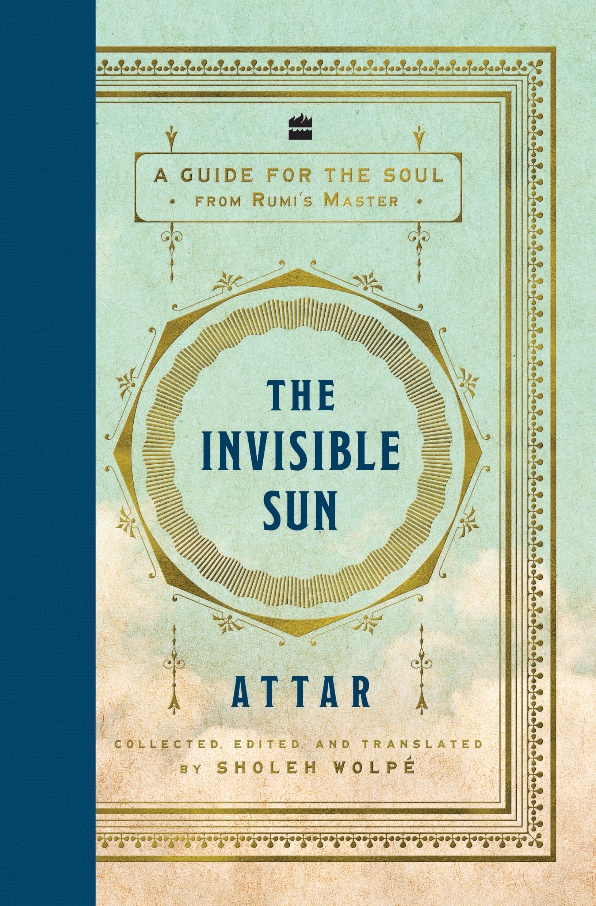
The Invisible Sun is a rare kind of book—one that reads like a gentle illumination rather than a lecture, a quiet companion for anyone willing to look inward. Attar (1145–1221), the 12th-century Persian Sufi mystic and poet, does not instruct readers on how to fix the world. Instead, he reminds us that the world is a reflection of our inner state, and true transformation begins within. In an age defined by ecological upheaval, social fragmentation, and personal disorientation, Attar’s verses feel startlingly contemporary, as if written for our precarious times.
Attar’s poetry weaves allegory, parable, and mystical insight into intricate patterns. He shows us that the ego—what Sufis call nafs—is the cyclone that keeps us from clarity. He urges us to “die before dying,” to surrender the false self, dissolve divisions, and awaken to a self that is neither superior nor separate but interconnected with all life. Consider this reflection:
“Both worlds, the upper and the lower, are but a drop of water, neither here nor there. When that droplet first appears, it is replete with reflections. But even if all those reflections were of iron, the hardest of metals, you could still shatter them back into water drops. Whatever has its foundation in water, be it fire, is nothing but illusion. When water itself is not stable, how can you use it as a firm foundation?”
Here, water—once symbolic, sacred, and elemental—is rendered unstable, mirroring the fragility of our own lives and the planet we inhabit. Attar’s words are more than metaphor; they are a lens for seeing the consequences of ego-driven choices, overexploitation, and human arrogance. They ask us: how can we build anything lasting if our own foundations are unstable?
Sholeh Wolpé’s translation brings Attar’s delicate, intricate Persian verse into luminous English, allowing readers to feel the spiritual heartbeat of the original while making the wisdom accessible and immediate. The poems are a masterclass in blending the mystical with the personal—they speak of love, longing, loss, and the search for the Divine, yet always return us to the self we inhabit every day.
The book is also deeply human. It doesn’t preach or dictate a moral code. Instead, it invites the reader into a dialogue with the soul, revealing the path through experience, vulnerability, and reflection. In doing so, Attar opens a space where personal transformation naturally flows into ecological and social consciousness. Reading these pages feels like touching a river—calm, powerful, and endless.
Here are a few excerpts that capture the essence of Attar’s vision:
“There is an invisible sun hiding inside us all. One day the veil falls away and that revealed sun shines. Discard your ego-self. Begin the journey.”
“If I worship you for fear of Hell, burn me in that same Inferno. If I worship you in hope of Heaven, ban my soul from Paradise. But if I worship you for You, lead me into your Eternal Presence.”
“Don’t pander to your ego. Don’t drag your precious soul through feces and filth. The key to unlock both worlds is love.”
These lines embody a radical humility, a surrender that does not weaken but awakens. They remind us that inner work—quiet, patient, and reflective—is the seed from which all meaningful action grows. In Attar’s vision, the healing of self, society, and the planet are inseparably intertwined.
The Invisible Sun is more than a book; it is a journey, a lamp, and a seed of transformation. It offers wisdom not as instruction but as inspiration, guiding readers to move through life with greater attention, reverence, and awareness. In a world increasingly defined by speed, distraction, and crisis, Attar’s poetry calls for stillness, reflection, and a deeper understanding of what it means to be truly alive.
If you are seeking a companion for self-reflection, a guide for navigating life’s inner and outer storms, or a window into the spiritual riches of Persian Sufism, The Invisible Sun is an essential read. Its light is subtle but enduring, capable of illuminating both the personal journey and our collective responsibility toward the world. Open it, and let the invisible sun shine within.
Among the luminous passages are:
“There is an invisible sun hiding inside us all. One day the veil falls away and that revealed sun shines. Why do you search for the Creator’s address? There is no map, no direction. Discard your ego-self. Begin the journey.”
“If I worship you for fear of Hell, burn me in that same Inferno. If I worship you in hope of Heaven, ban my soul from Paradise. But if I worship you for You, lead me into your Eternal Presence.”
“The key to unlock both worlds is love. Everything, large and small, honors your existence. Don’t look at yourself with contempt. There is nothing greater than you.”
“If your head is tipsy and your heart aflame, if you are drunk and senseless with the wine of longing, how could you be satisfied with just one sip of anything? Find the source where wine flows and never runs out.”
The Invisible Sun is more than a book; it is a companion for inner transformation. In an era dominated by distraction, greed, and environmental devastation, it offers a path toward awakening, humility, and reverence—for ourselves, for each other, and for the planet. Attar does not promise an easy journey, but he lights a lamp along the way, reminding readers that the most radical act is the cultivation of love, awareness, and inner clarity.
For seekers of wisdom, lovers of poetry, or anyone yearning to navigate the turbulence of modern life with grace, The Invisible Sun is indispensable—a mystical guide for personal and planetary healing.



 Bookshotsapp
Leave a comment