
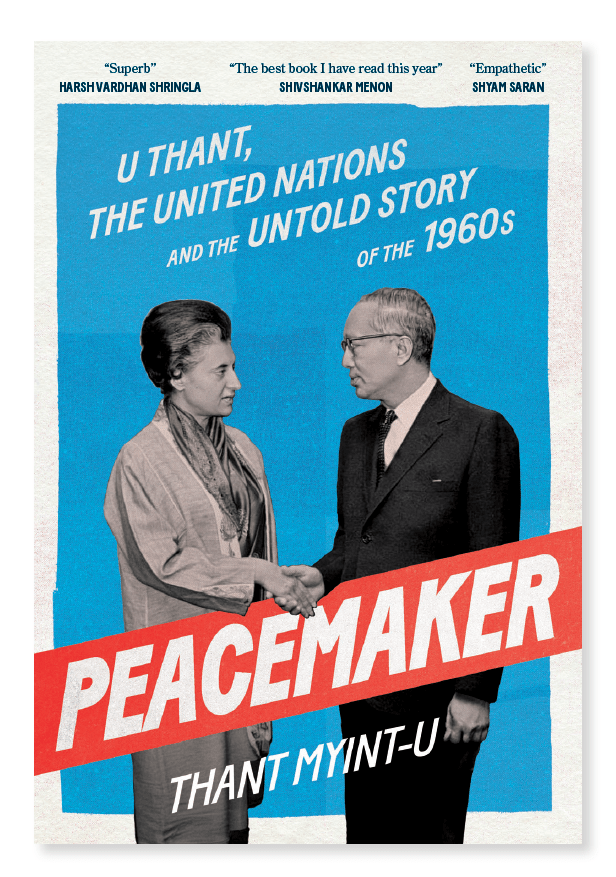
In Peacemaker, historian Thant Myint-U opens a long-shut door to one of the most consequential yet overlooked figures of the twentieth century—U Thant, the soft-spoken Burmese schoolteacher who unexpectedly became the world’s most powerful diplomat. In the turbulent decade of the 1960s, when the Cold War threatened to tear the planet apart, U Thant quietly worked behind the scenes to hold it together. This book restores him to the centre of history.
The narrative begins with a striking scene: John Lennon and Yoko Ono turning up uninvited at a farewell lunch for U Thant in New York in 1971. It is a reminder of how widely admired he once was—by politicians, artists, activists and global thinkers who saw in him a rare moral force in international affairs. Linus Pauling called him “one of the greatest men of the Twentieth Century.” Joan Baez sent him “love and gratitude.” The roster of well-wishers—from Coretta Scott King and Leonard Bernstein to Buckminster Fuller and the Dalai Lama—captures the aura he carried as the world’s conscience.
Yet, as the author makes clear, his legacy has faded. Peacemaker sets out to correct that.
The opening chapter, “New World,” shows a man caught between two lives: the modest Burmese headmaster who once ate fish soup for breakfast, and the global statesman now listening to crackling radio reports of Soviet nuclear tests from a Manhattan apartment. The contrast is vivid, and Myint-U uses it to great effect. U Thant’s journey is not that of a career diplomat but of a self-taught intellectual who steadily, almost reluctantly, stepped into global leadership.
The book’s strength lies in how it blends newly declassified documents with personal memory. It takes us inside the Congo crisis, the Cuban Missile Crisis, the grinding frustrations of Vietnam, and the painful slide to the 1967 Six-Day War. Myint-U portrays U Thant as a man who believed in dialogue even when the world seemed determined to ignore him. He emerges as a principled internationalist—calm, stubbornly hopeful, and guided by a Buddhist ethic of humility and compassion.
But this is not a hagiography. The author also shows the limits of idealism: U Thant’s struggles with superpower arrogance, his exasperation with American militarism, and his heartbreak as peace efforts repeatedly collapsed. The narrative is full of missed chances and roads not taken.
By the time the story reaches U Thant’s farewell in 1971—with Pete Seeger leading the room in song and dignitaries queuing for a final word—the reader understands the weight he carried and the loneliness of the job. His warning that the world must develop a “second loyalty” beyond patriotism feels painfully relevant today.
Peacemaker is ultimately a portrait of a forgotten moment when global cooperation seemed not only possible but imminent. It reminds us that individuals, even quiet ones, can alter the trajectory of history. In revisiting U Thant’s life, Thant Myint-U offers both a tribute and a challenge: to re-imagine diplomacy with courage, humanity, and moral clarity.
A moving, deeply researched and unexpectedly urgent book.
 Bookshotsapp
Leave a comment