
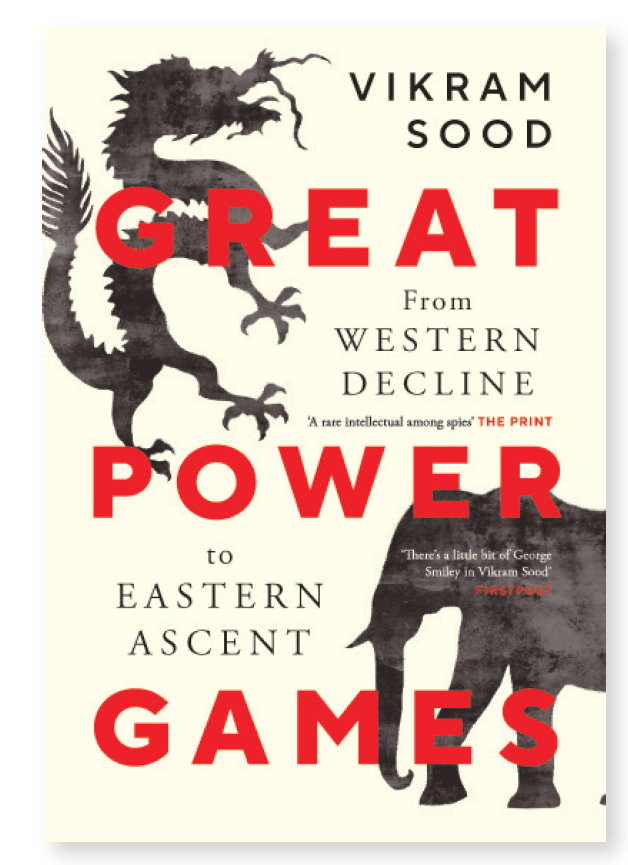
In Great Power Games, former RAW chief Vikram Sood offers something rare in India’s strategic literature: a book that refuses to flatter, refuses to moralise, and refuses to pretend that nations are noble actors. Instead, Sood strips geopolitics to its bones. What remains is a world governed by appetite, insecurity, and the relentless pursuit of dominance.
He begins with Carl Sagan’s poetic lament on the “pale blue dot” — only to swiftly remind us how, on that fragile speck, empires have slaughtered millions for fleeting glory. This tension between human insignificance and human vanity runs through the book. Sood’s tone is unsentimental, even cold at times, but never shallow. He writes like someone who has seen how power truly works, and is tired of others seeing it as a morality play.
A World in Freefall
Sood’s central insight is startling in its clarity:
If the Cold War was a contest between two superpowers, the present era is a contest between collapsing empires and rising ones — all operating inside an increasingly chaotic global system.
In his telling, the United States is no longer the unchallenged giant. It is a wounded hegemon, still powerful but unsure, still feared but no longer obeyed. China is the restless contender, unapologetic about its ambitions. Russia is the old imperial soul trying to claw back relevance. And Europe? Forever caught between anxiety and helplessness.
The brilliance of the book is how it explains this transition through fields far beyond diplomacy — philanthropy, media, weapon sales, supply chains, surveillance, culture, sanctions, even “development aid.” Power, Sood argues, is no longer just tanks and treaties. It is persuasion, narrative capture and economic pressure wrapped in benevolent language.
The Machinery of Manipulation
Some of the strongest chapters are those in which Sood details how “soft power” is engineered. Western foundations funding intellectuals in developing countries. Think tanks designing acceptable worldviews. Media creating heroes and villains. Allies being rewarded; dissenters disciplined.
He makes a provocative point:
The man carrying a smile and a grant proposal can often be more dangerous than the man carrying a gun.
This is the kind of insight that comes from intelligence work rather than academic theorising — and it shows.
His critique of Western liberal hypocrisy is sharp. He outlines how the US has often preferred compliant autocrats over noisy democracies, how it weaponises treaties and abandons them when convenient, and how it plays both sides in South Asia to keep India perpetually cautious.
India at the Crossroads
It is when Sood turns to India that the book gathers emotional force. He warns against naïve assumptions of friendship, against expecting the West to cheer India’s rise, and against underestimating China’s strategic patience.
The most arresting argument is blunt:
India has only one path to security in this century — to become a power in its own right.
Not an appendage. Not a junior partner. Not a balance-keeper. A power.
He is deeply wary of India being intellectually moulded by Western commentary, NGO networks, tech monopolies, or think tanks that profess friendship while cultivating dependency. “Judge every country,” he argues, “by how its actions affect Indian interests, not by how it speaks.”
The Gathering Storm
The book suggests that the coming decades will see:
- shrinking Western dominance,
- sharpening US–China rivalry,
- a more assertive Russia,
- rising Islamic radicalism,
- climate-driven instability, and
- technological warfare operating in silence.
In this setting, India must avoid being a pawn in someone else’s game. It must resist intellectual capture, build internal resilience, shore up defence and technology, and pursue a foreign policy that is unapologetically interest-driven.
A Hard Book—But a Necessary One
Great Power Games is not diplomatic literature. It is strategic literature. The prose is sharp, the warnings direct, and the worldview deeply sceptical. Some readers may bristle at Sood’s cynicism or see conspiratorial overreach in parts. But even his most pessimistic insights force the reader to interrogate comforting illusions.
What stands out is the book’s complete refusal to infantilise India. Sood treats India not as a victim of history but as a potential shaper of it. A gripping, densely argued and intellectually provocative exploration of global power. Vikram Sood writes with the cool detachment of an intelligence officer and the urgency of a patriot worried about a storm approaching.


 Bookshotsapp
Leave a comment