
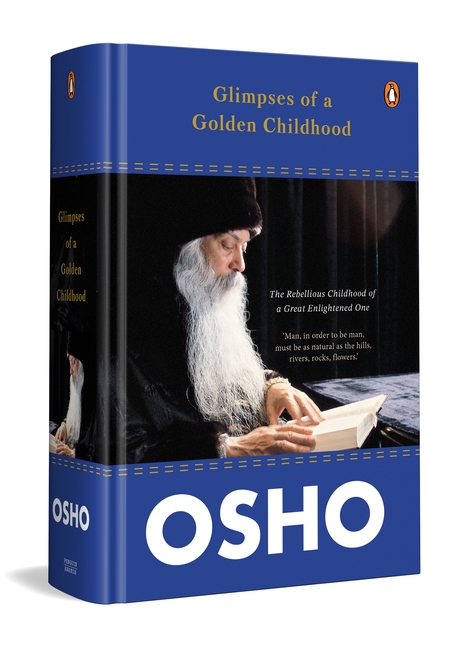
Osho’s Glimpses of a Golden Childhood unfolds as a layered meditation on childhood, conditioning, rebellion, and the pure encounter with life. Drawn entirely from spoken discourses—delivered extemporaneously, often in the unusual setting of a dental chair—the book captures the raw, unfiltered vibrancy of Osho’s voice. It is less a traditional autobiography and more a philosophical reflection on the roots of human behaviour, the subtle violence of social conditioning, and the lingering spark of innocence that survives beneath layers of seriousness.
Childhood: A Site of Control and Suppression
The core argument emerges clearly: society rewards obedience and punishes playfulness. Osho points out that an obedient child becomes the delight of parents and teachers precisely because he causes no disruption. His compliance is seen as virtue, his silence as discipline. By contrast, a playful child—though harmless—is viewed with suspicion. His curiosity and freedom signal potential danger: the danger of becoming a rebel.
This fear of rebellion is woven deeply into social expectations. If a child’s natural playfulness is allowed to flower, it may evolve into a kind of independence that resists imposed structures. A rebellious child will inevitably grow into a rebellious young person, one who refuses to be forced into a conventional marriage, a prescribed career, or the unfulfilled dreams of parents. He cannot be compelled to accept ideals chosen by others. His life unfolds from his own inmost impulses.
Thus, playfulness is not merely discouraged; it is deliberately crushed. Society, Osho argues, fears the authentic person—for such a person cannot be easily manipulated, enlisted, or made to obey.
The Psychology of Control
Behind this suppression lies a deeper psychological sickness: the human impulse to control and to be controlled. To dominate others brings a sense of egoic power; to be dominated relieves one of responsibility. This mutual pathology fuels a world where spontaneity is stifled from the very beginning. The very things that make a child alive—imagination, laughter, curiosity—are subdued so thoroughly that, over time, we carry within us what Osho calls a “dead child.”
This inner deadness manifests in the loss of humour. When the child within is silenced, adults find themselves incapable of laughing wholeheartedly or enjoying life’s small wonders. They become weighed down by seriousness. Rather than expanding, their lives narrow and shrink.
Seriousness as a Cultural Habit
In one of his striking observations, Osho considers Christianity’s global dominance. He attributes its spread to its image of the crucified Jesus: solemn, sorrowful, and burdened with suffering. People, recognizing their own inner seriousness and sadness, identify with this figure. In this resonance, Christianity grows.
Osho’s vision stands in sharp contrast. He dreams of places of worship—churches, temples, mosques, synagogues—filled with laughter, play, and joy. Only such a transformation, he suggests, can lead humanity toward a healthier and more integrated inner life.
The Fear of Losing Control
A central question is addressed directly: why do we suppress the vibrant child within us? The answer is rooted entirely in conditioning. From early childhood, we are instructed to maintain control, to act with discipline, to defer to elders and authorities who claim to know what is best. In this rigid framework, the spontaneous child is seen as a threat. Over time, the inner child is not just neglected—it is killed.
Osho’s message is simple yet piercing: when we silence the child, we silence our capacity for joy, play, ecstasy, and openness. Life becomes a burden carried with grim seriousness.
A Note on Language: The Spoken Origin
The book also contains a section explaining how these teachings were delivered. Osho’s words are not crafted from written manuscripts but transcribed from live talks. His editors have deliberately preserved the spoken quality—its flow, rhythm, and spontaneity. When he uses pronouns like “he,” it reflects the ease of speech, not exclusion. He clarifies that meditation reveals consciousness beyond gender; in deep awareness, one is neither male nor female.
Encountering the Present
The book opens with a luminous description of morning—a sunrise fresh and new each day. Although scientists claim the sun is millions of years old, Osho insists that each dawn appears young, untouched by time. To him, existence renews itself constantly. Only the grave seriousness of scientific thought insists on its antiquity.
This leads to a profound reflection on the word “encounter.” To encounter life is to meet each moment as it is—without modification, without judgement, without editing. A mirror becomes his metaphor: it reflects precisely what appears before it, without destroying or beautifying it. In this purity of reflection lies true perception.
Just before entering the room where these sessions were recorded—referred to as Noah’s Ark—Osho pauses to absorb the sunrise. Its beauty pulls him entirely into the present. He recalls the teaching of Jesus: “Think not of the morrow.” Tomorrow is an illusion; what exists, and what matters, is the radiance of this moment.
Preserving the Living Voice
The concluding notes emphasize that these talks were never meant to be static text. They were delivered spontaneously, without notes, in the immediacy of interaction. The editors’ task was not to rewrite but to capture the tone, rhythm, and authenticity of the spoken word. The result is a book that feels alive—fluid, conversational, and deeply personal.
Glimpses of a Golden Childhood is a contemplative, penetrating journey into the psychology of childhood, the mechanisms of conditioning, and the lost art of living spontaneously. Osho uses his own memories not as narrative episodes but as lenses through which to understand human nature. The book reveals how obedience deadens the spirit, how society moulds children into controlled adults, and how the miracle of the present moment remains available only to those who rediscover the playful, curious child within.



 Bookshotsapp
Leave a comment