
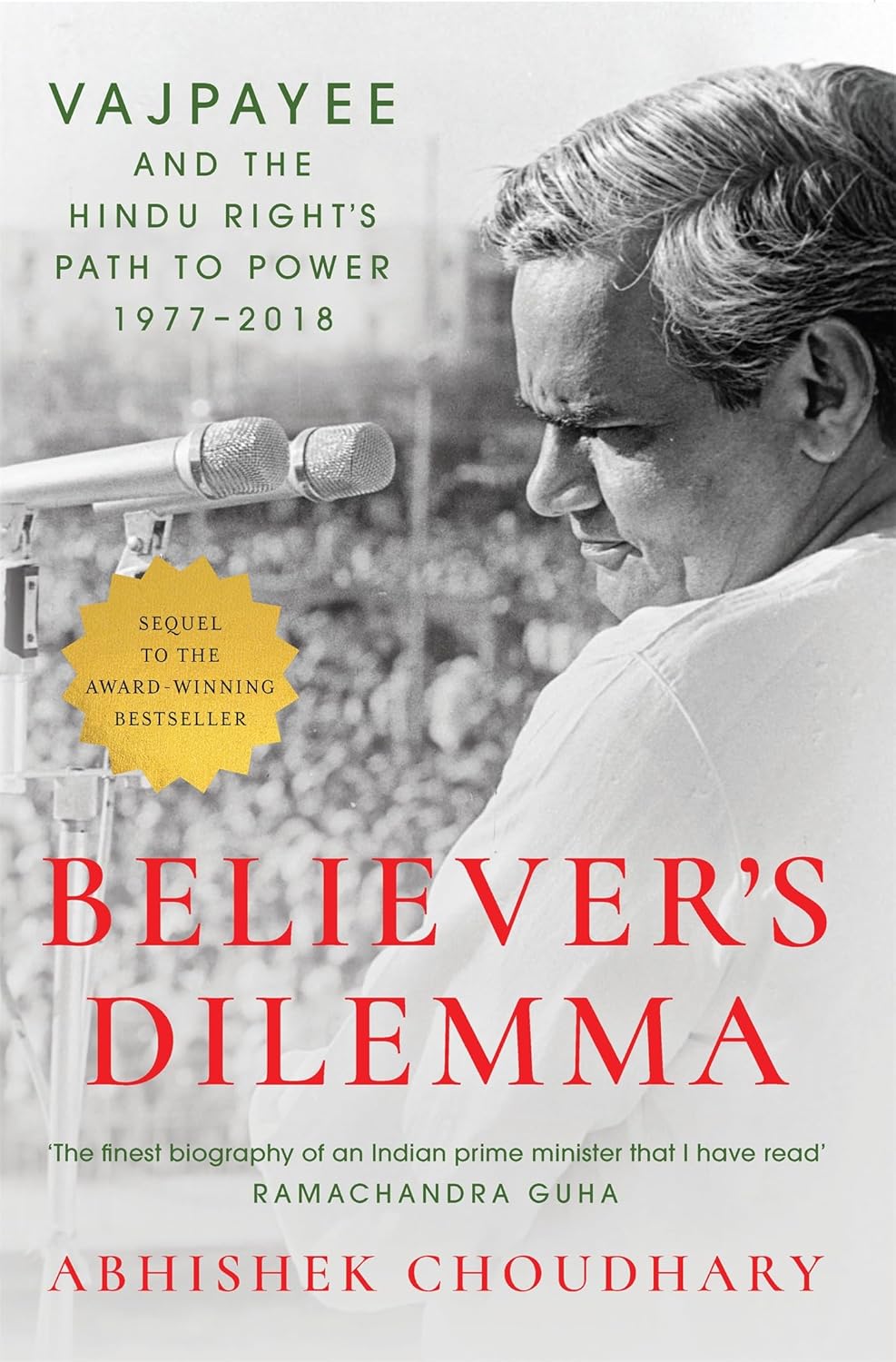
In the annals of modern Indian political history, few figures loom as enigmatically and consequentially as Atal Bihari Vajpayee (1924–2018). Charismatic yet inscrutable, eloquent yet occasionally elusive, Vajpayee straddled the treacherous terrains of ideology, coalition politics, and national leadership with a blend of psychological dexterity and moral pragmatism that few could emulate. Abhishek Choudhary’s two-volume biography—Vajpayee: The Ascent of the Hindu Right, 1924–1977 and Believer’s Dilemma: Vajpayee and the Hindu Right’s Path to Power, 1977–2018—is nothing short of a monumental scholarly achievement, a work that seeks to chart the life of India’s first non-Congress Prime Minister to complete a full term while simultaneously tracing the evolution of the Hindu nationalist movement he helped mainstream.
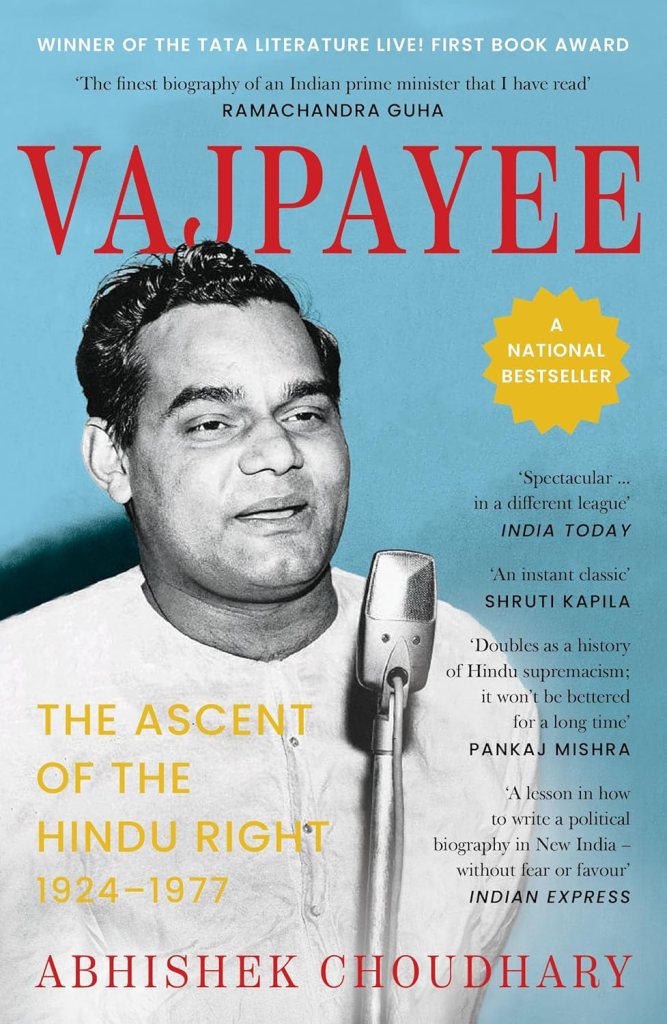
Choudhary’s magisterial study is remarkable in its scope and ambition. It is not merely a chronological account of Vajpayee’s life; it is an exploration of the man’s psyche, the ideologies he navigated, the political institutions he transformed, and the moral and intellectual contradictions that defined both his personal character and the Hindu Right itself. Drawing from newly unearthed archival materials, interviews with contemporaries, and exhaustive primary research, Choudhary refuses to sanitize or romanticize his subject. Vajpayee emerges as a man of extraordinary gifts—an orator, a poet, a parliamentarian of rare intelligence—but also as a figure marked by ideological dualities, strategic compromises, and the subtle moral hazards of coalition politics.
The Formative Years: A Hindu Soul Ripens (1924–1953)
The first volume, The Ascent of the Hindu Right, takes the reader to Bateshwar, a small town near Agra, often misrepresented in popular biographies as Gwalior, where Vajpayee was born the fifth of seven children. Here, Choudhary situates his early life within the socio-cultural milieu of the Hindi heartland, a crucible of conservative Brahmin values, historical imagination, and nationalist aspiration. The young Vajpayee, academically unremarkable but prodigious in opinion writing, absorbed the historical narratives of Maharana Pratap (Pratap Pratigya) and Rani Laxmibai (Jhansi ki Rani), developing a psychological framework steeped in the ideas of Hindu resilience, heroism, and struggle. These narratives, as Choudhary insightfully observes, shaped Vajpayee’s understanding of the past as not a chronicle of defeat under foreign rule, but as a series of intermittent victories and persistent resistance—a vision that would underpin his later political imagination.
From these early years emerges a Vajpayee who is essentially conservative yet quietly ambitious, detached yet deeply invested in ideological coherence. His antipathy to Gandhi, meticulously documented, reflects the tension between his emerging Hindu nationalist worldview and the Congress’ vision of inclusive, non-communal politics. Gandhi’s skepticism of the RSS as a “private army” is juxtaposed against Vallabhbhai Patel’s pragmatic view, who saw the potential to co-opt Hindu nationalist energies for political ends. Choudhary captures the fluidity of these early political alignments, portraying the “porous boundaries” between the Congress, the Hindu Mahasabha, and the RSS, and the strategic maneuverings that would shape the first decades of independent India.
Vajpayee’s intellectual and political maturation is further catalyzed by his relationships with Shyama Prasad Mookerjee and Deendayal Upadhyaya, two towering figures of the Hindu Right. Appointed as Mookerjee’s private secretary in 1953, Vajpayee plunged into organizational politics, navigating the complexities of party-building and electoral strategy. Mookerjee’s sudden death in Kashmir, and later Upadhyaya’s tragic demise under ambiguous circumstances, left indelible marks on Vajpayee’s personal and political psyche. Choudhary captures these episodes with sensitivity, highlighting how personal loss intertwined with political apprenticeship to mold a leader capable of both loyalty and strategic foresight.
The Jan Sangh, Parliament, and the Emergence of the Hindu Right (1953–1977)
As Vajpayee emerged from the shadow of his mentors, he became a defining figure in the Jana Sangh, an organization rooted in the RSS’s ideology. Choudhary meticulously charts the party’s evolution, situating Vajpayee’s growth alongside broader political currents: the Congress’ internal debates, Patel’s pragmatic conservatism, Nehru’s idealism, and the gradual coalescence of Hindu nationalist identity as a political force.
In Parliament, Vajpayee distinguished himself early on, mastering rhetoric, debate, and institutional engagement. Choudhary’s reconstruction of Vajpayee’s parliamentary interventions is particularly illuminating, revealing a man committed to the norms and procedures of governance, yet unafraid to challenge seasoned leaders such as Nehru. These early encounters reveal a critical dimension of Vajpayee’s genius: his ability to navigate ideological differences without sacrificing strategic advantage, to maintain personal integrity while engaging in tactical compromise—a skill that would define his political career.
The biography’s treatment of this period also emphasizes the ideological tensions that defined the Hindu Right. Choudhary revisits myths surrounding Vajpayee’s moderation, illustrating how his commitment to Hindu nationalism coexisted with a conciliatory approach to parliamentary politics. The narrative dispels the misleading trope of Vajpayee as the “right man in the wrong party,” instead presenting him as the right man in the right party, whose leadership and vision gradually mainstreamed the Jana Sangh into what would become the BJP.
Believer’s Dilemma: Navigating Power and Ideology (1977–2018)
The second volume, Believer’s Dilemma, carries the narrative into the post-Emergency era, chronicling Vajpayee’s rise within the Janata government, the formation of the BJP, and his eventual tenure as Prime Minister. Here, Choudhary’s narrative gains additional layers of psychological and political complexity, tracing how Vajpayee negotiated the competing imperatives of loyalty to the Sangh Parivar, coalition management, and the ethical demands of democratic governance.
Vajpayee’s tenure as foreign minister (1977–1979) and later as Prime Minister (1998–2004) is depicted with both nuance and critical insight. Choudhary emphasizes Vajpayee’s pragmatism in foreign affairs—his management of relations with Pakistan and China, the calculated decision to conduct nuclear tests, and the balancing act required in navigating a coalition of thirteen parties. Yet, the biography does not shy away from Vajpayee’s moral compromises. His inaction during the 2002 Gujarat riots and reluctance to confront rising hardline elements within the BJP and Sangh Parivar illustrate the tensions inherent in his ideological dualism. Vajpayee’s legacy, Choudhary suggests, is inseparable from these tensions: the capacity to reconcile Hindu nationalist ambitions with democratic norms, while occasionally yielding to political expediency.
A particularly striking contribution of Believer’s Dilemma is its exploration of the psychological underpinnings of the Hindu Right. By situating Vajpayee’s ideological commitments within his personal history, literary influences, and early political experiences, Choudhary illuminates the imagination, anxieties, and neuroses that have shaped Hindu nationalist thought in modern India. The biography demonstrates how these forces, both personal and collective, have left an enduring imprint on India’s political culture.
A Psychological Portrait of Leadership
What sets Choudhary’s work apart from conventional political biographies is its insistence on the psychological dimension of leadership. Vajpayee emerges not as a static archetype but as a dynamic, multi-faceted figure—an enigma whose eloquence, empathy, and moral vision were inseparable from ambition, ideological loyalty, and tactical calculation. Choudhary’s narrative demonstrates how Vajpayee’s charm and intellect enabled him to navigate complex coalition politics, maintain party unity, and manage international crises. At the same time, the biography critically examines the limitations of his leadership, highlighting moments where ideological fidelity conflicted with the demands of governance or the imperatives of justice.
The work also provides invaluable insights into the formation of the BJP as a modern electoral machine. Choudhary traces the party’s transformation from a marginal, ideologically rigid organization into a mainstream political force capable of national governance—a process in which Vajpayee’s moderation, rhetorical skill, and strategic acumen played a decisive role. The biography thus serves not only as a portrait of an individual leader but also as a history of a political movement that has reshaped the Indian state.
A Landmark Contribution
Abhishek Choudhary’s two-volume biography of Atal Bihari Vajpayee is a rare achievement: an authoritative political history, a penetrating psychological study, and a corrective to myths and half-truths that have long dominated popular narratives about the Hindu Right. It captures the dualities, contradictions, and moral complexities of a man whose leadership transformed Indian politics and whose personality continues to influence public life.
Vajpayee is presented as both a product and a shaper of the Hindu Right—a figure whose charisma, intellect, and strategic insight brought a marginalized ideological movement into the mainstream while negotiating the competing demands of democracy, governance, and coalition politics. Through Choudhary’s meticulous research and eloquent prose, readers gain not only a deep understanding of Vajpayee as a political actor but also a broader comprehension of the evolution of Hindu nationalism in India.
In its synthesis of political history, personal biography, and psychological insight, Vajpayee: The Ascent of the Hindu Right and Believer’s Dilemma set a new standard for scholarly biography in India. These works are indispensable for historians, political scientists, journalists, and anyone seeking to understand the complex interplay of ideology, leadership, and democracy in modern India. In capturing the genius, contradictions, and moral dilemmas of Atal Bihari Vajpayee, Choudhary has delivered a definitive, unputdownable, and profoundly illuminating account—a biography that will endure as the standard reference for decades to come.



 Bookshotsapp
Leave a comment