
From powerful political commentary and spiritual inquiry to intimate storytelling and practical self-help, this season’s list brings together a diverse range of voices and subjects. These titles explore history, identity, resilience, leadership, philosophy and personal transformation — offering readers fresh perspectives, original research and compelling narratives across both fiction and non-fiction.
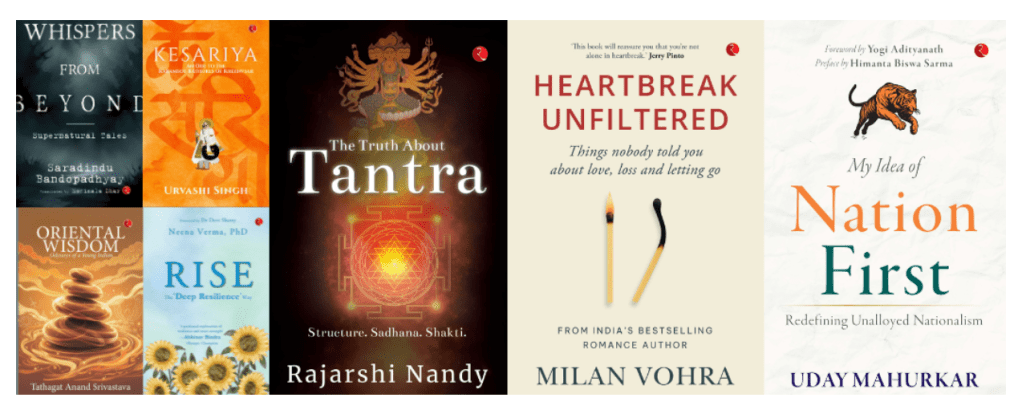
📌 My Idea of Nation First: Redefining Unalloyed Nationalism — Uday Mahurkar
Veteran journalist Uday Mahurkar returns with a fiery nationalist perspective in My Idea of Nation First, arguing that post-Independence politics suffered deeply from decades of minority appeasement. The book combines historical interpretation with sharp political commentary, examining contested issues—from Ayodhya and distorted historiography to ideological propaganda. Mahurkar makes a case for what he calls “unalloyed nationalism,” offering a strong defence of Savarkar’s thought while arguing for a balanced, moderate engagement with minority communities.
📌 Heartbreak Unfiltered: Things Nobody Told You About Love, Loss and Letting Go — Milan Vohra
India’s bestselling romance author Milan Vohra pivots to non-fiction with an intimate, story-driven exploration of heartbreak. In Heartbreak Unfiltered, she gathers 20 raw and relatable narratives from around the world to show how people navigate abandonment, betrayal, ghosting and grief. With warmth, humour and clarity, Vohra turns emotional recovery into a practical, human manual — offering both catharsis and a roadmap for letting go when relationships don’t end well.
📌 The Man Who Saw Tomorrow: The Untold Story of N.J. Yasaswy, The Founder of ICFAI — Pattabhi Ram & Sudhakar Rao
A sweeping biography of an institution builder who reshaped Indian education, The Man Who Saw Tomorrow charts the life and ideas of N.J. Yasaswy — long before private universities became mainstream. The book documents how Yasaswy’s vision led to ICFAI’s nationwide presence across business, law, tech and pharma schools. Authors Pattabhi Ram and Sudhakar Rao combine reportage, personal accounts and organisational history to offer a case study in leadership, persuasion and long-term transformation in higher education.
📌 The Decline of Hindu Civilization: Lessons from the Past — Shashi Ranjan Kumar
Civil servant and author Shashi Ranjan Kumar examines the historical arc of Hindu civilisation — from intellectual heights to cultural vulnerability. The Decline of Hindu Civilization asks difficult questions: Was decay driven by external invasions, internal stagnation, social rigidity or philosophical exhaustion? Combining comparative research with accessible analysis, the book seeks patterns in political, social and religious shifts, arguing that learning from history is essential to shaping a resilient future.
📌 Kesariya: An Ode to the Karamsot Rathores of Kheenvsar — Urvashi Singh
In Kesariya, Urvashi Singh presents a richly detailed account of one of Marwar’s most enduring Rajput lineages — tracing twenty-one generations of the Karamsot Rathores. From Rao Jodha’s legacy to the founding of Kheenvsar, the book blends history, heritage and family narrative. Singh, herself a descendant of this royal line, combines archival storytelling with cultural memory, making the story accessible to general readers and history enthusiasts alike.
📌 The Truth About Tantra: Structure. Sadhana. Shakti. — Rajarshi Nandy
Tantra is often misunderstood, sensationalised or reduced to stereotype. Rajarshi Nandy, a practitioner rooted in the Kaula lineage of Kamakhya, offers a corrective in The Truth About Tantra. He goes beyond myth and taboo, revealing Tantra as a lived philosophy built on disciplined awareness, ritual practice and embodied experience. Written in clear, accessible language, the book serves as an introduction for serious spiritual seekers.
📌 RISE: The ‘Deep Resilience’ Way — Neena Verma, PhD
Leadership specialist and resilience coach Dr Neena Verma redefines what it means to endure hardship in RISE: The ‘Deep Resilience’ Way. Moving beyond clichés of “bouncing back,” the book introduces original frameworks — including a “resilience mindset” and “deep resilience.” Using science, lived experience and practical tools, Verma provides guidance on cultivating inner strength in times of grief, disruption and emotional turbulence.
📌 The Eternal Sun: The Legacy of Surya Deva — Shalini Modi
Drawing on Vedic hymns, Puranic lore and astrological symbolism, Shalini Modi explores the mythological and philosophical presence of Surya Deva in Hindu thought. The Eternal Sun examines the Sun god’s role as healer, teacher and divine witness, narrating stories that connect ancient cosmology to contemporary spiritual practice. A blend of research, narrative interpretation and devotional culture, it invites readers to rediscover India’s oldest solar traditions.
📌 Whispers from Beyond: Supernatural Tales — Saradindu Bandopadhyay (Tr. Monimala Dhar)
Best known for Byomkesh Bakshi, Saradindu Bandopadhyay’s supernatural fiction reveals a different side of his literary talent. Whispers from Beyond is a collection of eerie, atmospheric stories where ghosts, guilt and unseen forces disrupt everyday life. Translator Monimala Dhar brings Bandopadhyay’s prose to a new readership, preserving the mystery and psychological depth of his original Bengali tales.
📌 Oriental Wisdom: Odysseys of a Young Indian — Tathagat Anand Srivastava
Written by a class XII student and already his third book, Oriental Wisdom is a travel-cum-learning narrative that turns a family vacation across Southeast Asia into a meditation on cultures, languages and human connection. With youthful energy and curiosity, Tathagat Anand Srivastava describes what travel teaches beyond textbooks — empathy, awareness and shared humanity.
📌 The Power of Saying No!: Why Really Successful People Say No to Almost Everything — Ashutosh Garg
Entrepreneur and management expert Ashutosh Garg delivers a sharp, actionable guide to one of the most underrated skills in professional life — saying no. The Power of Saying No! outlines why boundaries matter in a world driven by endless demands and constant hustle. Packed with examples and psychological insight, the book argues that protecting one’s time is key to both success and wellbeing.
📌 Corporate Hostages: Roads to Captivity, Paths to Liberation — Dr. N. Raj Mohan
Dr. N. Raj Mohan uses four decades of coaching and organisational experience to unravel a quiet crisis in Indian corporate life — emotional captivity at work. Corporate Hostages mixes narrative accounts with philosophical perspective, drawing inspiration from Buddhist teachings to offer ways out of professional burnout, fear-based loyalty and stagnation. It is equal parts reflection and self-help for working professionals.


 Bookshotsapp
Leave a comment