
Vikram Sampath’s monumental new work on Tipu Sultan enters a historical landscape cluttered with noise, nostalgia, and politically charged myths. Few figures in Indian history evoke such visceral reactions as Tipu—the “Tiger of Mysore” to some, a bigoted tyrant to others. Between these extremes lies an era that has long begged for a rigorous, evidence-driven, unemotional re-examination. With this prodigious tome, Sampath attempts exactly that, and does so with remarkable authority.
A Historical Battlefield More Than a Biography
What immediately sets this book apart is its ambition. Sampath doesn’t simply narrate Tipu’s life; he reconstructs the entire theatre of Mysore’s 18th-century upheaval—the fall of the Wodeyars, the rise of Haider Ali, the emergence of Mysore as a formidable military power, and the brittle alliances that shaped South India’s destiny. Tipu appears not as an isolated protagonist but as a product of a deeply turbulent, fractured political era.
The decision to devote nearly half the book to Haider Ali is not just contextual; it is structural. Haider’s ascent—from a soldier of modest origins to the de facto ruler of Mysore—is shown as the foundation upon which Tipu’s world was built. Sampath draws a sharp contrast between father and son: Haider’s pragmatic ruthlessness versus Tipu’s ideological zeal; Haider’s instinctive diplomacy versus Tipu’s rigid religiosity.
This framing is one of the book’s greatest strengths. It reminds the reader that Tipu’s story begins long before Tipu.
Tipu Sultan: The Man Behind the Myth
Tipu Sultan has always been the subject of extreme simplification. Sampath’s study insists on resisting this flattening.
His Tipu is neither a proto-nationalist freedom fighter nor merely a barbarous villain. Instead, he is portrayed as a man shaped by his upbringing—a ruler whose world was defined by warfare, religious certitude, and a perpetual sense of existential threat.
One of the book’s defining themes is the role of faith in Tipu’s governance. Sampath traces how Tipu’s early, structured Islamic education, and the influence of clerics in his life, coloured every aspect of his rule—from military campaigns to taxation policies, from temple destruction to conversion drives.
This is not presented as ideological accusation, but as historical documentation through letters, administrative records, and contemporary accounts.
Tipu’s establishment of a theocratic state (Sarkar-e-Khudadad), his renaming of places and calendar systems, and his direct appeals to Islamic authorities abroad (including the Ottoman Caliph and Afghan rulers) offer evidence of a ruler whose conception of power was inseparable from faith.
The Atrocities and Their Context
Sampath does not shy away from chronicling the violence associated with Tipu’s rule, especially in Coorg, Malabar, Mangalore, and parts of Karnataka. These episodes—mass conversions, destruction of temples and churches, harsh reprisals against rebels, the infamous massacre of Mandyam Iyengars—are disturbing, but the narrative avoids sensationalism.
Instead, Sampath presents each event meticulously, with citations and cross-references, allowing the brutality to speak for itself.
Yet the book is not a catalogue of horrors. It also highlights instances where Tipu repaired temples, supported the Sringeri Math, or took pragmatic steps to retain support among non-Muslim subjects. But Sampath maintains that these acts were largely political calculations, not evidence of consistent tolerance.
The complexity is acknowledged, but the pattern remains clear.
War as a Way of Life
Perhaps the most gripping portions of the book are the vivid descriptions of the four Anglo-Mysore Wars. These are not dry military accounts; they are sweeping, cinematic reconstructions of strategy, alliances, betrayals, battlefield innovation, and human cost.
Sampath brings to life a world where India’s destiny was being reshaped by Marathas, Nizam, Europeans, and Indian polities competing for dominance. Tipu emerges as a formidable warrior, but also as a leader whose overconfidence, misplaced alliances, and inability to adapt gradually cornered him into isolation.
His death at Seringapatam—valiant yet futile—reads almost like classical tragedy.
Beyond Tipu: A Mirror to Indian Historiography
One of the book’s subtler contributions is its critique of how history has been written, edited, and weaponised in independent India. Sampath argues that Tipu’s image has been trapped in ideological binaries: glorified by some as anti-British icon, sanitised by others for political expediency, and demonised without nuance by his critics.
The author’s larger project seems to be the restoration of historical complexity—to insist that we confront the past without filters, even when it is uncomfortable.
The Writing: Scholarly but Engaging
Despite its size and depth, the book is surprisingly accessible. Sampath’s prose is fluid, often elegant, and rich with narrative energy. The extensive notes, rare illustrations, maps, and archival excerpts elevate the reading experience, making this not just a biography but a complete historical atlas of the Mysorean interregnum.
Weaknesses? Only the Demands of Scale
If there is one challenge for the reader, it is the sheer density of military detail and archival material. Some may find the exhaustive descriptions of wars, diplomacy, and political correspondence overwhelming. But these are integral to the story Sampath wants to tell—a story of a kingdom whose life was defined by conflict.
Verdict: A Landmark Work on Tipu Sultan
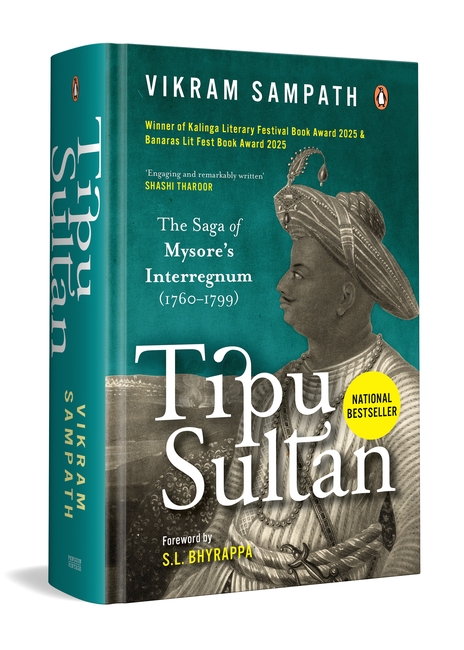
Tipu Sultan: The Saga of Mysore’s Interregnum (1760–1799) is not merely a biography—it is a reclamation of an era, a painstaking excavation of sources, and arguably the most comprehensive study of Tipu Sultan to date.
Sampath neither romanticises nor demonises. He dismantles myths on both sides and presents a Tipu who was brave but flawed, visionary in parts but blinded by zeal, feared for his military prowess yet undone by his own dogmas and miscalculations.
For anyone seeking to understand Tipu Sultan beyond clichés—this book is indispensable.



 Bookshotsapp
Leave a comment