
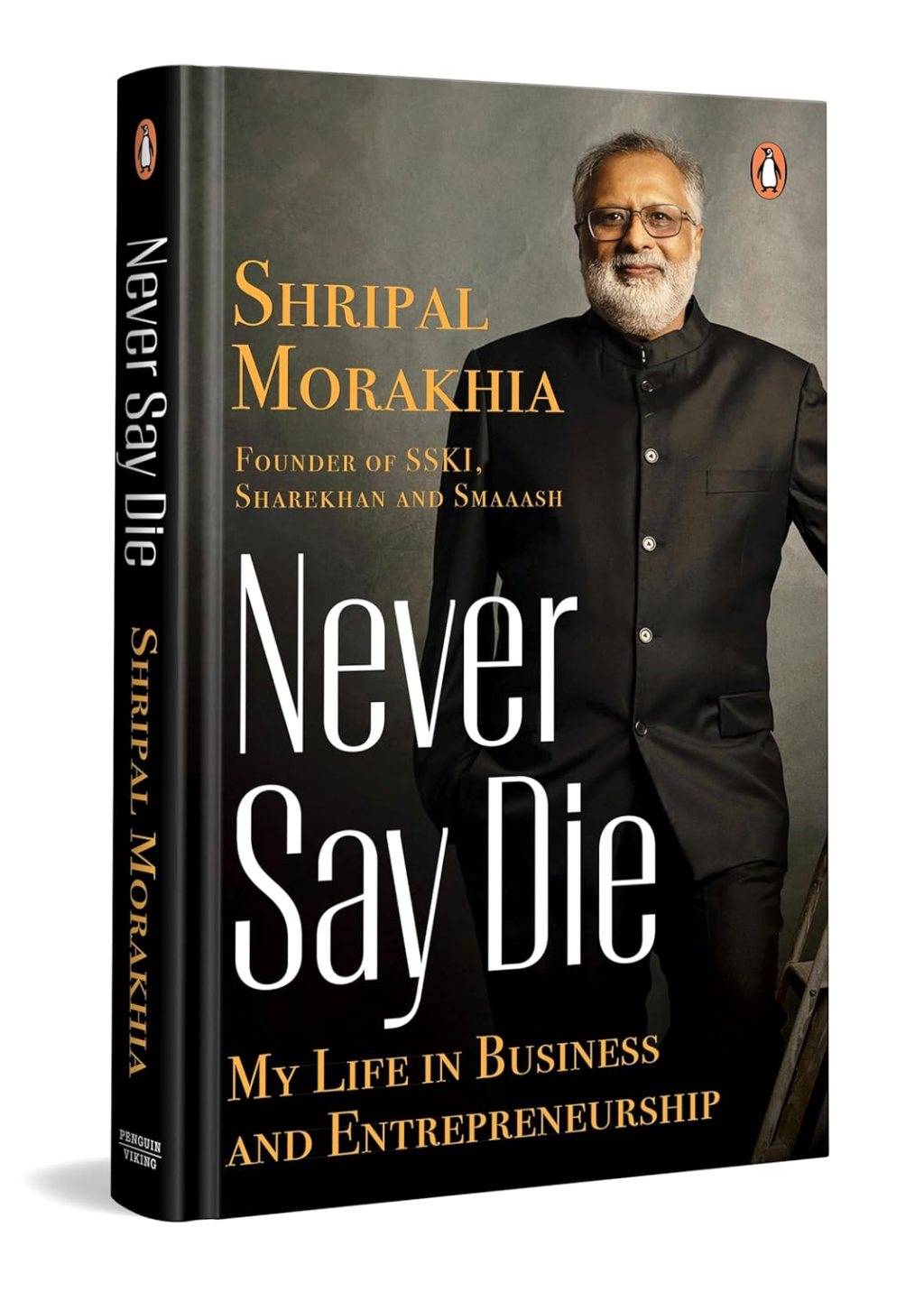
Most business memoirs follow a familiar arc: ambition, obstacles, perseverance, and eventual triumph. Failures appear only as carefully framed learning curves, and pain is mentioned briefly before the narrative races back to success. Never Say Die: My Life in Business and Entrepreneurship, published by Penguin Random House India, does something far rarer—it stays with the pain.
Written by Shripal Morakhia, founder of SSKI, Sharekhan, and Smaaash, this memoir is not about how to win. It is about what happens when everything is lost—and how one survives without the safety net of money, reputation, or certainty.
A man who shaped markets—and paid the price
Morakhia is not a marginal figure in Indian business history. He helped build SSKI into a dominant institutional brokerage, co-founded Sharekhan, which became a household name in online retail trading, and later created Smaaash, a high-tech experiential sports and gaming arena that blended entertainment, technology, and ambition on a grand scale.
His career moved through India’s riskiest and fastest-moving sectors—capital markets, media financing, telecom, and experiential entertainment. He negotiated complex deals with FIIs, executed high-stakes placements, and famously closed a $100 million ADR deal for a telecom company after a major foreign bank failed to do so.
This was not cautious entrepreneurship. Morakhia describes his mindset with brutal clarity: if he had X resources, his commitments were “X raised to the power of four.” It is this appetite for scale and risk that powered his rise—and later magnified his fall.
The crash the success stories don’t show
What separates Never Say Die from most business autobiographies is its unflinching account of collapse.
Morakhia writes openly about losing every penny he made, about his businesses unravelling, and about the humiliation that followed. One of the most disturbing episodes describes ARC officials and police arriving at his Altamount Road home at 7 p.m. to force his wife to vacate the apartment, while he was away. The loss of wealth is painful; the loss of dignity cuts deeper.
The book does not dress these moments up as character-building episodes. It allows them to remain what they were: devastating, disorienting, and dehumanising.
Mental health, masculinity, and silence
Perhaps the most important—and difficult—part of this memoir is its treatment of mental health.
The book carries a clear advisory for sensitive content, and rightly so. Morakhia writes about acute depression, emotional volatility, rage, and finally, a suicide attempt. The opening ICU scene—where he wakes up after consuming sleeping pills and Lizol—is written without melodrama, which makes it more unsettling. He does not frame survival as a miracle; he frames it as irritation. He did not want to live.
In India, conversations about founder burnout and mental health are growing, but they are still often abstract, sanitized, or filtered through corporate language. What makes Never Say Die different is that it comes from a high-profile male entrepreneur—a category where vulnerability is still considered weakness.
Morakhia allows the reader to see how ambition, ego, financial stress, and public humiliation combine into a psychological spiral that success alone cannot protect you from.
Not a comeback story—at least not in the usual sense
Readers looking for a triumphant “bounce back” narrative may be surprised. This book is not about reclaiming lost wealth or rebuilding an empire.
Instead, it documents a philosophical and spiritual reconstruction. Morakhia turns inward—towards therapy, breathing practices, meditation, and reflections drawn from the Mahabharata. He begins to question the metrics by which success is measured, concluding that time—not money or power—is the real judge of a life.
Those who betrayed, abandoned, or harmed him are not villains in the final chapters. He calls them teachers. Forgiveness, acceptance, and compassion replace revenge and resentment—not because they are noble, but because they are necessary for survival.
He refers to this phase as becoming “Shripal 2.0”—a version of himself stripped of illusion.
A counter-narrative to hustle culture
At a moment when Indian entrepreneurship is saturated with hustle slogans, unicorn worship, and valuation obsession, Never Say Die reads like a quiet but firm rebuttal.
Morakhia’s core belief was never just about money; it was about creation, effort, and perspiration. The book ultimately questions whether relentless ambition—when detached from emotional and spiritual grounding—inevitably extracts a hidden cost.
This is not an anti-business book. It is a book about what business can do to a human being if success becomes the only source of identity.
Why this book matters now
India is currently reckoning with:
- Founder burnout
- Excessive risk-taking
- Public failures playing out in real time
- And a long-overdue conversation on mental health
Never Say Die arrives not as commentary, but as testimony.
It reminds us that behind balance sheets and brand names are people capable of breaking—sometimes silently, sometimes spectacularly.
A memoir that stays with you
This is not a comfortable read, and it is not meant to be. It is honest to the point of discomfort, stripped of self-congratulation, and deeply human. Some books chart the rise of a businessman. This one drags the reader through the wreckage, the darkness, and the slow, uncertain act of choosing to live again. That alone makes Never Say Die worth reading.



 Bookshotsapp
Leave a comment