
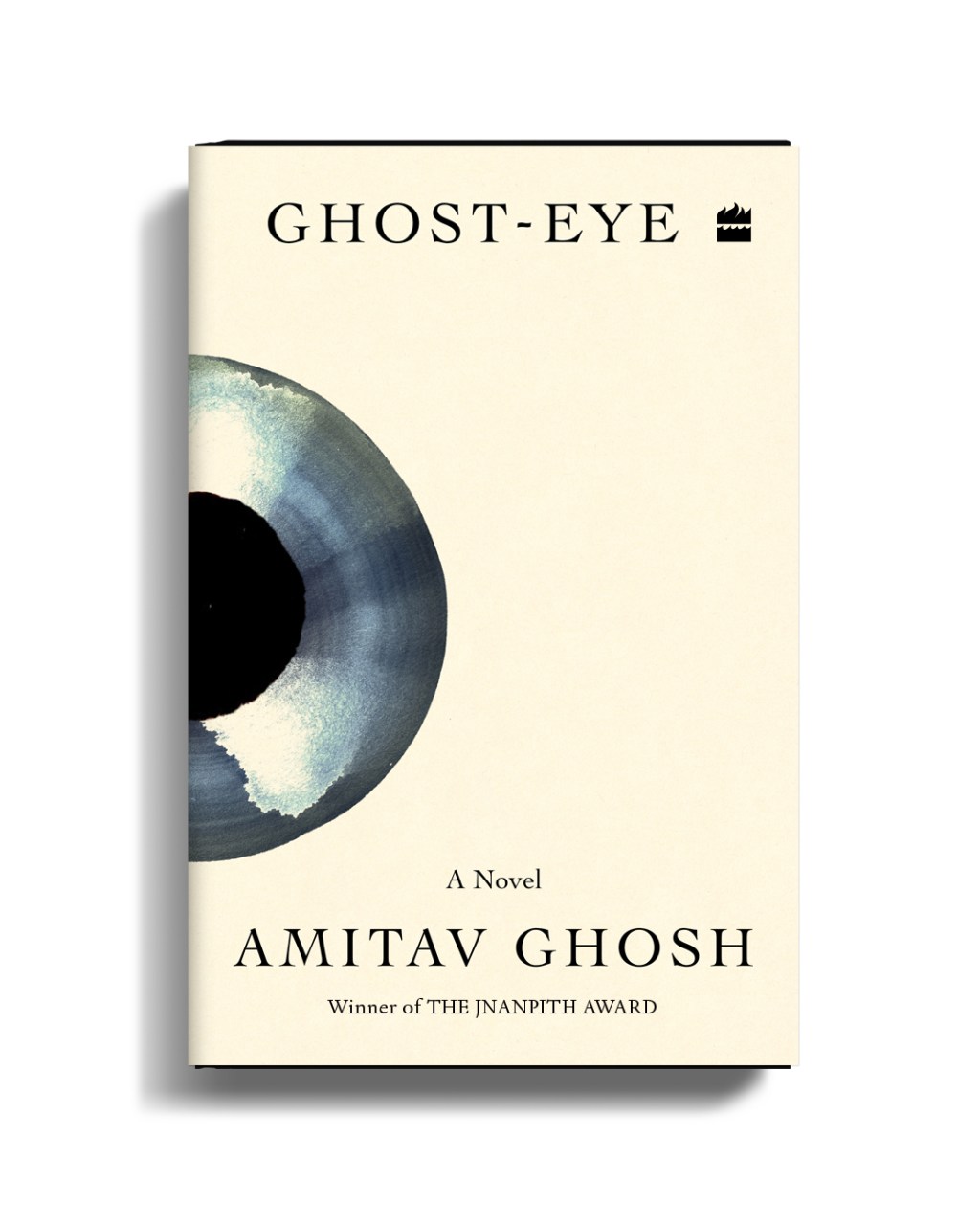
There are novels that tell a story, and then there are novels that quietly change the way you look at the world. Ghost-Eye belongs to the latter kind. It unfolds gently, without spectacle or urgency, yet leaves behind a lingering sense that something profound has been witnessed—something that cannot quite be named, only felt.
The story begins in 1969 Kolkata, inside a prosperous vegetarian household, where a young girl suddenly asks for rice and fish. The request is small, almost domestic, and yet it disrupts everything. The child insists that this is not her real home, that her true mother lives beside a river. What follows is not a dramatic confrontation but a calm, unsettling opening into mystery—one that is handled with remarkable restraint and tenderness.
From this moment, the novel opens outward in time and place. Decades later, in a world reshaped by a pandemic, we meet Dinu, a man living quietly in Brooklyn, whose connection to the past lies in his elderly aunt in Kolkata. When he is drawn into uncovering a long-buried episode of her life, the narrative begins to braid together memory, family, landscape, and fate with a confidence that never feels forced.
One of the great pleasures of Ghost-Eye is its attention to the everyday. Ghosh writes about food, especially fish, with an intimacy that turns cooking into a form of meditation. These passages slow the reader down, asking for patience and presence. They remind us that care, repetition, and sensory awareness are ways of knowing the world just as surely as logic or explanation.
The novel moves effortlessly between the ordinary and the uncanny. Folklore, belief, and intuition are treated not as curiosities but as valid ways of understanding reality. The idea of seeing two worlds at once—hinted at in the book’s title—becomes a guiding sensibility rather than a plot device. Humans, rivers, forests, animals, and memories all occupy the same moral space, each exerting quiet influence.
What makes Ghost-Eye especially moving is its calm generosity. The book never lectures, never insists. Instead, it invites the reader to notice connections: between past and present, between personal history and collective destiny, between what is visible and what is felt but unseen. Even its moments of mystery feel grounded in compassion and curiosity rather than fear.
The prose is lucid and unadorned, allowing complex ideas to emerge naturally through story and atmosphere. There is a deep trust here—in the reader, in the rhythm of narrative, and in the power of attentive observation. The result is a novel that feels spacious, reflective, and quietly transformative.
Ghost-Eye is a book to be read slowly, perhaps even returned to. It does not demand immediate understanding. Instead, it stays with you, altering perception in small but lasting ways. By the end, you realise that the novel has not merely told a story—it has taught you how to look, how to listen, and how to see the world with a little more depth and care.



 Bookshotsapp
Leave a comment