
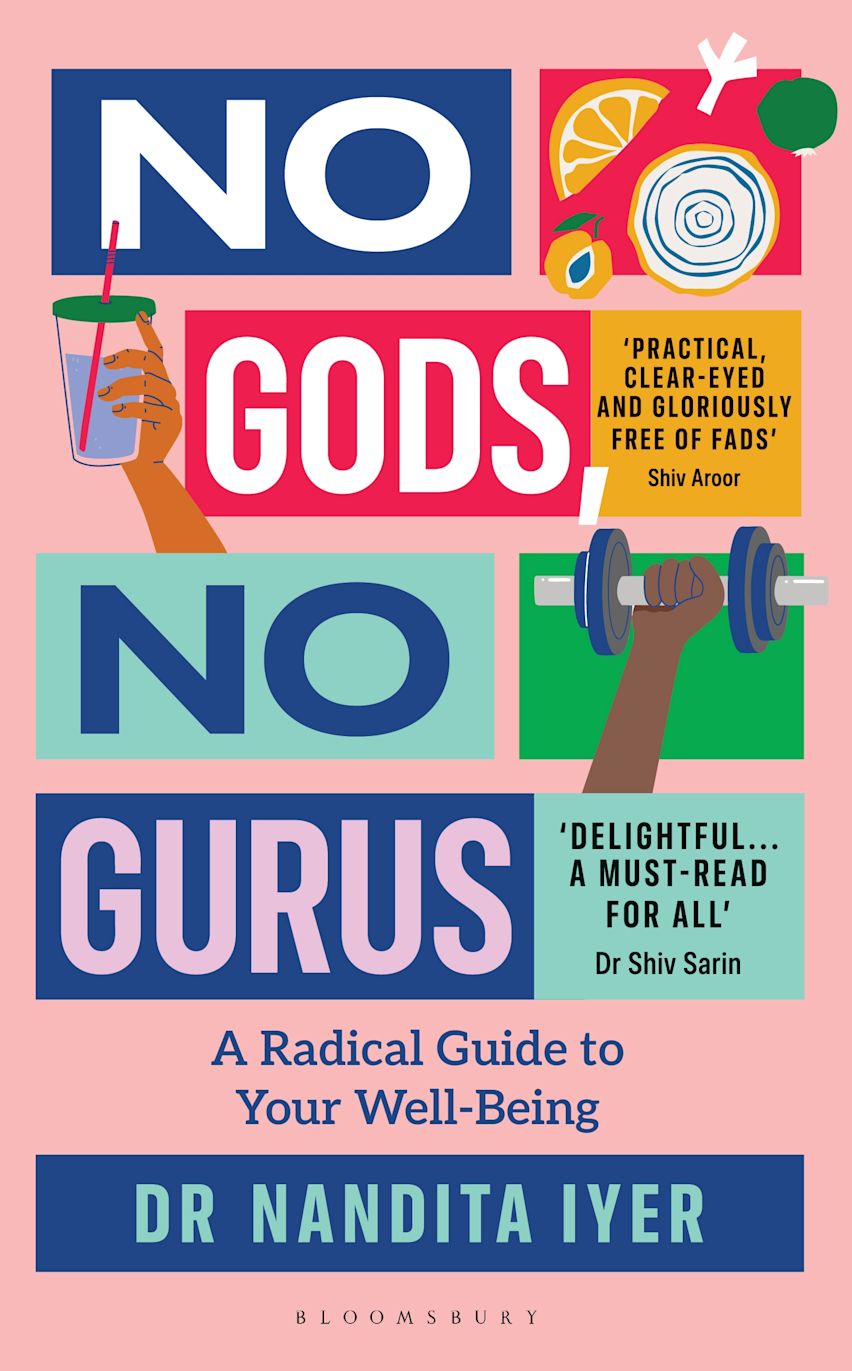
In No Gods, No Gurus: A Radical Guide to Your Well-Being, Dr Nandita Iyer advances a quietly subversive idea: that the body is already offering a continuous, personalised health report—one far more accurate than trending diets, viral reels, or celebrity-backed routines—if we are willing to pay attention.
The book opens with a moment that feels almost cinematic in its familiarity: the alarm clock breaking the silence of the morning, the body responding before the mind has fully woken up. Are you rested or already depleted? That first sensation, Dr Iyer suggests, is not trivial—it is diagnostic. From the very first pages, the book makes its case that health is not an abstract future goal but a lived, moment-to-moment experience.
No Shortcuts, No Saviours
The title is not rhetorical flourish. No Gods, No Gurus directly challenges the modern wellness economy built on hero worship, absolutism, and fear. Dr Iyer rejects one-size-fits-all solutions and the idea that health can be outsourced to experts who promise certainty.
Instead of positioning herself as another authority to follow, she dismantles the very notion of external saviours. Diets, detoxes, supplements, and biohacks are examined not through moral judgement but through scientific scrutiny. What survives is not a rulebook, but a framework—one that equips readers to think, question, and decide for themselves.
Health as a System, Not a Checklist
One of the book’s most persuasive contributions is its insistence that health is systemic. Cardiovascular fitness affects brain volume. Sleep influences inflammation. Gut health shapes mood and immunity. Emotional stress alters hormones, which in turn affect metabolism and cognition.
Dr Iyer’s discussion of the heart–brain connection exemplifies this approach. Vascular health is presented not merely as a cardiology concern but as a foundation for cognitive longevity. Exercise, sleep, blood sugar control, and diet are not isolated “pillars” but interconnected processes shaping how the brain ages.
The science is current and well-integrated, but never allowed to dominate the narrative. Research findings are used to illuminate lived experience, not overwhelm it.
Reading the Body’s Subtle Signals
A recurring theme in the book is that modern medicine often excels at crisis management while overlooking early warning signs. Dr Iyer draws attention to functional markers that quietly predict long-term outcomes: grip strength, heart-rate recovery, the ability to rise from the floor unaided, mental clarity, digestion, sleep quality, and emotional stability.
These are not presented as performance goals but as signals—messages from the body about resilience, adaptability, and biological age. By shifting attention from lab numbers alone to how the body actually functions in daily life, the book restores agency to the individual.
The Five Dimensions of True Health
Central to the book is a model of five interconnected dimensions: physical strength, mental agility, emotional balance, social connection, and spiritual anchor. Each is explored not in abstraction but through everyday realities—carrying groceries, learning new skills, maintaining relationships, coping with stress, and finding meaning beyond productivity.
The inclusion of social and spiritual health is particularly timely. Dr Iyer treats loneliness as a physiological risk and meaning as a stabilising force, linking both to inflammation, longevity, and resilience. In doing so, she bridges the gap between biomedical science and the lived human experience.
A Science-Backed Guide for Real Lives
What sets No Gods, No Gurus apart is its refusal to demand perfection. The book acknowledges modern constraints—sedentary work, digital overload, disrupted sleep cycles, chronic stress—and works within them rather than denying their existence.
Complex ideas such as metabolic flexibility, neuroinflammation, circadian disruption, and hormonal regulation are explained with clarity and restraint. The writing is confident without being preachy, accessible without being simplistic. Metaphors—like sleep as the brain’s clean-up crew or inflammation as a silent saboteur—serve understanding rather than spectacle.
Wisdom Over Instruction
Dr Iyer describes the book not as a manual, but as a guide to wisdom. That distinction matters. There are no rigid prescriptions or performative routines. Instead, readers are encouraged to check in with themselves regularly, notice patterns, and make small, sustainable adjustments.
This approach shifts wellness away from anxiety-driven consumption toward self-trust. Health becomes something you cultivate, not chase.
The Personal Thread
The acknowledgements offer a glimpse into the values underpinning the book—gratitude for teachers, family, music, endurance sports, community, and companionship. These personal notes are not indulgent; they reinforce the book’s central idea that well-being is shaped as much by relationships, purpose, and curiosity as by diet or exercise.
Reclaiming Authority in a Culture of Excess Advice
In an era obsessed with optimisation, metrics, and overnight transformation, No Gods, No Gurus stands out for its restraint. It neither flatters nor frightens the reader. Instead, it restores a sense of proportion—reminding us that health is dynamic, contextual, and deeply individual.
This is not a book that tells you what to worship. It quietly dismantles the need for worship altogether. By returning attention to the body’s signals and the mind’s capacity to learn, it offers something both radical and reassuring: the confidence to navigate health without surrendering agency.
Calm, rigorous, and deeply humane, No Gods, No Gurus is less about mastering the body and more about finally learning to listen to it.

 Bookshotsapp
Leave a comment