
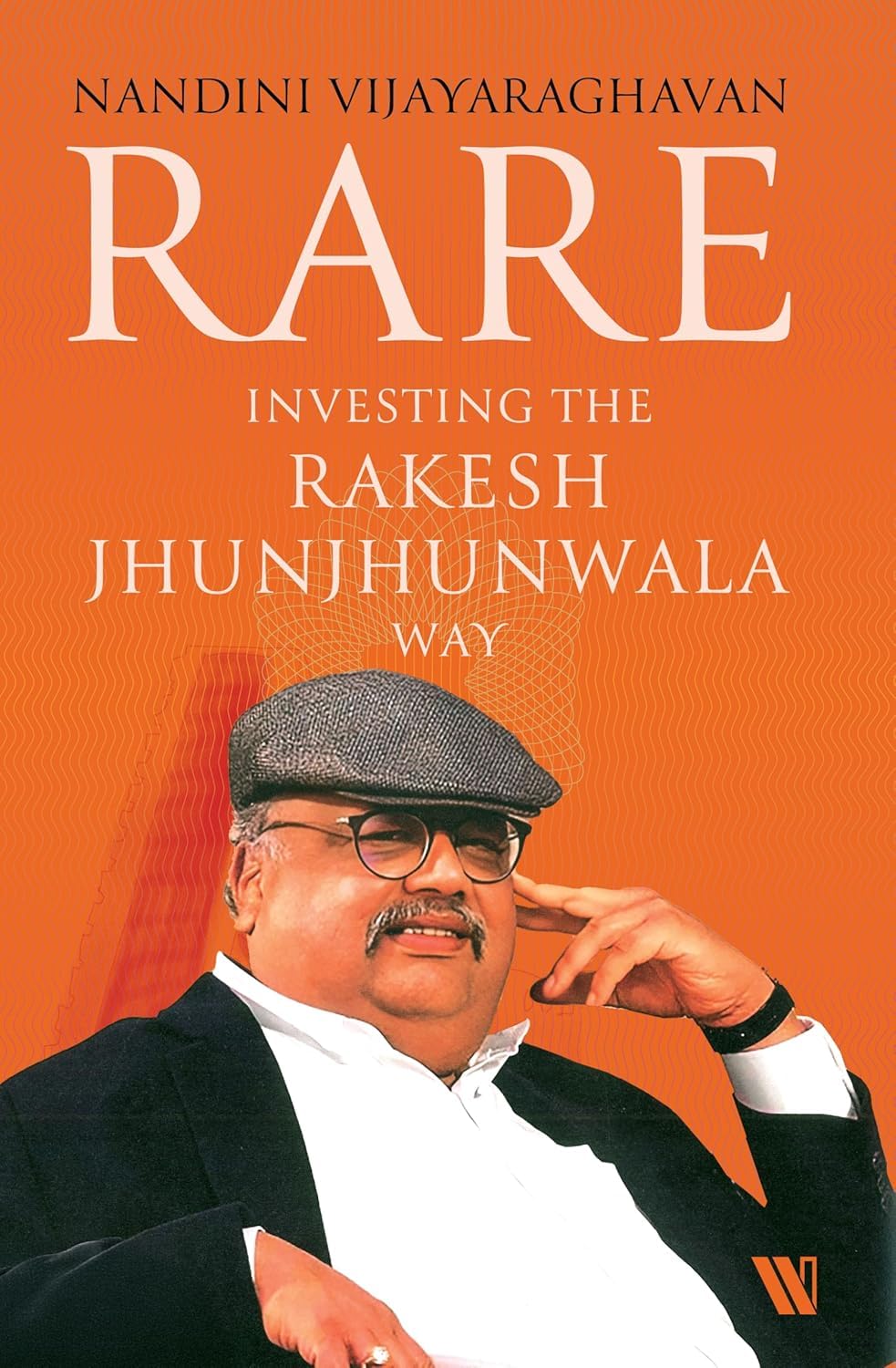
Rakesh Radheshyam Jhunjhunwala—popularly remembered as the “Big Bull of Dalal Street”—has often been reduced to an inspirational market legend, a rags-to-riches investor who surfed India’s post-liberalisation boom. Rare: Investing the Rakesh Jhunjhunwala Way, authored by analyst and banker Nandini Vijayaraghavan, consciously moves beyond this simplified narrative. Instead, it offers a layered, evidence-based account of the man, his method, and the historical forces that shaped his extraordinary rise.
This is not merely a book about stock picking. It is a work of financial biography that situates Jhunjhunwala within India’s evolving political economy, market institutions, and investor culture from the 1990s onward.
An Investor of Many Firsts
The book begins by establishing why Jhunjhunwala occupies a singular place in Indian financial history. He was India’s first professional investor to enter the Forbes Global Billionaires list and among the earliest Indian signatories of the global philanthropy pledge initiated by Warren Buffett and Bill Gates. Unlike many market icons of the 1990s, Jhunjhunwala was also an “asset-class agnostic” investor—successfully navigating listed equities, private equity, active trading, and even film production.
Crucially, Vijayaraghavan draws a sharp distinction between Jhunjhunwala and his controversial predecessors such as Harshad Mehta and Ketan Parekh. While all three operated in overlapping market cycles, Jhunjhunwala’s adherence to legal and ethical boundaries allowed him to build enduring credibility. This commitment to institutional legitimacy, the book argues, was as important to his success as his investing acumen.
RaRe Enterprises and the Discipline of Long-Term Conviction
One of the book’s most striking revelations is the performance of RaRe Enterprises, the investment firm founded by Jhunjhunwala. From inception until his demise, the firm reportedly compounded at an extraordinary 62 percent annually—making it one of the highest-performing investment vehicles globally.
Vijayaraghavan carefully dissects the underlying philosophy behind this performance. Jhunjhunwala’s approach combined deep macro conviction, patience across market cycles, and an ability to concentrate capital in high-conviction ideas—most famously Titan Industries. The book demonstrates that his success was neither accidental nor impulsive, but rooted in disciplined research, strong promoter assessment, and a willingness to tolerate volatility.
Liberalisation and the India Opportunity
A major strength of the book is its treatment of India’s 1990s liberalisation not as a backdrop, but as a central explanatory force. Jhunjhunwala’s rise is closely tied to the dismantling of the Licence Raj, the reduction of peak import duties from an astonishing 170 percent, and the broader opening of Indian industry to global competition.
The book captures a crucial psychological shift: the movement from the self-doubt of the 1970s and 1980s to the confidence that Indian enterprise could compete globally. Jhunjhunwala, Vijayaraghavan suggests, was both a beneficiary and a symbol of this transformation—embodying a generation that believed India’s growth story was not episodic, but structural.
Challenging the Simplistic Market Narrative
Perhaps the most intellectually honest section of the book is its refusal to endorse the neat, moralistic storyline often told about Indian markets: Harshad Mehta rose and crashed, Ketan Parekh followed and fell, and Rakesh Jhunjhunwala emerged untainted. Vijayaraghavan reminds readers that history is messier.
Jhunjhunwala’s ascent overlapped with the decline of these figures, and he operated in the same turbulent ecosystem. Acknowledging this overlap does not diminish his achievements; instead, it situates them within a realistic market context where opportunity, risk, and ethical choice constantly intersect. This insistence on historical complexity makes the book intellectually credible and refreshingly unsentimental.
The Man Behind the Myth
What elevates Rare beyond a conventional investment manual is its rich oral history. Drawing on never-before-seen interviews with Rekha Jhunjhunwala, nephew Vishal Gupta, banker and schoolmate Uday Kotak, colleagues at RaRe Enterprises, investor Ramesh Damani, Titan’s former MD Bhaskar Bhat, and filmmaker Balki, the book reconstructs Jhunjhunwala’s personality with warmth and restraint.
These voices reveal a man driven by curiosity, intellectual confidence, and a deep belief in India’s destiny—tempered by personal relationships, humour, and a surprisingly private inner life. The result is a portrait that humanises Jhunjhunwala without mythologising him.
Authorial Authority and Perspective
Nandini Vijayaraghavan brings strong professional credibility to the task. With advanced training in economics and finance, a CFA charter, and a career spanning analysis and banking, she writes with clarity and precision. Her background allows her to explain complex investment ideas without jargon, while her journalistic experience ensures narrative coherence and accessibility.
Importantly, she resists turning the book into either a devotional tribute or a technical handbook. Instead, she balances admiration with critical distance—a rare quality in books on iconic market figures.
Conclusion
Rare: Investing the Rakesh Jhunjhunwala Way succeeds precisely because it refuses easy answers. It portrays Jhunjhunwala not as a flawless market prophet, but as a product of talent, timing, discipline, and historical circumstance. In doing so, it offers valuable lessons—not only for investors, but for anyone seeking to understand India’s economic transformation over the last three decades.
For seasoned professionals, retail investors, and readers interested in the political economy of modern India, this book stands as the most balanced and comprehensive account yet of the man who came to symbolise India’s confidence in its own future.




 Bookshotsapp
Leave a comment