
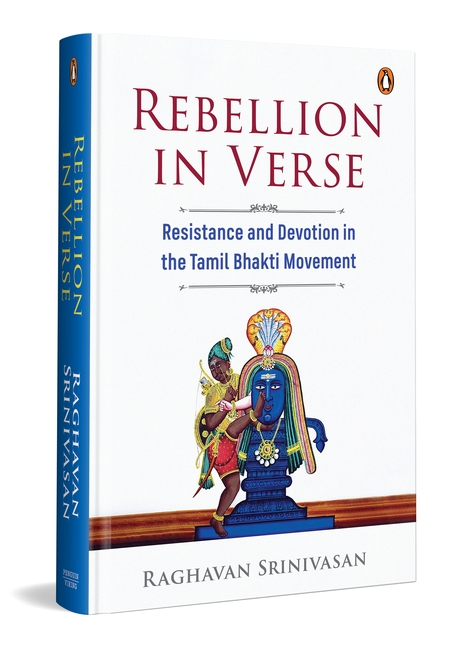
In Rebellion in Verse: Resistance and Devotion in the Tamil Bhakti Movement, Raghavan Srinivasan reminds us that some of India’s most profound revolutions were neither fought on battlefields nor articulated in manifestos. They were sung—softly at first, in Tamil, by poets whose very lives stood in defiance of the hierarchies that governed medieval society.
This book is not merely a study of devotional poetry. It is a social history of dissent, a meditation on how faith can become an instrument of resistance, and a corrective to the sanitised, temple-bound understanding of Bhakti that dominates popular imagination today.
At the heart of Srinivasan’s narrative lies a deceptively simple provocation, voiced centuries ago by the Saivite saint Appar:
Why chant the Vedas, follow Vedic karma? Why preach day by day the books of dharma? Why learn the six Vedangas by rote? One thing alone will to your rescue come— thinking always of the Lord Supreme.
These lines, Srinivasan argues, were nothing short of radical. In questioning the authority of Vedic ritual, Sanskrit learning, and priestly mediation, Appar was not rejecting spirituality—he was reclaiming it.
Bhakti as a Social Movement, Not a Metaphor
One of the book’s greatest strengths is its refusal to treat the Bhakti movement as an abstract spiritual flowering. Srinivasan places it firmly within the political economy of early medieval Tamilakam. The rise of urban centres, guilds of traders and artisans, and a productive agrarian base created new social energies that chafed against Brahmanical orthodoxy and rigid caste hierarchies.
Bhakti, as Srinivasan presents it, was the cultural expression of these pressures. It was a grassroots movement that spoke in the language of the street, the field, and the workshop. By composing in Tamil rather than Sanskrit, the Nayanars and Alwars made a decisive political choice. They dismantled the monopoly over sacred knowledge and asserted that access to the divine did not require birth, ritual purity, or scholastic mastery.
The book powerfully illustrates how saints such as Nandanar, an outcaste leather worker, Kannappar, a hunter, and Adipaththar, a fisherman, redefined religious authority through lived devotion rather than inherited status. Their sanctity lay not in conformity but in transgression—often literal, sometimes scandalous—of orthodox norms.
Women, Agency, and Divine Intimacy
Srinivasan’s treatment of women Bhakti saints is particularly compelling. Figures like Andal and Karaikal Ammaiyar are not reduced to pious anomalies but are situated as central disruptors of patriarchal expectations. Andal’s refusal of mortal marriage in favour of a divine lover is read not as mystical eccentricity, but as a radical assertion of female agency in a society that tightly controlled women’s bodies and desires.
Similarly, Karaikal Ammaiyar’s rejection of conventional femininity—embracing asceticism, aging, and even grotesqueness—becomes a profound critique of gendered norms of beauty and virtue.
In these chapters, Rebellion in Verse quietly but firmly positions Bhakti as an early challenge not only to caste but also to gender hierarchy.
The Politics of Language and the “Tamil Vedas”
Perhaps the most illuminating sections of the book explore how Tamil devotional hymns came to be revered as the “Tamil Vedas.” This was not a symbolic honorific alone. In temple processions, these hymns were often placed before Sanskrit texts—a physical inversion of hierarchy that mirrored a deeper ideological shift.
Srinivasan shows how temples evolved into community centres where art, music, and collective identity flourished. Bhakti did not retreat from the world; it reorganised it. The sacred and the social were no longer separate domains.
Yet the book is careful not to romanticise this transformation. Srinivasan acknowledges how later empires and institutions absorbed Bhakti’s energies, neutralising its radical edge. What began as rebellion was eventually ritualised; what once challenged power was later used to legitimise it.
From Tamilakam to the Subcontinent
The final sections trace Bhakti’s northward journey, showing how its core ideas—personal devotion, equality before God, and suspicion of orthodoxy—resurfaced in figures like Kabir, Mirabai, Tulsidas, and Guru Nanak. Srinivasan is careful here, avoiding simplistic claims of direct transmission while convincingly demonstrating a shared moral and spiritual grammar.
Bhakti, the book suggests, became one of the few truly pan-Indian traditions not imposed by empire or scripture, but carried by song, memory, and lived experience.
A Necessary Reclamation
What gives Rebellion in Verse its contemporary urgency is its concluding reflection on memory and forgetting. Srinivasan notes the irony that many Bhakti saints are today revered as icons while their defiance is quietly erased. Stone statues replace living questions; ritual devotion obscures ethical challenge.
In an age marked by renewed social divisions, the book asks readers to confront an uncomfortable truth: Bhakti was never meant to be safe.
Written in lucid, accessible prose without sacrificing scholarly depth, Rebellion in Verse succeeds as both historical inquiry and moral intervention. It invites readers to see devotion not as submission, but as courage—and poetry not as ornament, but as a weapon against injustice.
This is a book that does more than recount a past movement. It reopens a conversation about faith, equality, and resistance—one that remains unfinished.




 Bookshotsapp
Leave a comment