
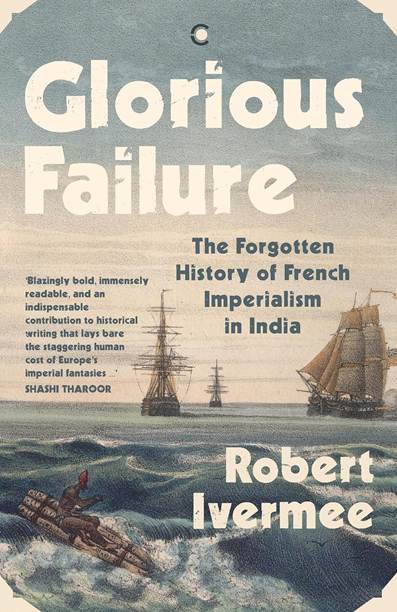
When colonialism in India is discussed, British rule dominates the imagination. The East India Company’s violence, followed by the pomp of the Raj, has shaped both popular memory and academic scholarship. The Portuguese may receive a brief mention as early arrivals. France, however, is largely absent from this story—reduced to nostalgic footnotes such as Pondicherry or Chandernagore. Robert Ivermee’s Glorious Failure compellingly overturns this neglect, showing that French ambitions in India were neither minor nor benign, but serious, expansive, and, for a time, remarkably successful.
Beyond Trade: France Enters the Imperial Race
Ivermee situates French involvement in India within the wider eighteenth-century struggle among European powers for control over Asian trade and territory. Like their British rivals, agents of the Compagnie des Indes arrived in India seeking profits from textiles and spices. As Mughal authority declined, commercial competition hardened into territorial conflict. European companies increasingly behaved like sovereign powers, raising armies, backing claimants to Indian thrones, and extracting revenue from conquered land.
Crucially, Ivermee reminds us that British dominance was not inevitable. In the mid-eighteenth century, France often held the upper hand. Through superior diplomacy, military expertise, and strategic alliances with Indian rulers, French officials positioned themselves as serious contenders for power in southern India.
The French Settlements and the Rise of Pondicherry
After several failed attempts elsewhere, the French eventually secured five settlements—Mahé, Karikal, Yanaon, Chandernagore, and Pondicherry—that survived, despite repeated British occupations, until their transfer to India in the early 1950s. Of these, Pondicherry emerged as the most important centre of French power.
Geographically, Pondicherry was an unpromising choice. It lacked a natural harbour, suffered from water scarcity and monsoon flooding, and depended on imported food. Yet its strategic location—safely distant from British Madras—and its access to high-quality textile-producing villages made it commercially viable. By the 1730s, Pondicherry had grown into a substantial colonial town of nearly 100,000 inhabitants, divided into “white” and “black” quarters.
Its population was strikingly diverse: Tamil merchants and artisans, Indo-Portuguese topas, mixed-race métis, European officials, and a vast enslaved population. One of the book’s most significant contributions is its frank discussion of slavery. Ivermee shows that slave ownership and trafficking were central to French imperialism in India—an aspect long glossed over by narratives that portray the French presence as culturally refined or relatively humane.
Dupleix and the High Tide of French Power
The dramatic rise of French influence was driven by individuals, most notably Joseph François Dupleix, governor of Pondicherry from 1742 to 1754. Dupleix epitomised the ambition, arrogance, and opportunism of eighteenth-century company officials. Like Robert Clive, his British counterpart, he operated in an information vacuum caused by slow communication with Europe, often acting independently of instructions from Paris.
Under Dupleix, French power expanded rapidly through military intervention and manipulation of Indian succession disputes. French-trained sepoy armies, paid for and sacrificed without hesitation, became instruments of imperial expansion. Ivermee makes clear that French rule, like British rule, rested on violence, coercion, and ruthless extraction.
Wars, Alliances, and Missed Opportunities
Much of Glorious Failure is devoted to military history, and rightly so. Ivermee carefully traces the shifting alliances among the French, the British, Hyderabad, Mysore, the Marathas, and local nawabs in the Carnatic. Indian rulers emerge not as passive victims but as strategic actors who allied with European powers to advance their own interests.
Equally important are Indian intermediaries such as Ananda Ranga Pillai, the influential Tamil merchant and diarist whose journal offers a rare insider’s view of French administration and Dupleix’s eventual downfall. These voices anchor the narrative firmly within Indian political and social realities.
Yet French gains proved fragile. European treaties repeatedly undid hard-won victories in India. The Treaty of Aix-la-Chapelle (1748), which forced France to return Madras to the British, marked a turning point. Dupleix was recalled in 1754, and in 1761 British forces razed Pondicherry, reducing French power to a shadow of its former self.
Tipu Sultan and the Last French Hope
The most tantalising “what if” of French India centres on Tipu Sultan of Mysore. His French-trained forces inflicted a devastating defeat on the East India Company at Pollilur in 1780. In 1788, Tipu sent envoys to Versailles seeking an alliance against Britain. Had France responded decisively, the balance of power in India might have shifted.
Instead, the French court hesitated, soon overwhelmed by the Revolution. Later Napoleonic schemes—most famously a proposed march from Egypt to India—remained fantasies. Tipu’s defeat and death at Seringapatam in 1799 effectively ended any realistic prospect of French revival in India.
The Afterlives of French India
Ivermee closes by examining the legacy of French failure. The idea of l’Inde perdue—the lost India—haunted French colonial imagination and was later mobilised to justify imperial ventures in Africa and Indochina. Romantic visions of India as a civilisational ancestor found expression in archaeology, Indology, and colonial ideology elsewhere.
A Necessary Correction
Glorious Failure is a lucid, well-researched, and timely work. It strips away nostalgia and challenges the comforting myth that French colonialism in India was marginal or benevolent. More importantly, it reminds Indian readers that colonial domination was contingent, contested, and shaped by global rivalries as much as local politics. In restoring France to India’s imperial history, Ivermee deepens our understanding of colonialism itself—not as destiny, but as a series of violent gambles, some of which failed spectacularly.



 Bookshotsapp
Leave a comment