
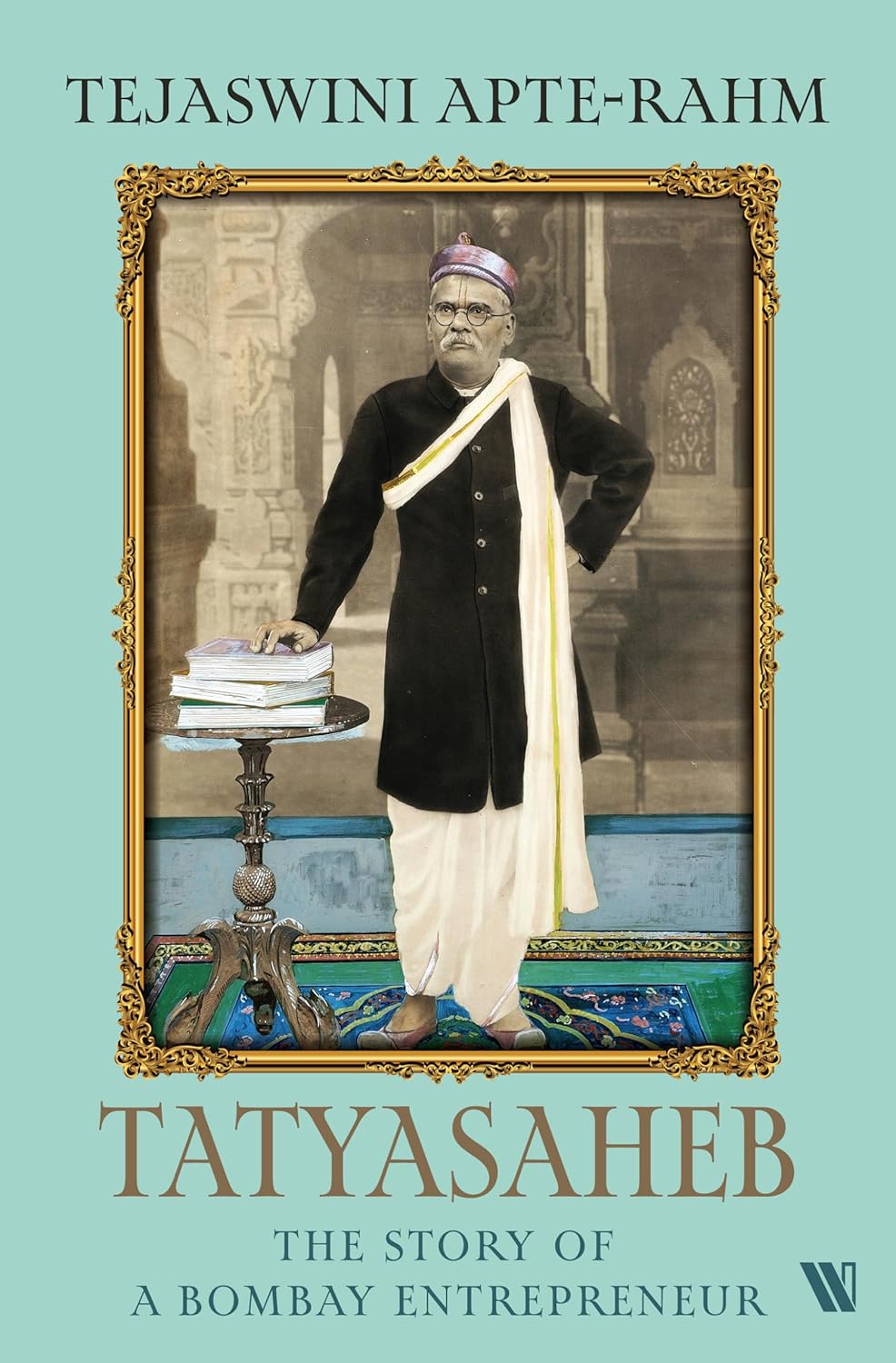
In Tatyasaheb: The Story of a Bombay Entrepreneur, Tejaswini Apte-Rahm reconstructs the extraordinary life of Vaman Shridhar Apte—known to generations as Tatyasaheb—and, in doing so, offers a richly textured portrait of Bombay at a moment when the city was inventing itself as India’s commercial capital. The book is both a compelling individual biography and a social history of enterprise, risk, and transformation in the late nineteenth and early twentieth centuries.
Arriving in Bombay at the end of the nineteenth century with little more than determination, Apte began his working life as an assistant in the Mulji Jetha Market, then the pulsating heart of the city’s textile trade. From these unglamorous beginnings, he rose—through persistence, shrewd judgement and an uncanny sense of timing—to become one of the city’s wealthiest businessmen, eventually living in a sea-facing mansion on Peddar Road. That such success emerged from an orthodox Kokanastha Brahmin background, traditionally distant from mercantile life, adds an important layer of social complexity to his story.
Apte-Rahm charts Tatyasaheb’s life with a keen eye for the intersections of personal ambition and historical change. Particularly striking is her account of his involvement in three “sunrise industries” of the Bombay Presidency: textiles, cinema and sugar. His role as the sole selling agent for Kohinoor Mills textiles situates him firmly within Bombay’s industrial boom, while his unexpected and turbulent association with Dadasaheb Phalke reveals a lesser-known chapter of India’s silent film era. That Tatyasaheb went on to produce over a hundred feature films speaks to a daring entrepreneurial spirit unafraid of cultural as well as financial risk. Later, with the founding of the Phaltan Sugar Works, he emerged as a major industrialist beyond the city, extending Bombay capital into the Deccan hinterland.
What elevates the book beyond a conventional success story is its attention to everyday life and social custom. Apte-Rahm brings alive the cramped chawls of Girgaon, the rituals and hierarchies of a Brahmin household, and the domestic worlds that coexisted with aggressive commercial expansion. The family narrative—intimately drawn—serves as a lens through which changing ideas of work, respectability, wealth and modernity are examined.
The author’s prose is lucid and assured, balancing archival research with narrative momentum. Her background as a novelist is evident in the book’s vivid scene-setting, while her journalistic and research experience ensures historical rigour. Importantly, Tatyasaheb avoids the hagiography that often afflicts business biographies. The portrait that emerges is of a man of immense drive and acumen, but also one shaped by conflict, uncertainty and the volatile nature of emerging industries.
At a larger level, the book is also the story of Bombay itself—of how the city became a wealth-generating dynamo by attracting risk-takers who, in turn, were transformed by its opportunities. In tracing Tatyasaheb’s rise from Khatryachi Chawl to Peddar Road, Apte-Rahm captures the spirit of a city that rewarded audacity, adaptability and vision.
Tatyasaheb: The Story of a Bombay Entrepreneur is an engaging and important contribution to Indian business history and urban studies. It will appeal not only to readers interested in entrepreneurship, but also to those seeking to understand how individual lives and family histories are entwined with the making of modern Bombay.
 Bookshotsapp
Leave a comment