
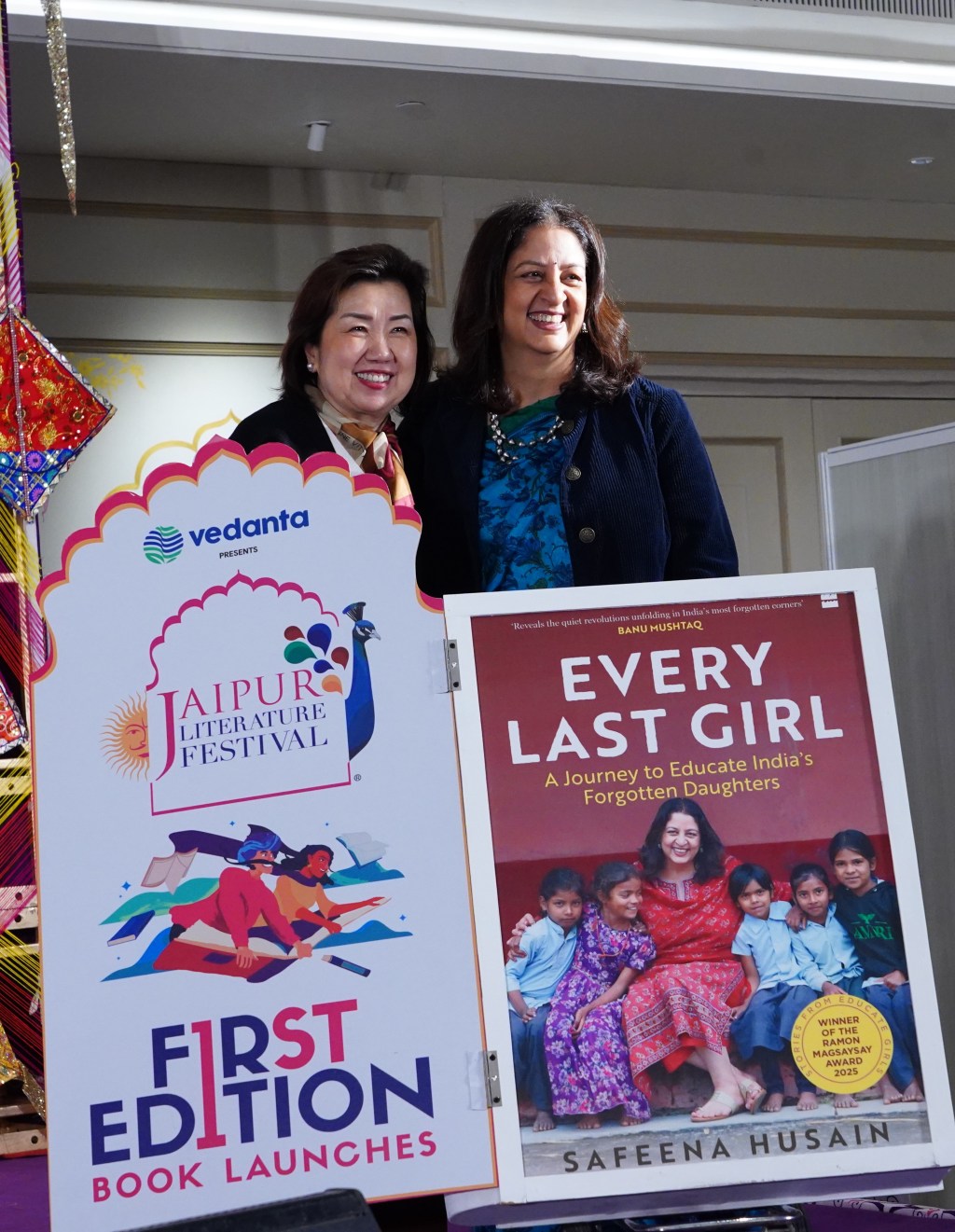
Social entrepreneur and Educate Girls founder Safeena Husain launched her much-anticipated book, Every Last Girl: A Journey to Educate India’s Forgotten Daughters, at the Jaipur Literature Festival (JLF) 2026 on Wednesday. Published by HarperCollins India, the book was unveiled during a conversation between Husain and Susanna Afan, President of the Ramon Magsaysay Award Foundation (RMAF).
The launch comes on the heels of a landmark achievement for Educate Girls. In 2025, the organisation became the first Indian non-profit to receive the Ramon Magsaysay Award—Asia’s highest civilian honour—recognising its pioneering, community-led model to advance girls’ education at scale.
Chronicling a Movement
Every Last Girl traces the extraordinary journey of Educate Girls, the non-profit founded by Husain in 2007 with the simple yet radical aim of ensuring that no girl is denied education because of her gender, poverty, or social circumstance. What began as a pilot across 50 villages in Rajasthan has since grown into a nationwide movement spanning more than 30,000 villages across some of India’s most underserved regions.
Over nearly two decades, the organisation has helped more than two million girls return to school, reshaping local attitudes toward education through a deeply embedded, community-first approach. Central to this effort is Team Balika, a network of nearly 55,000 volunteers who work at the grassroots, going door to door to identify out-of-school girls and support families through dialogue, learning initiatives, and access to government schemes.
Personal Narrative Meets Ground Reality
Blending memoir with reportage, the book offers an insider’s view of the challenges and breakthroughs involved in building a large-scale social movement. Husain writes candidly about resistance rooted in entrenched gender norms, bureaucratic hurdles, and the emotional toll of working in regions where girls are still systematically undervalued.
At the same time, Every Last Girl documents how data-driven insights and the thoughtful use of AI and machine learning have strengthened the organisation’s impact, enabling Educate Girls to track progress, refine interventions, and scale responsibly without losing its human core.
Voices from the Launch
Speaking at the event, Safeena Husain underscored the urgency that prompted her to write the book. “Despite incredible progress, girls’ education remains an urgent issue,” she said. “Millions of girls are still out of school, held back by a persistent mindset that values them less. Even today, we meet girls named Maafi, Naraaz, and Antimbala—names that reflect apology, anger, or being the ‘last girl’. To change mindsets, we must create awareness and dialogue, and Every Last Girl is my attempt to accelerate that change so we don’t lose another generation to illiteracy.”
Susanna Afan of the Ramon Magsaysay Award Foundation contextualised the work within a broader moral framework. “Across backgrounds and ideologies, Ramon Magsaysay Awardees share a commitment to step into the hardest spaces to create lasting impact,” she said. “Educate Girls represents the next frontier of India’s transformation. Every Last Girl is not just a story of scale, but one of moral clarity—of what becomes possible when systems are designed for the last and the forgotten.”
Beyond a Book
More than a chronicle of an organisation, Every Last Girl is positioned as a call to collective responsibility. It highlights how persistence, collaboration, and community ownership can dismantle deeply rooted barriers to education, and how investing in girls transforms families, economies, and futures.
Now available nationwide, Every Last Girl: A Journey to Educate India’s Forgotten Daughters adds an important voice to conversations around education, gender equity, and social change—offering both inspiration and a blueprint for action at a time when the stakes could not be higher.

 Bookshotsapp
Leave a comment