
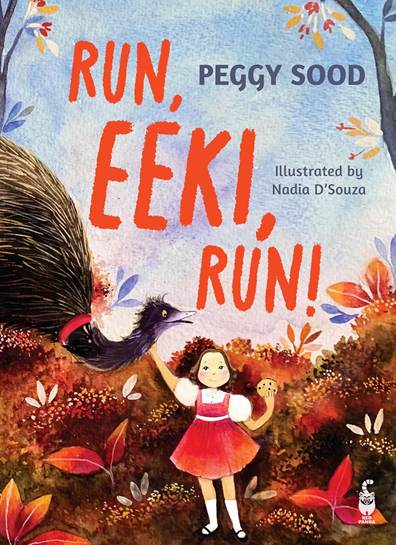
In a literary landscape increasingly attentive to questions of identity, inclusion, and self-worth, Eeki the Emu arrives as a quietly powerful children’s book that speaks to young readers with warmth, simplicity, and emotional intelligence. At its heart is a deceptively simple question: what does it mean to soar if you cannot fly?
Eeki, the book’s endearing protagonist, is an emu who can run remarkably fast but cannot fly like the birds he watches overhead. This inability, initially experienced as a lack, becomes the emotional core of the narrative. Through Eeki’s journey, the book gently explores the pain of comparison, the loneliness of being different, and the slow, affirming process of discovering one’s own strengths.
Rather than offering a moral that feels imposed or didactic, Eeki the Emu allows its message to unfold naturally. The story suggests that success and joy do not come from imitating others, but from understanding oneself. In doing so, it reframes difference not as a deficiency but as a distinct and valuable way of being in the world.
A Story That Speaks to Children—and the Adults Who Read With Them
What makes Eeki the Emu especially resonant is its dual address. While the language and narrative are firmly rooted in a child’s world, the emotional undercurrents will be instantly recognisable to adults—parents, teachers, and caregivers—who mediate children’s early encounters with disappointment and self-doubt.
The book is particularly effective as a read-aloud, encouraging conversation between adult and child. Questions such as “What are you good at?” or “Is it okay to be different?” emerge organically from the story, making it a valuable tool for classrooms and homes alike. In a time when children are increasingly exposed to narrow definitions of success, Eeki the Emu offers a refreshing counter-narrative: that growth lies in embracing who you are.
Themes of friendship and belonging run alongside Eeki’s personal discovery. Supportive relationships play a crucial role in helping him recognise his own abilities, reinforcing the idea that self-belief often develops within caring communities.
Peggy Sood: A Life Devoted to Literacy
The book’s emotional assurance is unsurprising given the background of its author. Peggy Sood brings to Eeki the Emu decades of experience as an educator and literacy advocate. Having served for 30 years at the American Embassy School, New Delhi, as a teacher and later as Vice Principal, Sood has worked closely with children across age groups and learning abilities.
Now a curriculum consultant and teacher educator, she conducts literacy workshops for schools and libraries across India. Her work consistently emphasises one core belief: that reading to a child every day is the single greatest predictor of academic success. This conviction is deeply embedded in Eeki the Emu, which is clearly designed not only to entertain but to nurture a lifelong relationship with books.
Sood’s storytelling reflects her understanding of children’s emotional worlds. The pacing is gentle, the language accessible, and the emotional beats carefully calibrated—never overwhelming, never trivialising the child’s experience. It is the work of someone who knows that stories can shape confidence as much as competence.
Nadia D’Souza’s Illustrations: Nature, Satire, and Sensitivity
Complementing the text are the evocative watercolour illustrations by Nadia D’Souza, a Goan artist known for her nature-inspired works. Her animals are not merely decorative; they carry expression, mood, and quiet commentary on the human condition. In Eeki the Emu, this sensibility translates into visuals that deepen the emotional resonance of the story.
D’Souza’s use of watercolour lends softness and fluidity to the landscapes, allowing young readers to linger over the pages. The animals, while rooted in the natural world, subtly reflect human emotions—hesitation, curiosity, resilience—without tipping into caricature. Her characteristic touch of satire is understated here, giving way to warmth and empathy, while still retaining an artistic depth that rewards repeated readings.
The harmony between text and illustration is one of the book’s strengths. Together, they create a cohesive reading experience that feels calm, reassuring, and visually engaging.
A Book for Our Times
Eeki the Emu joins a growing body of children’s literature that seeks to normalise difference and celebrate multiple forms of ability. Yet it distinguishes itself through its restraint. There are no dramatic transformations, no sudden triumphs. Instead, there is a gradual, believable shift in perspective—one that teaches children that self-acceptance is a journey, not a moment.
For parents, educators, and librarians looking for books that open up meaningful conversations without moralising, Eeki the Emu is a thoughtful and timely addition. It reminds us that soaring does not always mean leaving the ground—it can also mean running confidently along your own path, at your own pace.
In Eeki’s story, young readers may recognise their own uncertainties and, more importantly, discover the quiet reassurance that being different can indeed be a superpower.


 Bookshotsapp
Leave a comment