
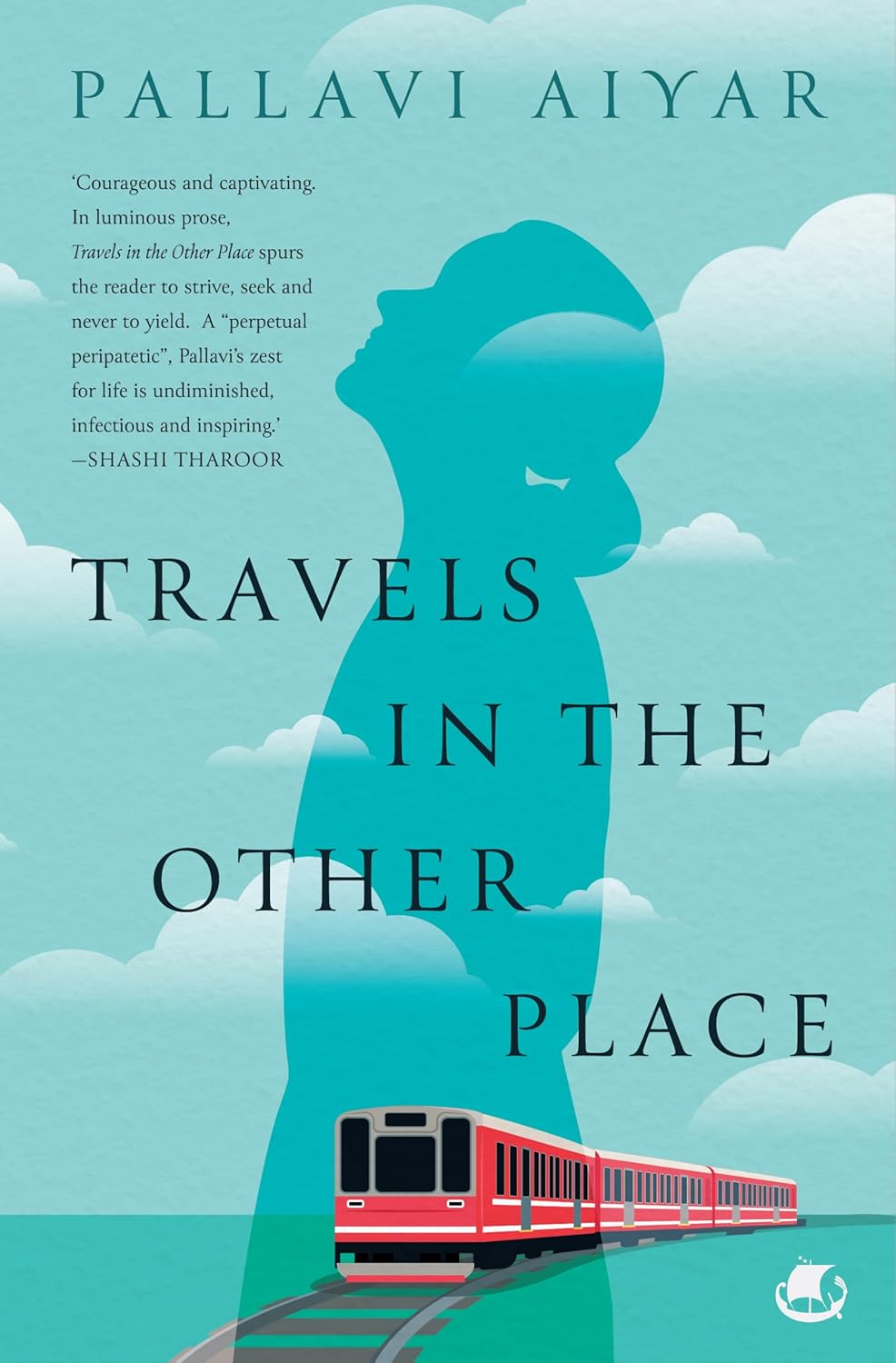
‘I had long advocated travel outside one’s comfort zone in my writings. Now I would walk the talk.’ With this arresting declaration, Pallavi Aiyar sets the tone for Travels in the Other Place, a luminous and deeply reflective collection of personal essays that blurs the boundaries between travel writing, memoir, and philosophical inquiry.
Spanning continents, decades, and inner landscapes, the book traces Aiyar’s journey from a bookish childhood in 1980s India to the profound rupture of a cancer diagnosis in Spain in 2022. Along the way, it offers readers not a conventional travelogue, but something far more intimate and searching: an exploration of how movement across borders reshapes identity, belonging, and the self.
Eight Essays, Many Worlds
Structured as eight discrete yet thematically interlinked essays, Travels in the Other Place introduces readers to the author at different stages of life, in different countries, and under markedly different emotional and intellectual conditions. Each essay functions as an encounter—sometimes with a place, sometimes with an idea, and often with a version of the author herself.
The “other place” of the title is deliberately ambiguous. It refers not only to foreign lands and unfamiliar cultures, but also to altered states of being: illness, migration, motherhood, and the quiet disorientation that accompanies life lived between languages and passports. Aiyar’s writing moves fluidly between the external terrain and the inner life, suggesting that the most challenging journeys are often the ones that take place within.
Travel Writing Reimagined
While Aiyar draws on her long career as an international correspondent, this book resists the certainties of reportage. Instead, it embraces doubt, vulnerability, and self-questioning. Episodes that might seem mundane—hair, bureaucratic paperwork, the act of parenting abroad—are treated as portals into larger questions about power, privilege, gender, and global inequality.
Illness, in particular, becomes a critical lens. The cancer diagnosis in Spain is not presented as a standalone trauma, but as a moment that reframes the author’s relationship with her body, her adopted homes, and the idea of control in a globalised world that promises mobility but delivers precarity. These passages are marked by restraint and wit rather than self-pity, making them all the more affecting.
Identity in a Fractured World
At its core, Travels in the Other Place is a meditation on identity in an era defined by both unprecedented connectivity and deepening fracture. Aiyar interrogates what it means to belong when one’s life is spread across continents, and when national, cultural, and personal identities are increasingly unstable.
Her essays reflect the tensions of being what she describes as “territorially polygamous”: at home everywhere and nowhere at once. The book is particularly resonant for readers who live transnational lives, but its insights extend far beyond that demographic. In an age of mass migration, climate anxiety, and geopolitical churn, Aiyar’s reflections feel timely and necessary.
A Voice of Wit and Humanity
Despite the gravity of its themes, the book is animated by a lightness of touch. Aiyar’s prose is elegant, witty, and sharply observant, capable of moving from humour to poignancy within a single paragraph. Her eye for the absurd—especially in encounters with bureaucracy and cultural misunderstanding—grounds the book in lived experience, preventing it from slipping into abstraction.
What distinguishes Travels in the Other Place is its refusal to offer easy resolutions. Instead of answers, it offers clarity of thought and emotional honesty. The essays invite readers to sit with uncertainty, to acknowledge discomfort, and to recognise that growth often emerges from dislocation.
About the Author
Pallavi Aiyar is a foreign correspondent, columnist, and author with over two decades of experience reporting from across the world, including China, Belgium, Japan, Indonesia, and Spain. She is the author of eight books and is widely recognised for her ability to combine geopolitical insight with cultural and personal nuance.
In addition to her books and journalism, Aiyar writes a weekly newsletter on global travel and culture on Substack, The Global Jigsaw, where she continues to explore the intersections of place, politics, and everyday life. She is currently based in Beijing, China.
A Book for the Restless and the Reflective
Travels in the Other Place will appeal to readers of literary non-fiction who are drawn to thoughtful, hybrid forms of writing. It speaks to travellers, expatriates, and anyone who has felt the quiet unease of standing between worlds. More than a record of journeys undertaken, it is a meditation on how movement—chosen or imposed—reshapes who we are.
In charting her own passage through illness, migration, and memory, Pallavi Aiyar offers a mirror to our times: a world on the move, uncertain of its bearings, yet still searching for meaning, connection, and grace.

 Bookshotsapp
Leave a comment