
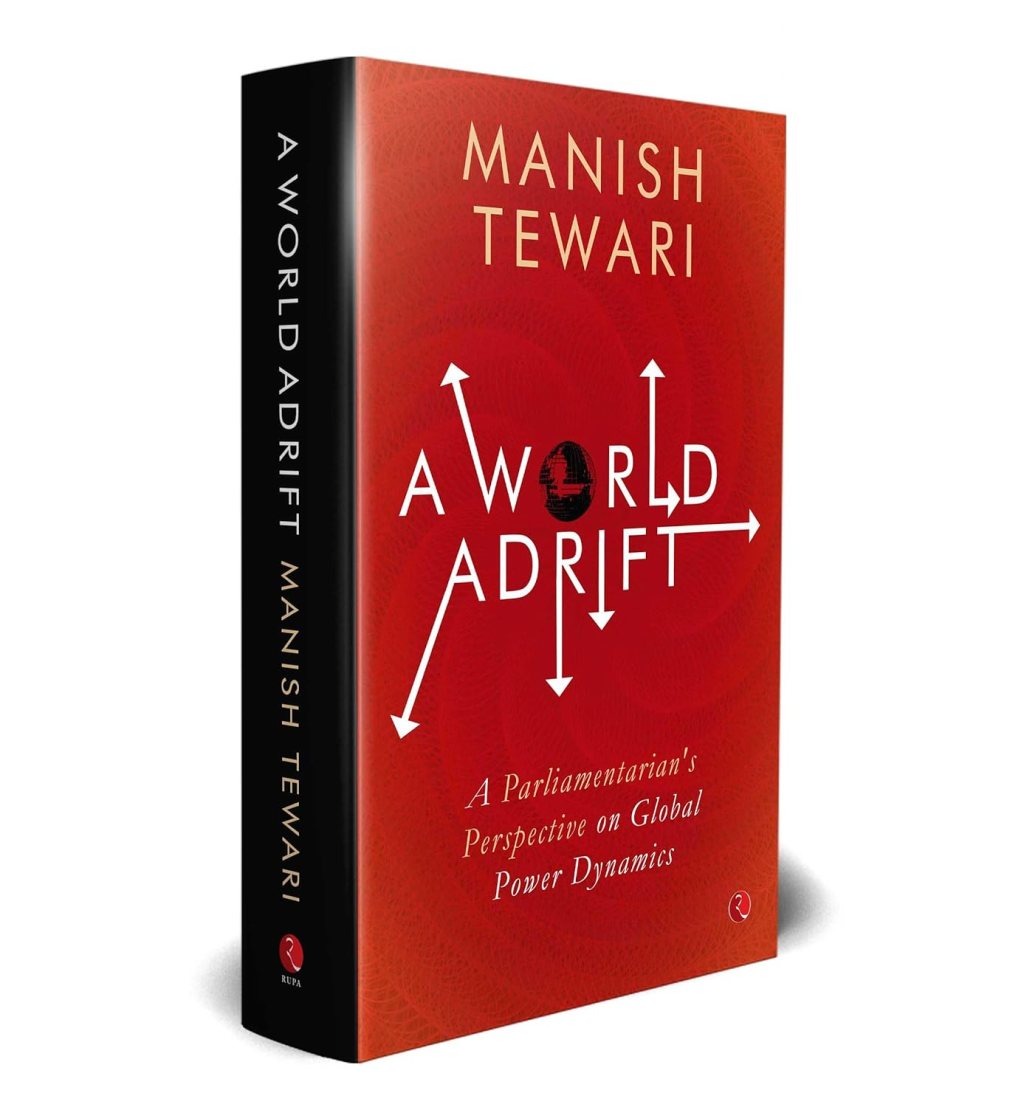
In a moment of global uncertainty marked by shifting alliances, ideological flux and accelerating technological change, A World Adrift arrives as a timely and intellectually ambitious intervention. Written by senior parliamentarian and former Union Minister Manish Tewari, the book offers a wide-ranging examination of geopolitics and statecraft at a time when the certainties of the post–Cold War order have visibly frayed.
Priced at INR 995 and spanning 552 pages, A World Adrift is neither a conventional survey of international relations nor a partisan political tract. Instead, it positions itself as a reflective yet unsparing meditation on how power is exercised, constrained and contested in a world where old doctrines collide with new realities, and where ideological frameworks struggle to keep pace with rapid change.
A World in Transition
Tewari’s central argument is that the international system is passing through a phase of profound transition. The book traverses regions and themes with confidence—from the shifting strategic chessboard of Asia to the enduring turbulence of the Greater Middle East—mapping the fault lines that will shape global politics in the decades to come. These are not presented as isolated theatres of conflict, but as interconnected arenas where history, ambition, technology and ideology intersect.
What distinguishes A World Adrift is its insistence on ambiguity as the defining condition of our times. The author suggests that the collapse of familiar frameworks has not yet been followed by the emergence of stable new ones, leaving nations to navigate an unsettled landscape marked by flux rather than equilibrium. This uncertainty, Tewari argues, demands a recalibration of how states think about power, alliances and long-term strategy.
Beyond Geopolitics: The Craft of Statecraft
While geopolitics provides the structural spine of the book, its deeper concern lies with the art of statecraft. Tewari examines how technology, ideology and tradition now coexist in an uneasy embrace, reshaping both the tools and the limits of political action. Cyber capabilities, artificial intelligence and information warfare appear alongside more traditional concerns of territory, military power and diplomacy.
The book repeatedly returns to the idea that effective statecraft today requires not just moral clarity or rhetorical ambition, but hard-headed realism. In doing so, it challenges comforting assumptions and urges policymakers to confront difficult trade-offs rather than defer them.
India at the Crossroads
A significant portion of A World Adrift is devoted to India’s place in this unsettled global order. Writing from the vantage point of a seasoned parliamentarian deeply engaged with national security and foreign policy, Tewari portrays India as a nation uniquely positioned—armed with civilisational depth, democratic resilience and strategic opportunity, yet constrained by internal contradictions and capacity gaps.
The book poses an urgent question: will India seize the tailwinds of history and act decisively to shape its destiny, or will it remain hesitant, constrained by vacillation and institutional inertia? Tewari’s answer is neither fatalistic nor triumphalist. Instead, he calls for the political courage to practise tough, pragmatic politics grounded in national interest and strategic foresight.
An Insider’s Perspective
Tewari’s long career lends the book a distinctive authority. A lawyer by training and a three-term Member of Parliament, he has served as Union Minister of Information & Broadcasting and held positions on key Cabinet and Parliamentary Committees, including Finance, Defence and External Affairs. His involvement in shaping India’s data-protection legislation and his work on national security issues inform many of the book’s most incisive passages.
Equally significant is his experience beyond India’s borders, including his tenure as a Senior Fellow at the Atlantic Council in Washington, D.C. This global exposure allows A World Adrift to move fluently between domestic imperatives and international dynamics, avoiding parochialism while remaining firmly anchored in India’s strategic concerns.
A Call to Attention
Written in a tone that combines urgency with reflection, A World Adrift is addressed to a broad readership: students of history and international relations, policymakers, and citizens seeking to make sense of an increasingly unstable world. It does not offer easy answers or predictive certainties. Instead, it asks readers to engage seriously with complexity and to recognise that history rewards neither complacency nor indecision.
More than a chronicle of global disorder, the book functions as a call to awareness—and to action. As the tides of history continue to shift, A World Adrift challenges India, and indeed the wider world, to decide whether it will navigate with purpose or remain stranded amid the currents of change. The voyage, as Tewari makes clear, has already begun.

 Bookshotsapp
Leave a comment