
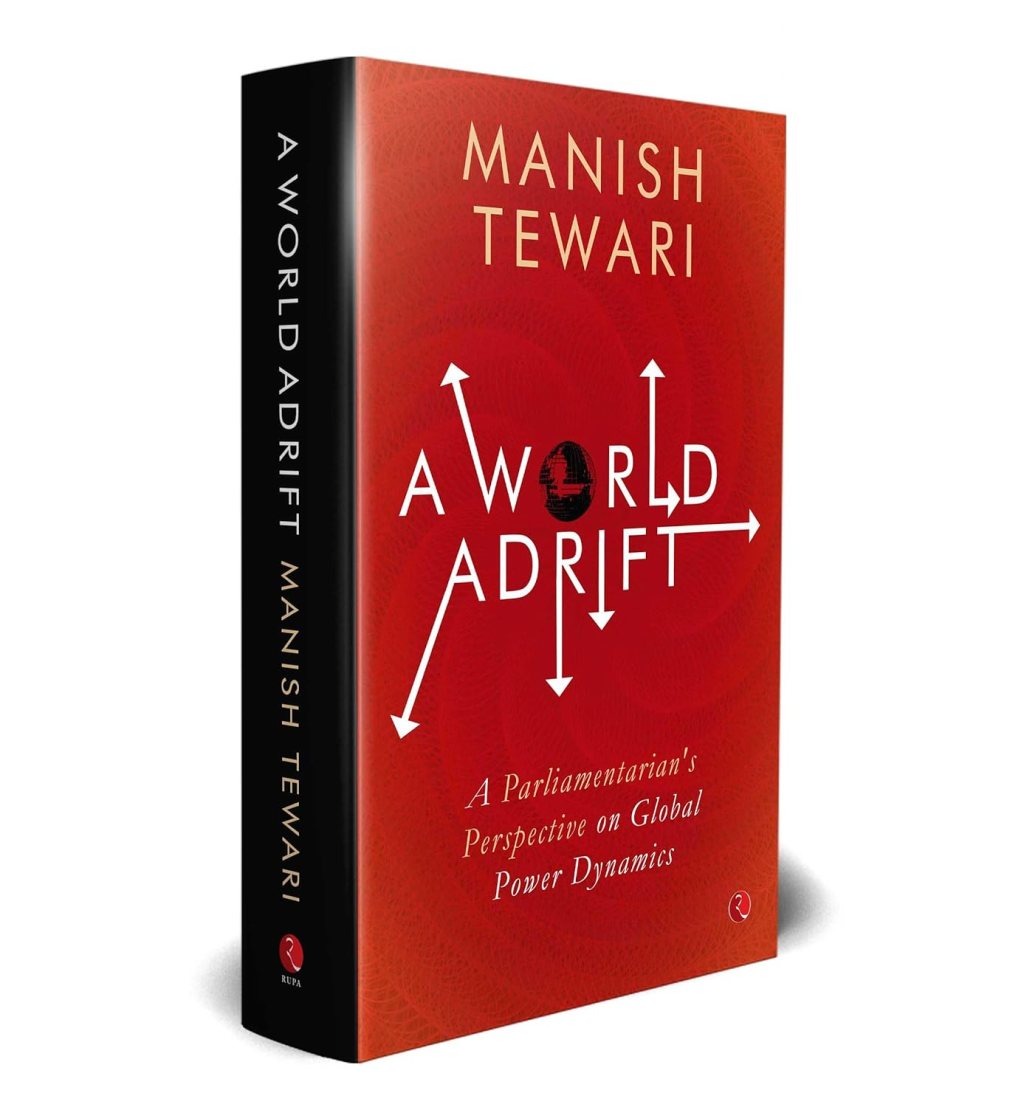
There is a quiet urgency running through A World Adrift. Not the breathless urgency of instant commentary, but the deeper unease of someone watching history accelerate faster than institutions can cope. Manish Tewari’s latest book arrives at a moment when the certainties of the post-1945 world order are visibly crumbling, and what replaces them remains stubbornly unclear.
Launched at the India International Centre in New Delhi, the book prompted a wide-ranging conversation on global disorder, strategic autonomy, and the unsettling speed at which international politics is being rewritten.
Beyond a Parliamentarian’s Perspective
Former Union finance minister and veteran diplomat Yashwant Sinha, who released the book, described it as “exceptionally brilliant” — and crucially, much more than a parliamentarian’s view of foreign affairs. That distinction matters.
A World Adrift does not read like a collection of speeches or policy notes. Instead, it is a layered examination of a world that has slipped into what Tewari calls an “orderless” phase — where old rules no longer apply, new ones are yet to stabilise, and power vacuums are opening across regions.
When History Accelerates Faster Than Institutions
At the heart of the book lies a simple but unsettling proposition: the post-Second World War global order has effectively collapsed. What follows such collapses, Tewari argues, is never neat. Transitions are messy, unstable, and often violent.
The book traces this churn through five interlinked themes — the erosion of the old order, the relentless rise of China, India’s struggle to preserve strategic autonomy, a revolution in military affairs, and the emergence of geopolitical vacuums with no obvious claimants.
China’s Rise and the End of Strategic Comfort
One of the book’s strengths is its refusal to treat China’s ascent as a sudden rupture. Tewari situates it as a long arc beginning in 1978 — an arc that has now entered a more assertive and potentially coercive phase.
For India, this reality demands constant recalibration rather than fixed alignments, especially as global power centres themselves appear fatigued and inward-looking.
Strategic Autonomy Begins at Home
Perhaps the book’s most compelling intervention is its insistence that geopolitics cannot be divorced from domestic cohesion. For India, Tewari argues, strategic autonomy cannot be sustained by diplomacy alone.
Pluralism, he warns, is no longer a luxury that can be taken for granted; it is a strategic necessity. A society weakened by internal polarisation inevitably compromises its ability to negotiate, deter, and lead in an increasingly hostile world.
The United States: An Exhausted Hegemon
Drawing from his engagement with Washington during the first Trump presidency, Tewari identifies a recurring sentiment: American exhaustion. The United States, long the external balancer of global power, appears increasingly unwilling to shoulder that role.
Its retreat from multilateral institutions and its growing unilateralism signal not a temporary pause but a conscious shift. If the US steps back from maintaining equilibrium, Tewari suggests, instability will not remain regional — it will become systemic.
Europe’s Test of Relevance
Europe, too, stands at a crossroads. How it responds to emerging flashpoints — particularly those that test territorial sovereignty — will determine whether NATO and the broader European project retain strategic coherence in a harsher world.
The coming years, Tewari argues, may well decide whether Europe remains a strategic actor or recedes into geopolitical irrelevance.
A Restless Neighbourhood and New Forms of Disruption
Closer home, A World Adrift raises uncomfortable questions about India’s neighbourhood. The oft-repeated slogan of “Neighbourhood First” is interrogated with a blunt query: is there a corresponding “India First” sentiment across the region?
Political churn in Sri Lanka, Bangladesh, and Nepal is examined through the lens of social media mobilisation, manufactured narratives, and the weaponisation of grievances. These disruptions, Tewari suggests, reflect a widening gap between popular aspirations and the capacity of governments to deliver.
Writing Geopolitics in Real Time
Importantly, the book resists fatalism. On Bangladesh, Tewari dismisses the idea that India has “lost” the relationship, pointing instead to deep historical, emotional, and political ties that endure beyond momentary diplomatic strain.
The book is also candid about the difficulty of writing geopolitics when assumptions can be overtaken by events within weeks. Rather than offering fixed predictions, Tewari maps forces and pressures — acknowledging that uncertainty itself is now a permanent feature of global affairs.
I had the opportunity to assist during the final stages of the manuscript, focusing on editorial review and risk checks. Working on a book anchored in geopolitics at a moment of such rapid global flux was itself a rigorous learning experience.
Navigating an Orderless World
Ultimately, A World Adrift is less a prediction of what the new world order will look like, and more a guide to navigating its absence. It argues that in a time of chaos and churn, strategic autonomy is not about rigid alliances or rhetorical posturing, but about preserving space — diplomatic, political, and social — to act on one’s own terms.
In an era where the unimportant often crowds out the essential, this is a book that insists on slowing down, thinking deeply, and confronting uncomfortable truths. That alone makes it a necessary read.


 Bookshotsapp
Leave a comment