
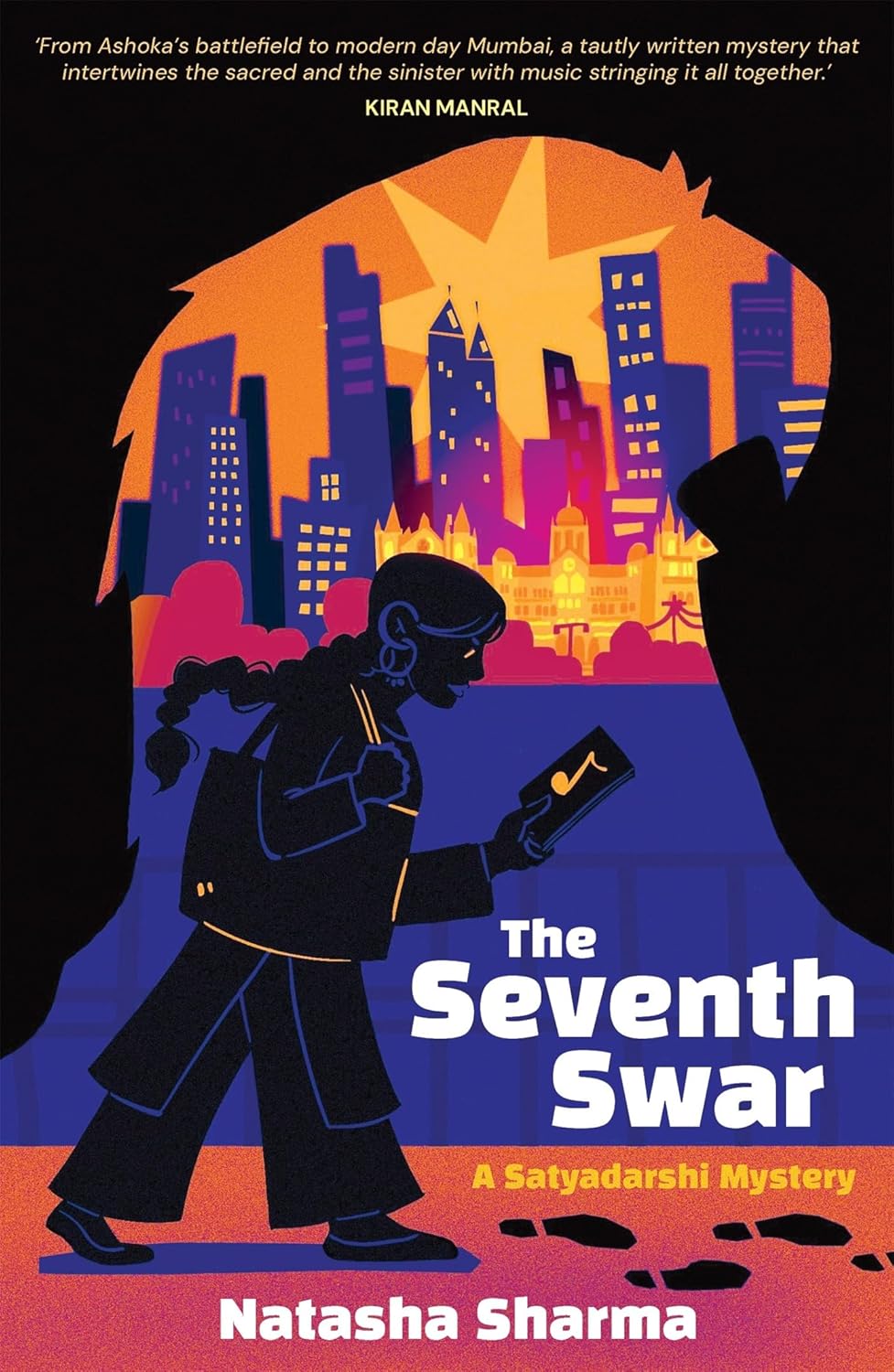
At first glance, the case seems unremarkable. An elderly woman has been found brutally stabbed in her Mumbai flat, and Satyadarshi — a former police officer now working as a private investigator — assumes she is walking into another grim but familiar assignment. That illusion doesn’t last long.
As the investigation unfolds, the crime begins to echo with disquieting oddities. A recurring wall hanging appears too often to be coincidental. Classical music hides patterns that refuse to stay decorative. A battered old book seems to whisper stories far older than the murder itself. Slowly, the case pulls Satyadarshi into a past she never expected to confront — one that reaches back to the reign of Emperor Ashoka and curls its way into her own family history.
Natasha Sharma’s The Seventh Swar thrives on this uneasy overlap between the contemporary and the ancient. It is a murder mystery, yes, but one that hums with history, music, and personal reckoning.
What anchors the novel is its protagonist. Satyadarshi is not a stylised detective cut from noir tradition. She is fallible, emotionally cluttered, and deeply human. She second-guesses herself, navigates a messy personal life, and carries unresolved tensions that shape how she sees the world. Sharma allows her detective to be intelligent without being infallible — a choice that makes her instantly relatable.
The supporting cast adds warmth and levity. There is a mother determined to marry her off, an assistant who grounds her, an investigation involving a distinctly unfit South Bombay dog, and an almost-romance marked by geeky trivia and inconvenient physical chemistry. Even the author’s own dog makes a brief appearance, blurring the line between fiction and affectionate indulgence.
What truly distinguishes The Seventh Swar is its sensory relationship with Mumbai. The city is not merely a backdrop but a living presence — sticky, loud, overwhelming, and intimate. Sharma writes with an acute awareness of smell, sound, and texture, making the reader feel the city’s pulse as keenly as the characters do. The prose is sharp and playful, never straining for effect.
The historical thread — centred on Ashoka and the idea of legacy — could have felt overstretched, but Sharma integrates it with restraint. The novel’s use of symbols, codes, and cultural memory invites comparison with popular historical thrillers, yet it remains rooted in an Indian intellectual and emotional landscape rather than borrowed spectacle.
Despite its expanding scope, the book maintains a brisk pace. The narrative moves confidently between humour and menace, romance and violence, never losing control of its tone. Importantly, it manages to be gripping without reveling in brutality. The murders are unsettling, but never gratuitous.
Ultimately, The Seventh Swar is an inventive blend of genres — crime, romance, and historical intrigue — that feels both accessible and thoughtful. It offers the pleasures of a classic whodunit while asking larger questions about inheritance, identity, and the ways the past continues to shape the present.
For readers who enjoy mystery without excessive bloodshed, and stories where intellect and emotion coexist, this novel strikes a rare and satisfying note — one that lingers, like a half-remembered melody, long after the final page.
 Bookshotsapp
Leave a comment