
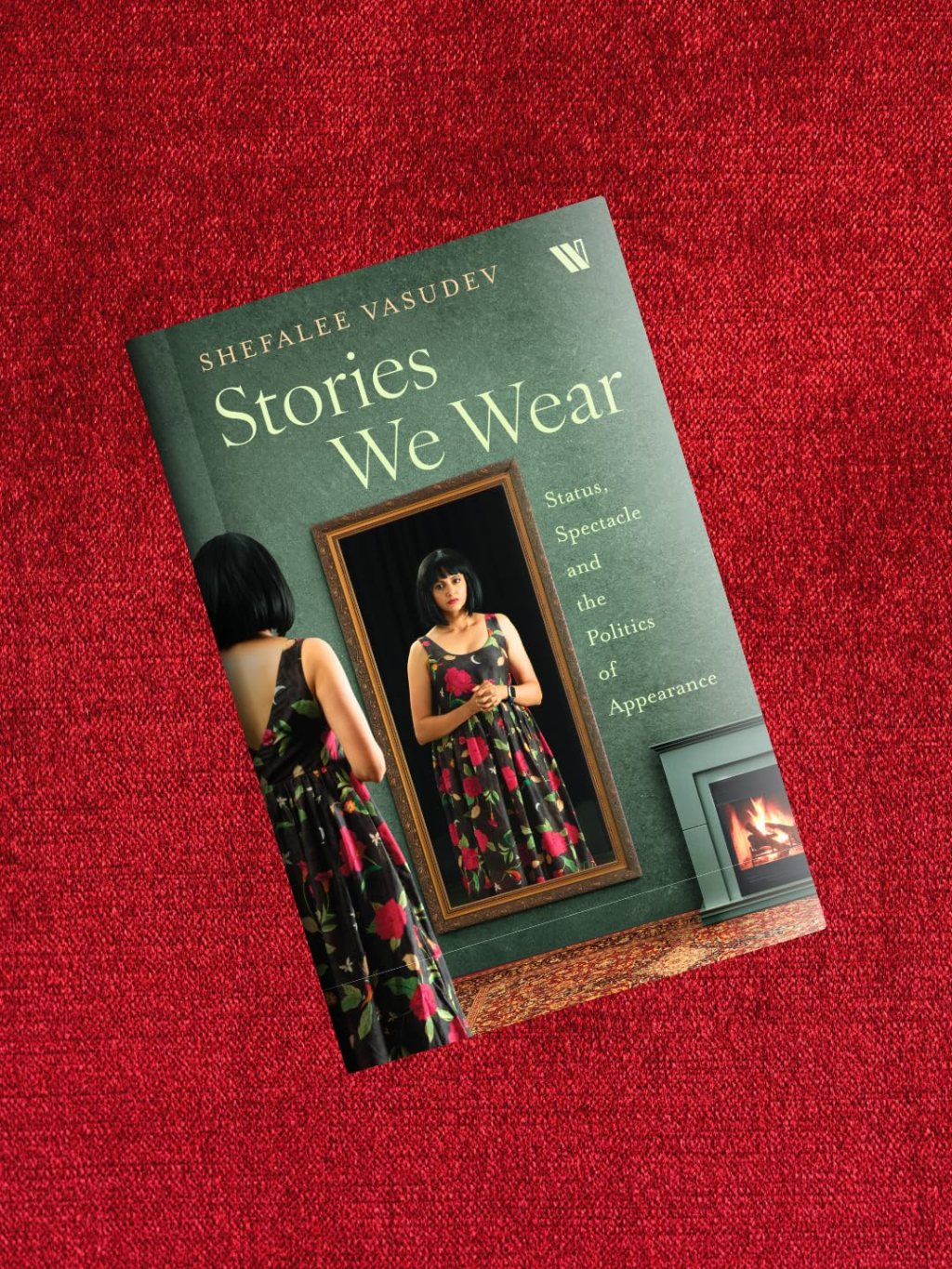
Clothes speak long before we do. They announce who belongs, who aspires, who resists and who grieves. In Stories We Wear, journalist and cultural commentator Shefalee Vasudev turns her attention to this quiet but powerful language, offering a layered portrait of India through what its people choose—or are compelled—to wear.
At a time when fashion discourse is dominated by trend cycles and algorithm-friendly visuals, Vasudev’s book feels deliberately unhurried. It asks readers to pause and consider clothing not as decoration or desire, but as evidence: of history, social position, personal memory and political meaning.
Clothing as Social Evidence
Vasudev approaches fashion as a form of cultural documentation. A sari worn daily, a uniform put on without choice, khadi draped with intention, or even an outfit selected for airport travel—each becomes a clue to how Indians navigate visibility, power and belonging.
Drawing from years of reportage and observation, she moves effortlessly between personal essays and broader social commentary. Her writing treats garments as lived objects, shaped by caste, class, gender, aspiration and loss. Fashion here is not aspirational fantasy; it is lived reality.
Across Spaces, Across Lives
One of the book’s strengths lies in its range. Vasudev’s lens travels through unexpected settings—villages, cafés, burn wards, cremation grounds, film and OTT narratives, influencer culture and airports. Each space reveals a different relationship between clothing and identity.
The airport, for instance, emerges as a contemporary theatre of aspiration. What people wear there, she suggests, reflects not just comfort or style, but the performance of mobility in a country where movement itself signals privilege. Similarly, her reflections on screen heroines and “anti-heroines” unpack how costume shapes the moral and emotional vocabulary of popular culture.
Khadi, Memory and Misunderstanding
Vasudev’s engagement with khadi is among the book’s most thoughtful sections. Once inseparable from ideas of sacrifice and political resistance, khadi’s repeated rebranding as fashion raises difficult questions about what is remembered, what is erased, and what is conveniently repackaged.
Rather than romanticising the fabric, she interrogates the gap between symbolism and lived practice—highlighting how heritage can be flattened when stripped of context.
Where Fashion Meets Fragility
Some of the book’s most arresting moments come from its quieter, heavier chapters. Essays that engage with injury, illness and death show how clothing acquires a different weight in moments of vulnerability. Here, garments are no longer performative—they become intimate markers of survival, dignity and farewell.
These sections are written with restraint and empathy, underscoring Vasudev’s insistence that fashion does not vanish in times of pain. Instead, it reveals truths we would rather not confront.
Beyond Glamour
Vasudev dismantles the idea that fashion belongs solely to designers, celebrities or glossy magazines. Her focus consistently returns to ordinary people and the unconscious choices they make every day. Whether driven by necessity, fear, conformity or hope, these choices form a visual record of social life.
The book quietly challenges readers to reconsider their own assumptions about fashion—who it includes, who it excludes, and why the word itself often feels inaccessible.
A Thoughtful Cultural Portrait
Stories We Wear is neither a style manual nor a trend forecast. It is a reflective, often unsettling examination of how Indians dress their identities and negotiate contradictions in a rapidly changing society.
Shefalee Vasudev writes with clarity, curiosity and moral seriousness. Her strength lies in asking the right questions and allowing the answers to remain complex.
In the end, this is a book that doesn’t tell readers what to wear. It asks them to notice—what they already do.




 Bookshotsapp
Leave a comment