
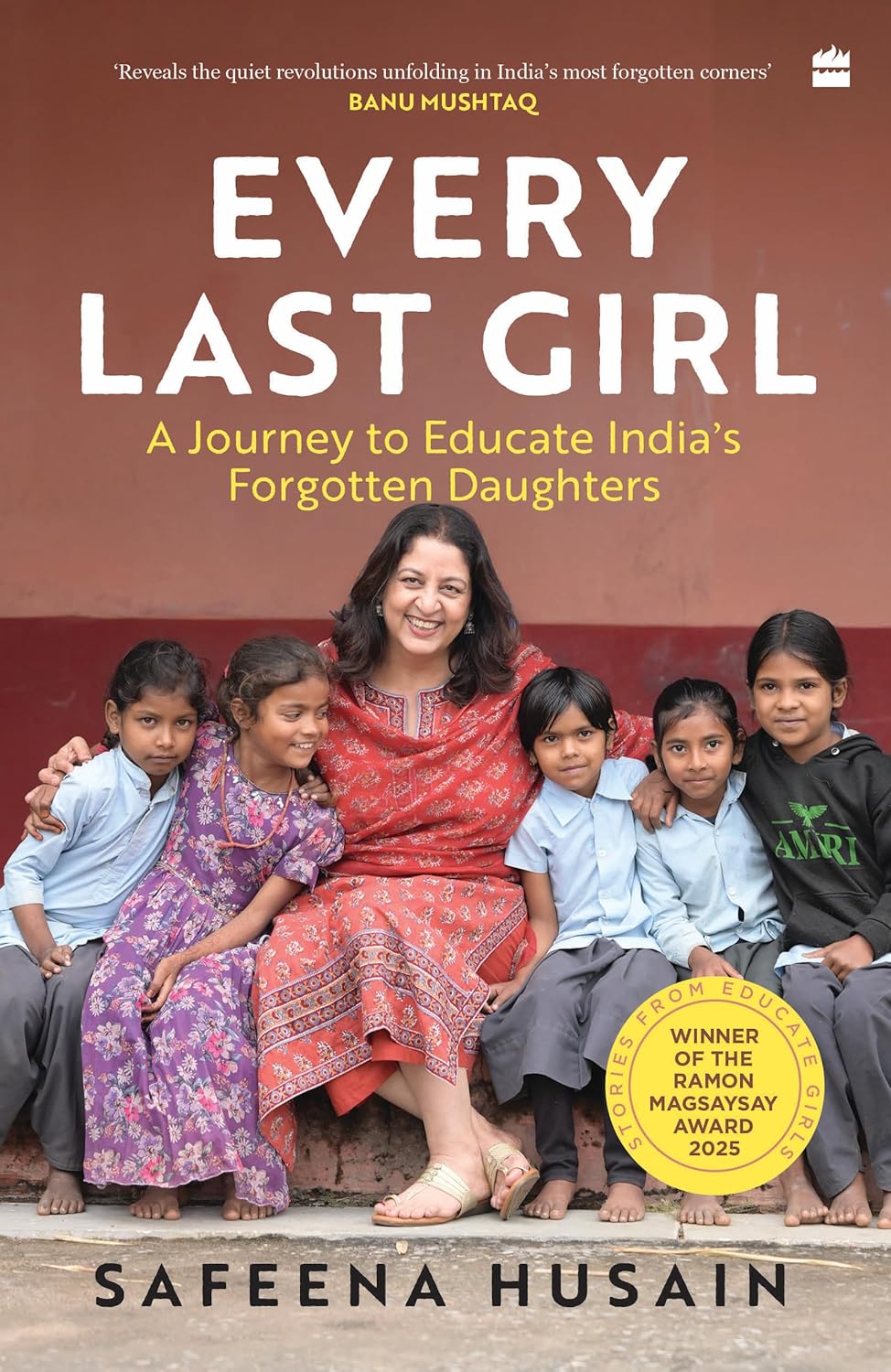
Some books document change. Others explain it. Every Last Girl does something rarer—it shows how change is patiently built, village by village, child by child, often against staggering odds.
Written by Safeena Husain, founder of the non-profit Educate Girls, the book chronicles nearly two decades of work to bring some of India’s most marginalised girls back into classrooms. But this is not a celebratory organisational history. It is an honest, grounded account of what it takes to build trust, challenge social norms, and sustain hope in places where education for girls is still seen as optional—or even undesirable.
From a Small Beginning to a National Movement
The story begins in 2007, when Educate Girls was working in just 50 villages in Rajasthan. Today, the organisation operates in over 30,000 villages across some of India’s most underserved districts and has helped more than two million girls return to school. The scale is impressive, but Husain is careful not to let numbers overshadow the human effort behind them.
What emerges clearly is that Educate Girls did not grow because of a single intervention or idea, but through consistent community engagement—working with parents, village leaders, teachers and local volunteers to shift long-held beliefs about girls’ education.
The Power of Community-Led Change
One of the book’s central arguments is that lasting social change cannot be imposed from outside. Husain details how the organisation built a volunteer force of over 55,000 people—many of them from the same communities they serve. These volunteers become advocates, negotiators and, often, quiet revolutionaries within their own villages.
Girls who were once invisible—kept at home for domestic work, married early, or lost to migration—are identified, supported and brought back into learning spaces. The book shows how each success is hard-won, involving countless conversations, resistance, setbacks and second chances.
Stories That Stay With You
What gives Every Last Girl its emotional weight are the stories woven throughout. Husain brings readers into rural classrooms, into family homes, and into conversations with parents who are torn between survival and aspiration. These narratives reveal how poverty, gender norms, displacement and systemic neglect intersect to keep girls out of school.
Importantly, the girls are not portrayed as passive recipients of help. Their courage, curiosity and determination emerge strongly, reminding readers that education is not just about access, but about dignity and possibility.
Data, Technology and Ground Reality
Alongside storytelling, the book also explores how Educate Girls uses data and technology— including AI and machine learning—to track enrolment, learning outcomes and drop-out risks. Rather than presenting technology as a magic solution, Husain frames it as a tool that strengthens human effort and accountability.
This balance between data-driven decision-making and deeply human engagement is one of the organisation’s defining features, and the book explains it with clarity and humility.
A Personal Reflection
Husain’s personal reflections lend the book its quiet urgency. She acknowledges that the only real difference between her life and the lives of many girls she meets is access to education. This awareness runs through the narrative—not as guilt, but as responsibility.
Her writing makes it clear that educating a girl does more than change one life. It reshapes family expectations, alters community norms and challenges what society believes is possible for women and girls.
Why This Book Matters Now
In 2025, Educate Girls became the first Indian organisation to receive the Ramon Magsaysay Award, recognising its pioneering, scalable, community-led approach to girls’ education. That honour gives Every Last Girl additional context, but the book stands firmly on its own.
At a time when conversations about education often focus on policy frameworks and global targets, this book pulls attention back to the individual girl—the one who is still missing from school registers, still waiting to be seen.
Final Thoughts
Every Last Girl is not a feel-good story, nor is it a manifesto. It is a patient, persuasive reminder that progress is built through persistence. It asks readers not just to admire impact, but to understand the work behind it.
Above all, it leaves you with a simple, unsettling question: if we know what becomes possible when a girl is educated, why would we ever accept leaving even one behind?
This is a book that stays with you—quietly urging action, long after the last page is turned.



 Bookshotsapp
Leave a comment