
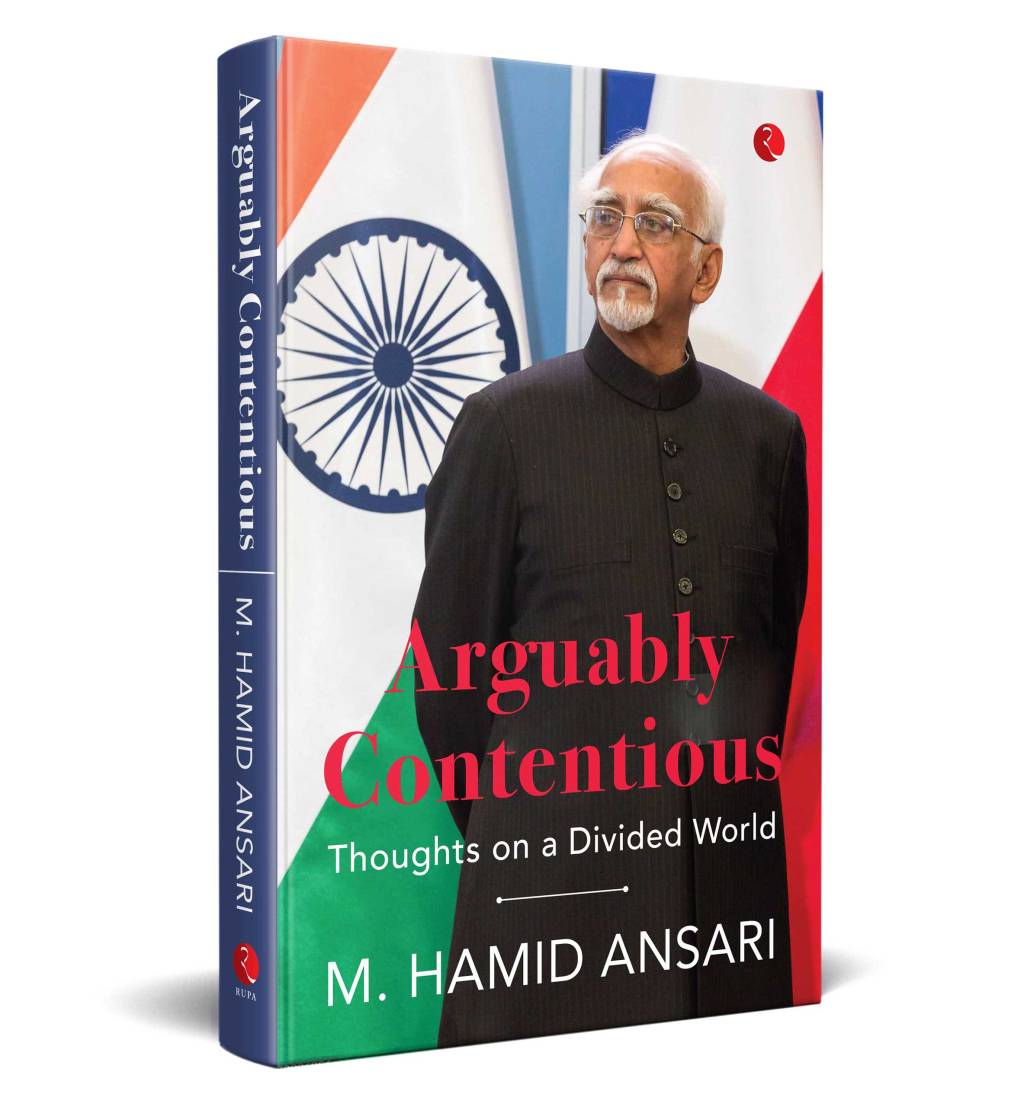
In Arguably Contentious: Thoughts on a Divided World, former Vice President of India M. Hamid Ansari offers neither polemic nor provocation for its own sake. Instead, he presents a calm, deeply reasoned meditation on India and the world at a time when certainties are eroding and divisions—social, political and ideological—are hardening. The book draws on Ansari’s long career as a diplomat, academic and constitutional functionary, and reflects a lifetime spent engaging with questions of pluralism, statecraft and democratic responsibility.
Written in the measured voice of a seasoned statesman, the volume brings together essays, lectures and speeches that collectively examine how India’s internal challenges intersect with its global engagements.
India’s Democratic Moment of Reckoning
At the heart of the book lies an anxious concern for the state of Indian democracy. Ansari engages with issues that have come to define contemporary public life: the deepening of social divisions, the contested meaning of secularism, and the narrowing space for dissent. His analysis is rooted not in ideological confrontation but in constitutional morality—the principles of equality, citizenship and justice that form the bedrock of the republic.
Rather than sounding alarmist, Ansari adopts a reflective tone, urging readers to recognise how subtle departures from constitutional norms can cumulatively weaken democratic institutions. The question he repeatedly returns to is not merely political, but moral: what kind of India is being shaped by present choices?
Pluralism Under Pressure
One of the book’s most compelling strands is its sustained engagement with pluralism. Ansari treats diversity not as a slogan, but as a lived and negotiated reality. He reflects on the implications of majoritarian thinking and the marginalisation of minority voices, warning that the erosion of pluralism threatens the social compact that holds India together.
His writing here is marked by restraint, yet the implications are unmistakable. Democracy, he suggests, cannot survive on electoral legitimacy alone; it requires an ethical commitment to inclusion and dialogue.
West Asia Through a Diplomat’s Lens
Beyond India’s domestic concerns, Arguably Contentious turns to global affairs, with particular attention to West Asia—a region Ansari knows intimately through decades of diplomatic engagement. His essays trace the political upheavals unleashed by the Arab Spring, the shifting alignments of regional and global powers, and the enduring instability that defines much of the region today.
What distinguishes Ansari’s perspective is his insistence on historical context. Events are not treated as isolated crises but as outcomes shaped by colonial legacies, state formation, and unresolved political questions. This approach lends depth and balance to his analysis, avoiding the simplifications that often dominate discussions of West Asia.
India’s Foreign Policy: Values and Interests
Ansari’s reflections on foreign policy are guided by a central conviction: India’s engagement with the world must be anchored in both values and interests. He argues that India’s civilizational and strategic ties with West Asia demand a nuanced diplomacy—one that is pragmatic without being opportunistic, and principled without being rigid.
Importantly, he links India’s international credibility to its internal cohesion. A nation struggling with democratic erosion at home, Ansari implies, risks losing moral authority abroad. Foreign policy, in his telling, cannot be divorced from the health of domestic institutions.
A Lifetime of Thought, Brought Together
Structurally, the book brings together writings produced over many years, yet it maintains a striking thematic coherence. Diplomacy, dialogue, restraint and constitutionalism recur as guiding ideas. The essays may differ in context and occasion, but they converge on a single concern: how states and societies navigate conflict without surrendering to polarisation.
The historical grounding Ansari provides throughout the book enriches its arguments, reminding readers that today’s crises are rarely without precedent—and that lessons from the past remain relevant.
A Voice of Reason in an Age of Noise
Arguably Contentious: Thoughts on a Divided World is not a book of easy answers. It demands attention, patience and reflection. Ansari does not seek to persuade through rhetoric, but through reason. In an era dominated by sharp binaries and loud certitudes, his insistence on empathy, dialogue and constitutional values feels both old-fashioned and urgently necessary.
For readers interested in Indian democracy, foreign policy and the ethical dimensions of public life, this book offers a rare combination: intellectual seriousness without abstraction, and political critique without polemic. Above all, it reaffirms the value of restraint and thoughtfulness—qualities that remain indispensable to both democracy and diplomacy.


 Bookshotsapp
Leave a comment