
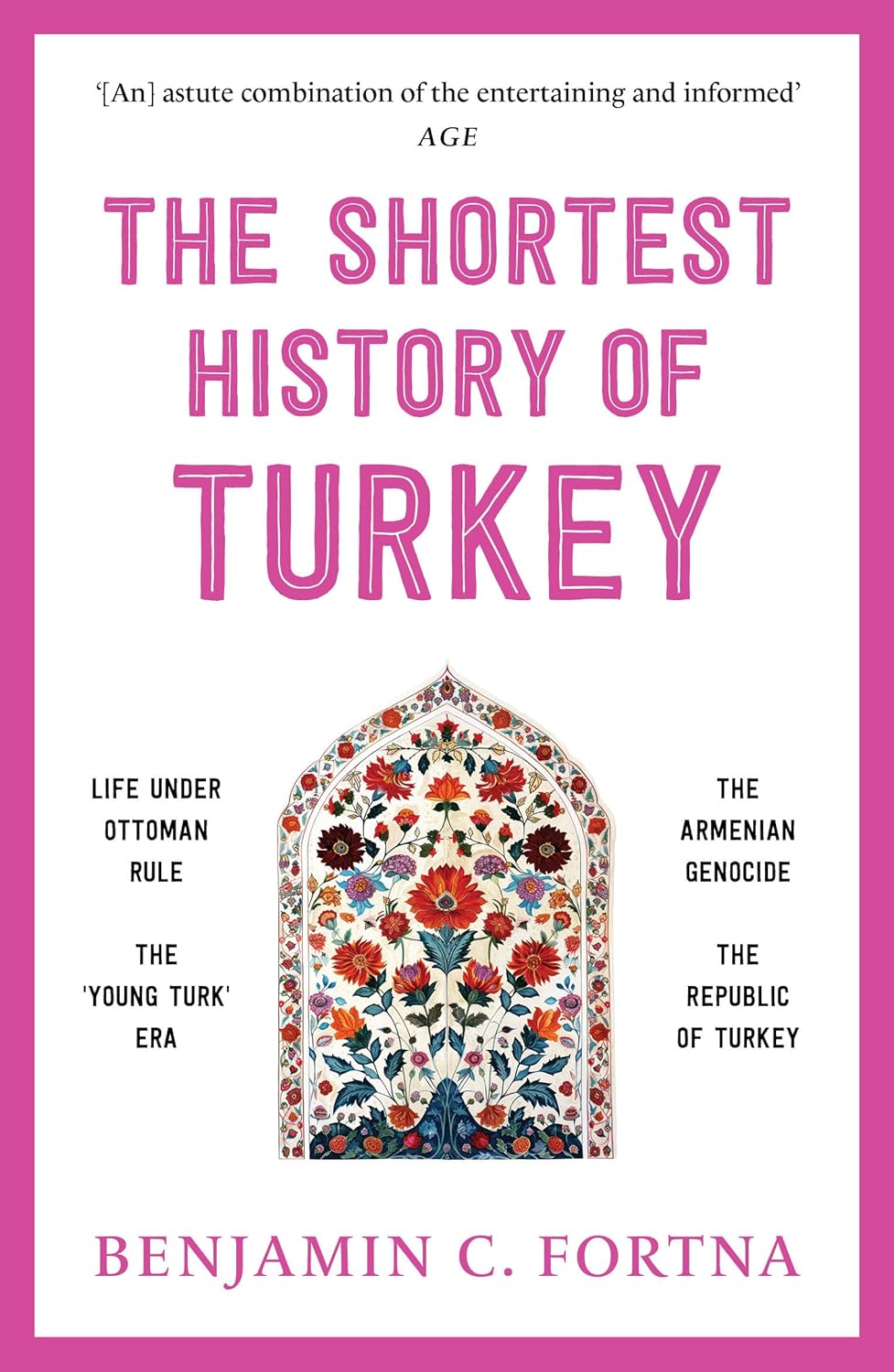
Some books explain a country. Others make you feel its contradictions. The Shortest History of Turkey belongs firmly to the latter category. Reading Benjamin C. Fortna’s book is less like moving briskly through a timeline and more like standing at a crossroads where empires, faiths, ideologies and ambitions continue to collide.
Turkey has long been described as a bridge between worlds, but Fortna makes it clear that this is not a comfortable or neutral position. It is a place of tension, argument and constant negotiation. By the time one reaches the final pages, it becomes evident that modern Turkey cannot be understood without listening closely to the echoes of its past—echoes that refuse to fade, no matter how often political regimes attempt to silence or reshape them.
Where History Begins Matters
Although the lands of present-day Türkiye carry some of the oldest traces of human civilisation on earth—Palaeolithic cave dwellers, Neolithic settlements over 12,000 years old, and the rise and fall of Greek, Persian and Roman power—Fortna makes a deliberate choice to begin in the Middle Ages. His story opens with the arrival of Turkic peoples in the eleventh century, a moment that sets in motion nearly a thousand years of political, cultural and religious transformation.
The early chapters, covering the Seljuks and the rise of the Ottomans, move swiftly but confidently. Fortna does not linger on spectacle or military triumph for its own sake. Even the epoch-defining capture of Constantinople in 1453 is treated with restraint. Instead, the emphasis lies in understanding how an empire functioned, adapted and governed an astonishingly diverse population—Christians, Jews, Muslims and others—across three continents.
This measured approach allows the reader to grasp a crucial insight: the Ottoman Empire was not merely a precursor to modern Turkey, but a complex political and cultural system whose legacies continue to shape contemporary debates. Fortna is particularly attentive to the empire’s final century, when reform, anxiety and experimentation coexisted with decline. The nineteenth century emerges as a laboratory of ideas—constitutionalism, centralisation, secular administration and identity politics—that would later be recast in the language of nationalism.
Collapse, Reinvention and the Burden of Modernity
It is in the second half of the book that the narrative deepens and, at times, deliberately weighs on the reader. The collapse of the Ottoman Empire after World War I and the birth of the Turkish Republic mark not a clean break, but a violent and contested reimagining of society. Under Mustafa Kemal Atatürk, the new state pursued an uncompromising vision of secularism, modernity and ethnic unity. Religion was pushed from public life, the past was reinterpreted, and a single-party state enforced a new national identity with remarkable discipline.
Yet Fortna resists simple judgments. The Kemalist project is shown not only as authoritarian, but also as deeply formative—laying the foundations of modern education, law and governance. At the same time, the book makes clear that repression does not erase belief or memory. Instead, it stores them, waiting for new political openings.
What follows is a dense, often exhausting—but deeply illuminating—account of Turkey’s political evolution across the twentieth and early twenty-first centuries. Military coups, fragile democracies, ideological shifts and the slow re-emergence of Islam in public life are all traced with careful attention. One of Fortna’s most compelling arguments is that Turkish politics has repeatedly returned to two grand narratives: the glory of the Ottoman past and the secular authority of Atatürk. Each generation reshapes these figures to suit its needs, turning history into a political instrument.
By the time the narrative reaches the era of Recep Tayyip Erdoğan, the reader understands that his leadership did not arise in a vacuum. Fortna situates contemporary authoritarian populism within a long tradition of strong central authority, moral vision and historical reinterpretation. The present, in this telling, is less a rupture than a culmination of unresolved tensions—between faith and secularism, plurality and unity, memory and reinvention.
Reading the Present Through a Thousand Years of History
What makes The Shortest History of Turkey particularly effective is Fortna’s refusal to oversimplify. This is not a story of inevitable decline or linear progress. It is a story of recurrence, contradiction and adaptation. The book demands attention, especially in its later chapters, but the effort is rewarded with clarity. By the end, Turkey appears not as an enigma, but as a nation wrestling—sometimes painfully—with the weight of its own history.
For readers unfamiliar with Turkish history, the book offers an accessible entry point. For those already acquainted with the Ottomans or the modern republic, it provides a valuable reframing. Above all, it succeeds in its most important task: helping the reader understand modern Turkey as the product of a millennium-long conversation—one that is still ongoing, and still unresolved.
When the book closes, what lingers is not a list of dates or leaders, but a sense of continuity. Empires fall, republics rise, ideologies shift—but the struggle to define Turkey’s identity endures. Fortna’s achievement lies in showing that to understand Turkey today, one must first learn how deeply its past continues to speak.

 Bookshotsapp
Leave a comment