
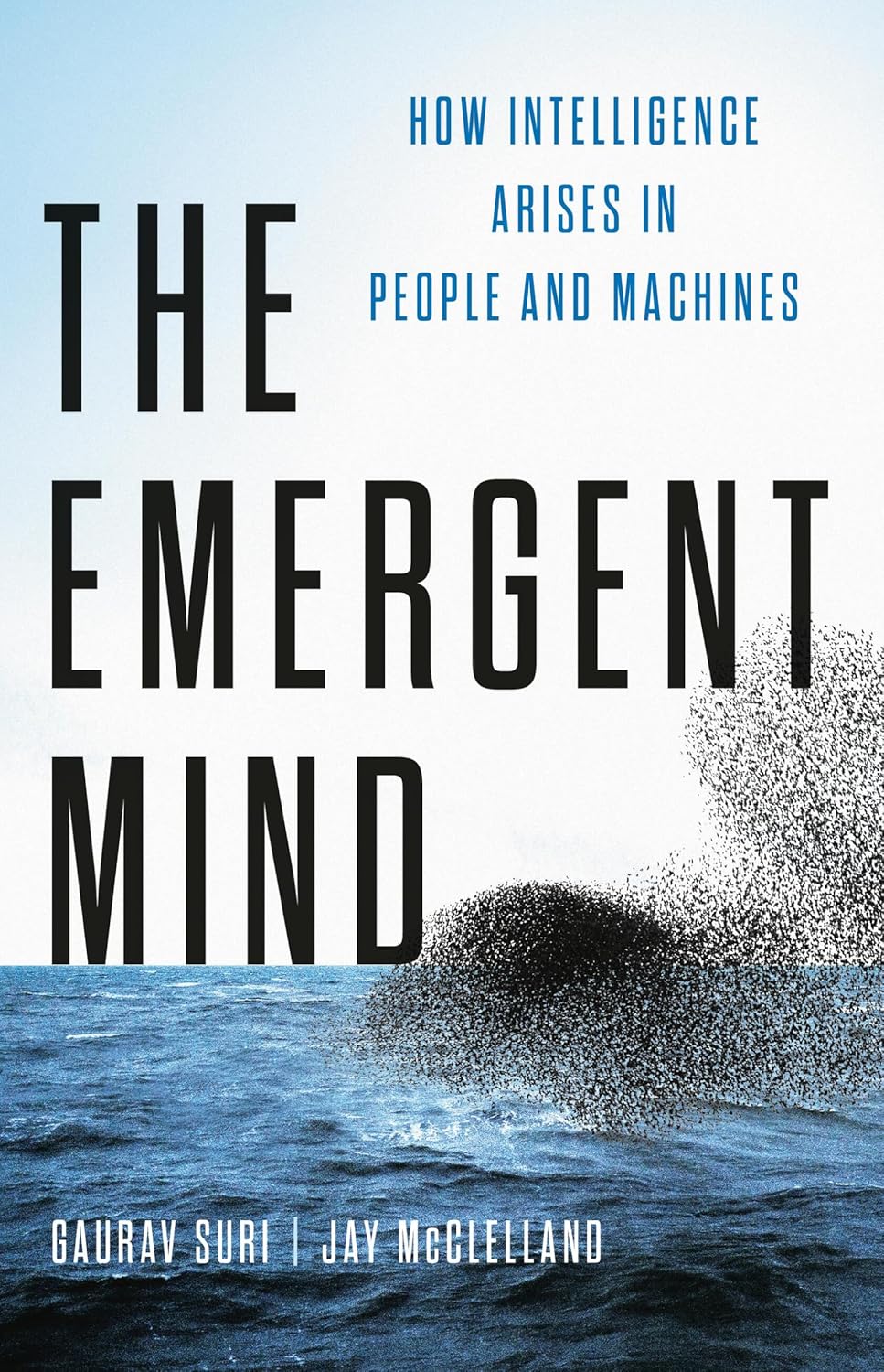
In an age defined by rapid advances in artificial intelligence, few questions feel more urgent than these: How does the human mind actually work? And how similar—or different—is it from AI?* In The Emergent Mind, cognitive scientists Jay McClelland and Gaurav Suri offer a bold and illuminating answer grounded in one central idea: emergence.
The Core Idea: Emergence
At the heart of the book lies a deceptively simple but transformative concept—complex systems arise from the interaction of simpler parts. Just as individual neurons interacting in vast networks give rise to thoughts and emotions, artificial neural networks—originally inspired by the brain—can produce intelligent behavior through similar principles.
Rather than reducing humans to machines, Suri and McClelland argue something far more interesting: the same fundamental processes that enable AI systems to learn may help explain how our own minds generate meaning, decisions, and identity. Intelligence, they propose, is not programmed from above—it emerges from below.
What Makes This Book Stand Out
1. A Rare Synthesis of Cognitive Science and AI
Jay McClelland, one of the pioneers of artificial neural networks, brings decades of groundbreaking research to the discussion. His work laid foundations for modern deep learning long before AI became mainstream. Together with Gaurav Suri’s expertise in computational neuroscience and decision science, the authors create a seamless bridge between brain science and machine learning.
The book doesn’t treat AI as a distant technological marvel—it shows that AI’s roots are deeply intertwined with theories of how humans think.
2. Making the Invisible Visible
When we make a decision, we experience it consciously—debating, feeling uncertainty, choosing. But according to the authors, that conscious awareness is just the “tip of the iceberg.” Beneath it lies a vast, dynamic network of neural activity.
The brilliance of The Emergent Mind lies in how it makes this hidden complexity understandable without oversimplifying it. The explanations are lucid, accessible, and grounded in real science rather than hype.
3. Rethinking What It Means to Be a Mind
Perhaps the book’s most profound contribution is philosophical. It doesn’t merely ask, How do minds work? It asks, What does it mean to be a mind?
If thoughts and emotions emerge from patterns of interaction, then the boundary between biological and artificial systems becomes less rigid. The book does not claim machines are human—but it challenges us to rethink intelligence as a continuum rather than a binary distinction.
Writing Style and Accessibility
Despite tackling deep scientific and philosophical territory, the writing remains engaging and surprisingly clear. The authors avoid technical overload, making complex neural network concepts approachable for general readers while still satisfying scientifically curious minds.
The tone is thoughtful rather than sensational. In an era of exaggerated AI claims, this measured and evidence-based approach is refreshing.
Critical Reflection
If there is any limitation, it is that readers looking for dramatic predictions about AI domination or dystopian futures may find the book more analytical than speculative. But that is also its strength. Instead of fear-driven narratives, it provides understanding.
Why This Book Matters Now
As AI systems grow more capable, society is grappling with ethical, philosophical, and practical questions. The Emergent Mind offers a grounded framework for thinking about these issues—not by focusing on headlines, but by explaining the underlying science.
It is especially valuable for:
- Students of psychology, neuroscience, or AI
- Professionals navigating AI’s impact on society
- Readers curious about how thought, emotion, and decision-making actually work
- Anyone seeking a deeper, more nuanced perspective on human vs. artificial intelligence
The Emergent Mind is a rare achievement: scientifically rigorous, philosophically rich, and genuinely accessible. It reframes intelligence not as magic, not as mysticism, and not as mere machinery—but as an emergent property of interacting systems.
For anyone captivated by the mysteries of the human brain or the rise of artificial intelligence, this book is not just informative—it is transformative.



 Bookshotsapp
Leave a comment