
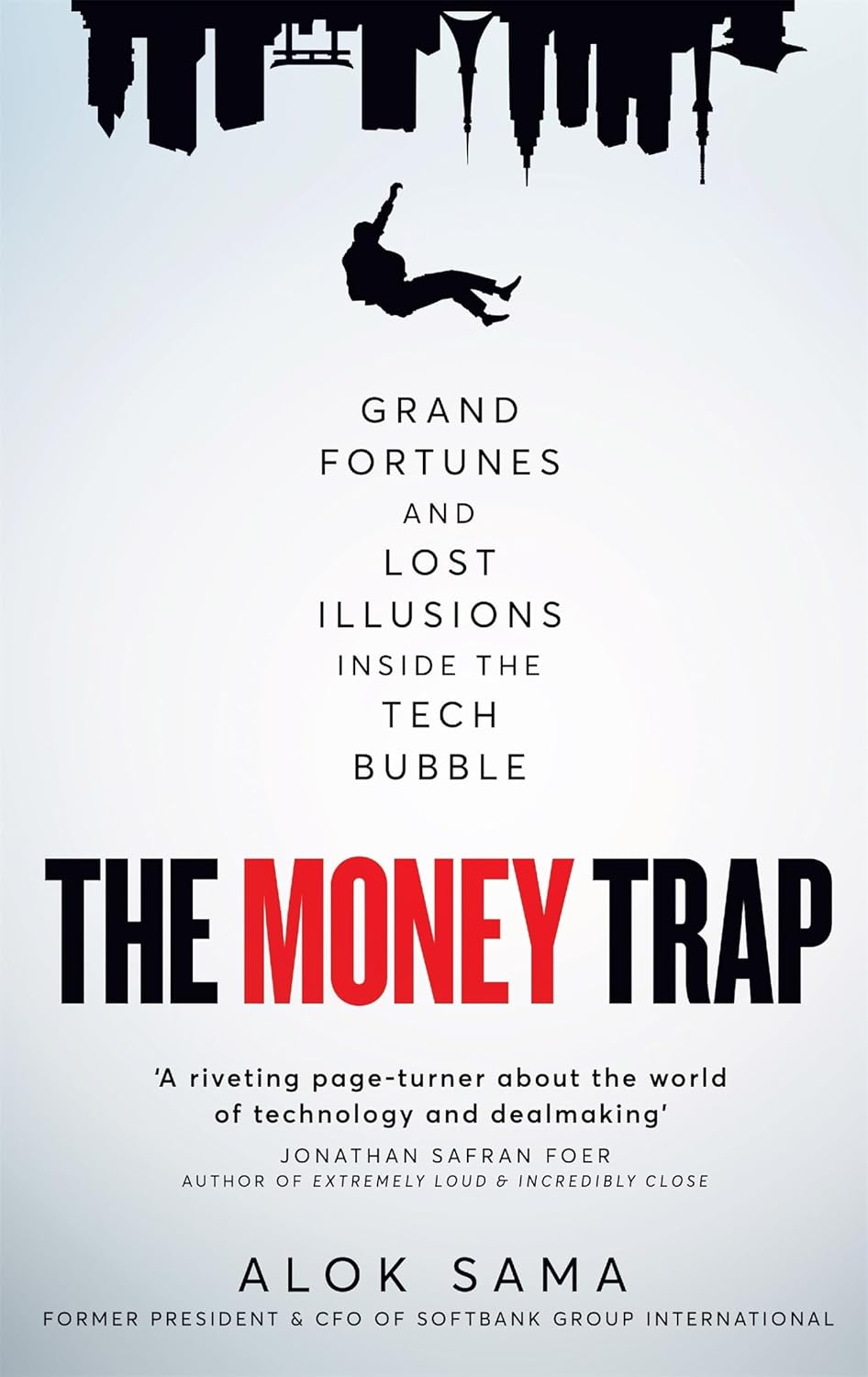
In an age when tech titans style themselves as world-shapers and venture capitalists speak in the language of destiny, The Money Trap arrives like a dispatch from inside the command center. Written by former SoftBank dealmaker Alok Sama, this memoir is not merely a business chronicle—it is a literary reckoning with ambition, power, and the seductive myth that capital alone can engineer happiness.
Winner of the Godrej Lit Live! Business Book of the Year 2025 and the CK Prahalad Best Business Book 2025, Sama’s debut has already drawn comparisons to a financial thriller. But its real power lies elsewhere: in its self-awareness.
Inside the Eye of the Tech Storm
Sama, once a veteran banker at Morgan Stanley, stepped into the orbit of Masayoshi Son—the mercurial founder of SoftBank and architect of the Vision Fund era. What follows is a globetrotting odyssey through boardrooms, private jets, and late-night deal negotiations involving companies that have reshaped the modern world.
SoftBank’s investments—among them Arm Holdings, Nvidia, Alibaba, Uber, WeWork and TikTok—serve as backdrop rather than headline. Sama is less interested in corporate strategy than in the psychology of those who deploy unimaginable sums with missionary zeal.
The result is part corporate confessional, part morality tale.
A Literary Voice in a Financial World
Unlike many executive memoirs polished into bland self-congratulation, The Money Trap pulses with introspection. Sama writes not as a triumphant titan but as a man caught in the machinery of scale—fascinated, complicit, occasionally horrified.
The book opens with the tension of a spy novel and sustains the pace of a thriller. Yet beneath the adrenaline lies something more existential. As deals swell into the tens of billions, so too do questions about identity, loyalty, and cost. A mysterious smear campaign, hinted at in the synopsis and threaded throughout the narrative, destabilizes the protagonist’s carefully constructed world.
Critics have praised the memoir’s narrative drive. Jonathan Safran Foer calls it “a riveting page-turner,” while journalist Bradley Hope highlights its wit and rare insider access. The comparisons to literary nonfiction are apt: Sama’s MFA from New York University is evident in prose that lingers on mood and memory rather than quarterly returns.
Power, Illusion, and the Cost of Scale
At its heart, The Money Trap interrogates the ideology of exponential growth. Masayoshi Son famously framed his mission as “happiness for everyone.” Sama subtly probes that promise. What happens when capital becomes both instrument and idol? When vision veers into hubris?
The book’s most compelling passages are not the headline-grabbing negotiations but the quieter reckonings: the toll on family life, the psychic burden of proximity to power, and the uneasy realization that more money rarely simplifies moral choices—it multiplies them.
Final Thought
The Money Trap succeeds because it transcends its genre. It is certainly a gripping insider account of high finance in the age of tech disruption. But it is also an immigrant’s story, a meditation on class mobility, and a study in modern myth-making.
For readers of serious nonfiction, it stands alongside the best contemporary business memoirs—not as a manual for dealmaking, but as a cautionary tale about the limits of ambition. Sama reminds us that in a world obsessed with valuation, the most elusive metric remains personal freedom.
A sharp, stylish, and unexpectedly humane exploration of money’s gravitational pull.



 Bookshotsapp
Leave a comment